
September 19, 2026
One Page Annual Marketing Plan for Leaders: Templates + 2 Examples

An annual marketing plan is the document that turns company goals into a funded, scheduled set of marketing actions for the year ahead. Its job is alignment: it connects budget, timeline, and team capacity to specific business outcomes, so marketing stops reacting and starts driving. Marketing leaders, founders, and team leads use it to get buy-in, set priorities, and know exactly what “on track” looks like each quarter.
TL;DR:
- A one-page executive summary should clearly state the single business outcome, top three priorities, quarterly themes, total budget split, and three key KPIs.
- The situation analysis must be concise, limited to one page, and include baseline performance data, competitor insights, customer signals, and a focused SWOT.
- SMART marketing objectives must be specific, measurable, achievable, relevant, and time-bound, directly aligned with impact and resource feasibility.
- The annual plan should integrate the company’s overall goals, involve cross-departmental input, and be finalized early in Q4 to start execution by January.
- Regular quarterly reviews, clear owner attribution, risk contingency budgeting, and trigger-based decision rules are essential to keep the plan effective and adaptable throughout the year.
Table of Contents
- What Goes on the Executive Summary Page
- How Do You Write a Situation Analysis That Holds Up?
- How Do You Turn Business Goals Into SMART Marketing Objectives?
- What Persona Details Actually Belong in the Plan?
- How Does SOSTAC Fit an Annual Marketing Plan?
- What Belongs in the Channel-by-Channel Calendar?
- How Do You Build a Budget Leadership Will Approve?
- Who Owns Measurement and When Do You Review It?
- What Should the Templates and Examples Actually Look Like?
- When Should You Draft and Review the Annual Plan?
- How Connection Built Approaches Plan Execution
- Where Annual Plans Actually Go Off the Rails
- Risk Management and Contingency Planning
- Integration With Overall Business Objectives and Cross-Departmental Alignment
- Getting Stakeholder Buy-In and Formal Approval
- Keeping the Plan Alive Through the Year
- What I’ve Seen Sink Otherwise Solid Plans
- Ready to Build a Plan That Actually Gets Used?
- Templates and Frameworks Worth Bookmarking
- Sources
- FAQ
What Goes on the Executive Summary Page
Leadership does not read a 40-page deck. They read one page, and that page has to work on its own. Build your executive summary as a “plan on a page” that a CEO or board member can scan in ninety seconds and immediately grasp what marketing is doing with its budget this year. Forrester’s research on plan-on-a-page formats found this single-page approach directly increases the odds a plan gets read and approved, because it forces marketing to state the outcome before the activity.
Your one-pager needs:
- The one number: the single business outcome the whole plan exists to move (revenue target, pipeline value, retention rate).
- Top 3 priorities: the strategic bets for the year, stated as outcomes, not tactics.
- Quarterly themes: a one-line label for what each quarter is built around.
- Budget headline: total annual spend and the percentage split across the top 2 to 3 channels.
- 3 KPIs: the metrics leadership will actually track, tied directly to the one number above.
Everything else in the plan supports this page. If a section doesn’t trace back to it, cut it.
How Do You Write a Situation Analysis That Holds Up?
A situation analysis is what separates a data-driven plan from a wish list dressed up in PowerPoint. It has to answer three questions fast: where is the market moving, what are customers telling you, and where do competitors have an edge. Skip this section and budget owners will ask for it anyway, usually after they’ve already started doubting your numbers.
Build it in four moves:
- Pull performance baselines first. Last year’s traffic, conversion rate, cost per lead, and channel mix set the floor you’re planning against.
- Scan 3 to 5 direct competitors. Note pricing shifts, new offers, and messaging changes. You don’t need a full audit, just enough to spot where you’re exposed.
- Collect customer signals. Support tickets, sales call notes, and review sites often reveal more than a formal survey.
- Run a tight SWOT. Limit each quadrant to three bullets. A SWOT with fifteen items per box gets ignored.
Business recommends keeping this research phase time-boxed rather than open-ended, since perfect market data rarely exists and waiting for it just delays the plan.
Pro Tip: Cap the situation analysis at one page. If you need more than a page to prove your plan is grounded in reality, the problem is usually too much narrative, not too little data.
How Do You Turn Business Goals Into SMART Marketing Objectives?
Every annual marketing plan lives or dies on whether its goals are specific enough to act on. A goal like “grow brand awareness” tells your team nothing about what to build, spend, or measure. Running it through the SMART filter, specific, measurable, achievable, relevant, time-bound, forces the vague goal into something you can staff and budget against.
A practical translation looks like this:
- Vague goal: Increase brand awareness.
- SMART version: Grow branded search volume by 20% and email list size by 15% by Q4, measured monthly.
- Vague goal: Improve lead quality.
- SMART version: Raise marketing-qualified-lead-to-opportunity conversion from 18% to 25% by the end of Q3.
Once you have SMART objectives, sequence them by impact and feasibility, not by whichever channel is loudest that quarter. Rank each goal on expected business impact against the effort and budget it requires, then fund the highest-impact, lowest-friction goals first. This is also where you decide what you’re deliberately not doing this year.
What Persona Details Actually Belong in the Plan?
A persona slide with a stock photo and a name like “Marketing Mary” does nothing for your annual plan. What actually earns a place in the document is behavioral: what job is this person trying to get done, what triggers them to start looking for a solution, and which channels they trust at each stage.
Include for each core persona:
- Job-to-be-done: the outcome they’re hiring your product or service to deliver.
- Trigger event: what happens right before they start searching or asking around.
- Preferred channels: where they actually spend attention, not where you wish they did.
- Buying timeline: how long from trigger to decision, which drives your campaign pacing.
Validate these fast by pulling ten recent CRM records and mapping them against your assumptions. If sales keeps mentioning a use case your personas don’t cover, that’s your fourth persona.
How Does SOSTAC Fit an Annual Marketing Plan?
SOSTAC, Situation, Objectives, Strategy, Tactics, Action, Control, gives an annual marketing plan a spine that runs straight through to measurement. Situation analysis and objectives feed strategy; strategy sets the tactics and calendar; action assigns owners and dates; control is the KPI and review structure that keeps the whole plan honest. Skipping the control stage is one of the more common reasons plans get approved on paper and then quietly ignored by March.
Inside that framework, layer your programs into three tiers:
- Always-on: SEO, email nurture, paid search maintenance, the work that runs every week regardless of campaign calendar.
- Campaign moments: 2 to 4 major pushes tied to product launches, seasonal demand, or industry events.
- Experiments: smaller, higher-risk tests with capped budgets, meant to find next year’s campaign ideas.
Choosing your 2 to 4 major campaigns for the year should come from the situation analysis, not from whoever pitches the loudest idea in the planning meeting. Pick moments where your audience’s buying timeline and your product calendar actually intersect.
Pro Tip: If a campaign idea can’t name the KPI it moves and the always-on program it borrows budget from, it’s not ready for the calendar yet.
What Belongs in the Channel-by-Channel Calendar?
Every channel in your annual marketing plan needs the same five fields, filled in before the year starts, not discovered mid-quarter.
- Objective: what this channel is responsible for moving (awareness, pipeline, retention).
- KPI: the one metric that proves the objective is working.
- Owner: a named person, not a team name.
- Budget: annual allocation and how it’s split by quarter.
- Key deliverables: the specific assets or campaigns tied to dates.
Populate your quarterly calendar by pacing always-on work evenly across Q1 through Q4, then layering campaign moments where the situation analysis says demand peaks. A retailer might run always-on content and paid search every month, then load two campaign pushes around a spring launch and a holiday push, using Q3 as the quieter quarter to build creative for Q4. Blending SEO with content marketing is a strong example of an always-on program that compounds instead of resetting every quarter, which makes it worth pacing steadily rather than campaign-style.
How Do You Build a Budget Leadership Will Approve?
Budget approval usually fails for one of two reasons: the numbers don’t map to outcomes, or the plan asks for money without showing how it’s split. Fix both by presenting spend in clear buckets tied directly back to your objectives.
- Always-on programs: the baseline spend that keeps pipeline and organic visibility from collapsing.
- Campaign budgets: allocated per major campaign, tied to the specific KPI it’s meant to move.
- Experiments: a capped, separate line item, so a failed test doesn’t threaten committed programs.
- People and contractors: in-house headcount, freelance or fractional support, and when each hire or contract needs to start relative to campaign timing.
Justify each bucket with an expected outcome, not just a dollar figure. “$40,000 in paid search, expected to drive 300 qualified leads at current conversion rates” gets approved faster than “$40,000 for paid search.” When staffing gaps show up in Q2 or Q3, that’s the moment to flag a need for fractional support rather than waiting until the workload is already unmanageable.
Who Owns Measurement and When Do You Review It?
A plan without named owners and review dates is a wish list with better formatting. The fix is a measurement plan built on three things: which metrics matter, who’s accountable for each one, and what triggers a change in tactics.
Pick 2 to 3 metrics per channel, plus 3 top-level marketing KPIs that map straight back to the executive summary’s “one number.” Layering metrics into visibility, engagement, and trust or intent tiers lets a small team start with simple tracking and add sophistication later without losing sight of what actually matters.
- Assign a named owner to every KPI, not a department.
- Set cadence: monthly for channel-level metrics, quarterly for the top-line business KPIs.
- Define decision triggers: for example, if cost per lead rises 25% above baseline for two consecutive months, pause and reallocate.
- Set escalation rules: who gets notified, and how fast, when a trigger fires.
Naming owners and decision triggers is what converts a plan from a wishlist into a working commitment, according to planning frameworks built around this exact gap between strategy documents and executed programs.
Without triggers, teams tend to wait out a bad quarter hoping it self-corrects. With triggers, the plan makes that decision for you in advance.
What Should the Templates and Examples Actually Look Like?
Two documents do the real work here: a one-page plan for leadership and a working document your team actually operates from.
One-page plan fields: one number, top 3 priorities, quarterly themes, budget headline, 3 KPIs, and the year’s 2 to 4 major campaigns.
Working document (10 to 15 pages): situation analysis, SMART objectives, personas, SOSTAC-mapped strategy, channel templates, quarterly calendar, budget breakdown, and the measurement plan with owners.
Two short examples show how this scales:
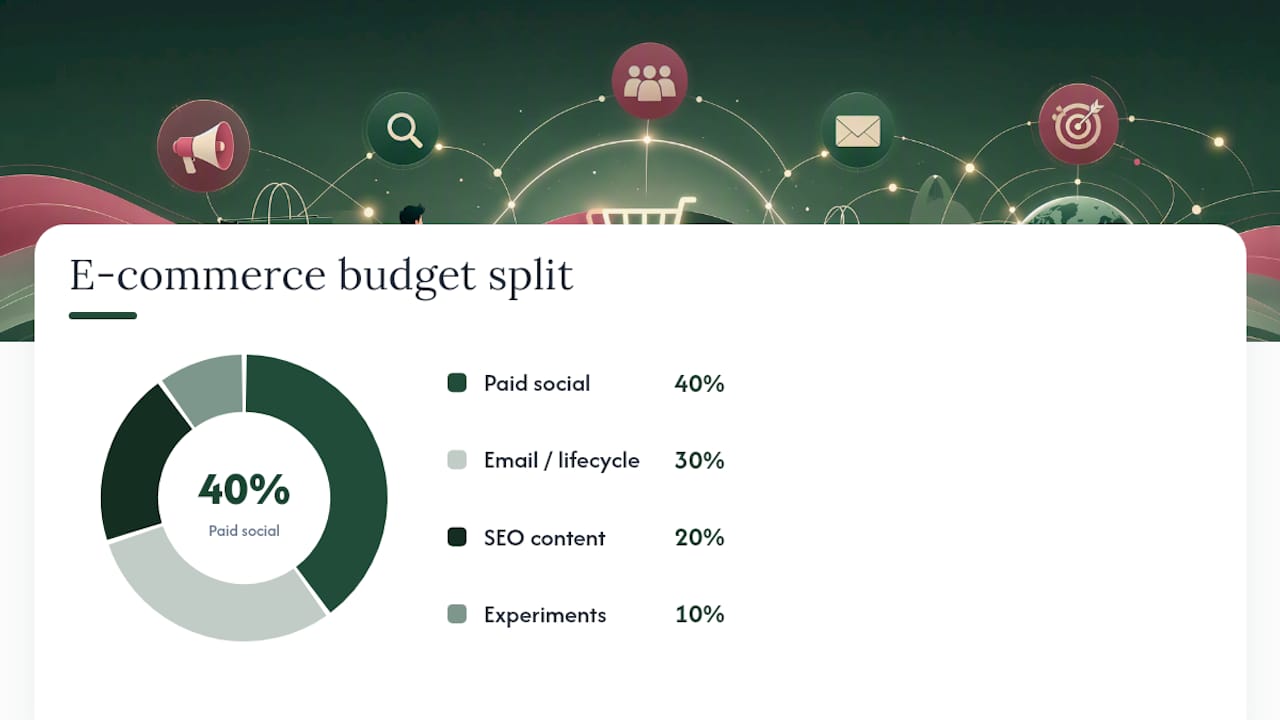
- E-commerce plan: One number is revenue per acquisition channel. Priorities are lifecycle email, paid social retargeting, and a Q4 holiday campaign. Budget skews 40% paid social, 30% email/lifecycle, 20% SEO content, 10% experiments.
- B2B services plan: One number is qualified pipeline value. Priorities are LinkedIn thought leadership, a spring case study campaign, and account-based outreach to a target list. Budget skews 35% content and SEO, 30% paid, 25% events/ABM, 10% experiments.
| Plan type | One number | Top budget line | Primary KPI |
|---|---|---|---|
| E-commerce | Revenue per channel | Paid social (40%) | Return on ad spend |
| B2B services | Qualified pipeline value | Content and SEO (35%) | Marketing-qualified leads |
Keep the working document in the 10 to 15 page range. Longer decks tend to go unread once the planning meeting ends.
When Should You Draft and Review the Annual Plan?
Plans built in a rush over the holidays are the ones that fall apart by February. Give yourself a real runway.
- Draft in Q4. Start situation analysis and goal setting in October, giving you eight to ten weeks before year-end.
- Finalize by mid-December. This gets budget approved and teams briefed before the calendar resets, so January starts with execution instead of planning meetings.
- Review quarterly, not monthly. Full rewrites aren’t the goal. Adjust campaign priorities, budget splits, and KPIs each quarter based on what the data is actually showing.
- Build in 5 to 10% contingency. Every year brings a surprise, a vendor price hike, a algorithm change, a competitor move. Contingency budget means you can respond without cannibalizing a committed program.
This rhythm keeps the plan a living document instead of a slide deck that gets filed away in January and rediscovered the following December.
How Connection Built Approaches Plan Execution
A plan only earns its budget once it moves from document to daily operations. That’s the gap Connection-built works inside: aligning the vision behind the business, the story it tells, and the marketing calendar so all three point in the same direction instead of pulling apart. That alignment work usually starts with a brand and messaging check before a single campaign gets scheduled, because a beautifully sequenced calendar built on unclear messaging still underperforms.
Fractional marketing engagements typically cover the gap between “we have a plan” and “we have someone running it”: managing ongoing channels, coordinating the campaign calendar, and reporting against the plan’s KPIs. For organizations without an in-house team large enough to own every channel from the plan, this is often the fastest way to get from approved document to active execution.
- Vision, storytelling, and brand alignment before channel tactics
- Fractional marketing support to run always-on programs and campaign moments
- Measurement and reporting built around the plan’s named KPIs, not vanity metrics
Where Annual Plans Actually Go Off the Rails
Good annual marketing plans fail from the same few habits. Getting these right matters more than any framework.
Risk Management and Contingency Planning
Every annual marketing plan runs into surprises: a platform algorithm shift, a competitor price cut, a vendor going dark mid-quarter. The plans that survive intact aren’t the ones that predicted the disruption. They’re the ones that budgeted for it.
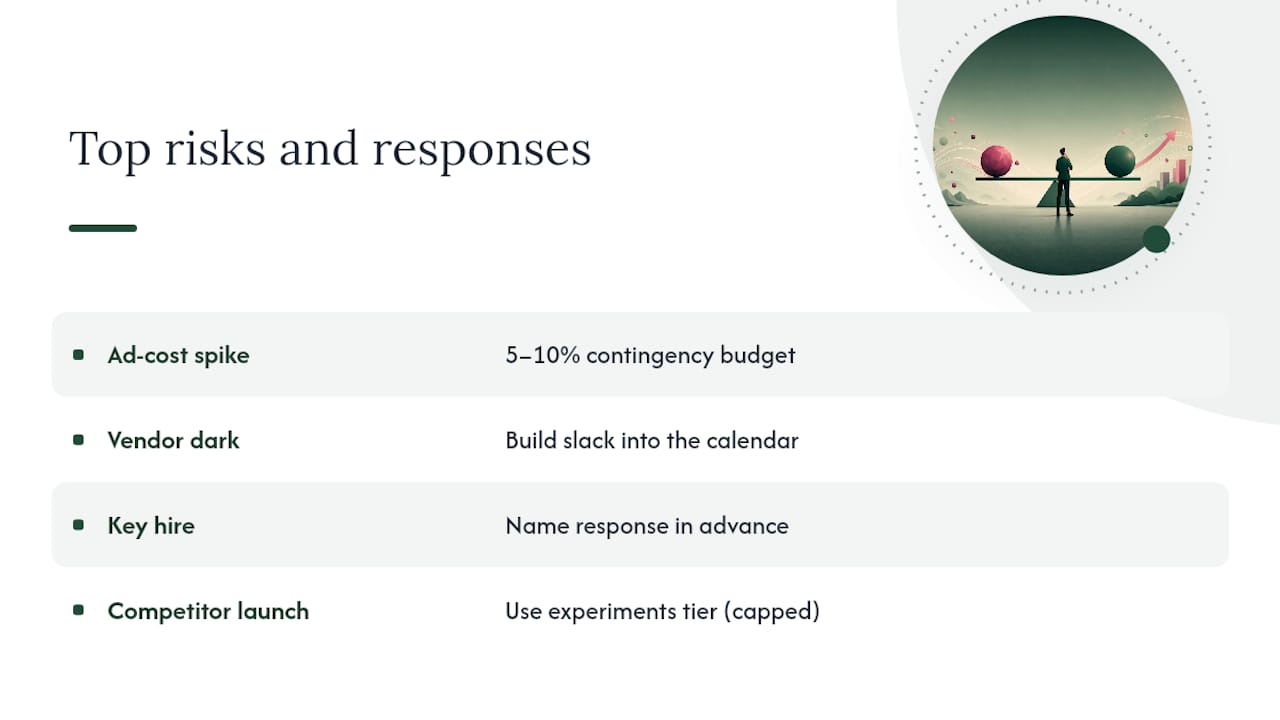
Build risk management directly into the plan rather than treating it as an afterthought. Start by listing the three or four risks most likely to hit your specific business this year, an ad platform cost spike, a key hire falling through, a major competitor launch, and name what you’d do in response to each one before it happens. This is a five-minute exercise that saves weeks of scrambling later.
Financially, the 5 to 10% contingency budget mentioned earlier is your first line of defense. It exists specifically so a mid-year surprise doesn’t force you to cannibalize a committed always-on program or an already-launched campaign.
Operationally, build slack into your calendar rather than scheduling every channel at full capacity every week. A quarter with zero breathing room means any disruption, a sick team member, a delayed creative asset, cascades into missed deadlines across every deliverable that depended on it.
The experiments tier in your layered budget doubles as risk insulation. Because experiment budgets are capped and separate from committed spend, a failed test costs you a line item, not the whole quarter’s momentum. This is also why the control stage in SOSTAC matters: a measurement plan with clear decision triggers is itself a risk management tool, since it catches underperformance early enough to redirect budget before a full quarter is lost.
Treat contingency planning as a standing section reviewed each quarter, not a one-time exercise done in Q4 and forgotten.
Integration With Overall Business Objectives and Cross-Departmental Alignment
An annual marketing plan that lives in isolation from the rest of the business rarely survives budget season. The strongest plans are built as a direct extension of company-wide targets, revenue goals, product roadmap, customer retention priorities, not a parallel document marketing wrote on its own.
Start by mapping your “one number” from the executive summary directly to a company-level target, whether that’s annual revenue, net new customers, or expansion revenue from existing accounts. If finance can’t trace your marketing KPI back to a number they already care about, the plan hasn’ t earned its budget yet.
Cross-departmental alignment shows up in three places most often. Sales needs to agree on what counts as a qualified lead before your funnel metrics mean anything to them. Product needs to share its roadmap early enough that campaign moments can align with actual launch dates instead of guessing. Customer success or support teams often hold the clearest signal on what’s actually driving churn or satisfaction, information your situation analysis should pull from directly rather than reconstructing independently.
Build these connections into the planning calendar itself. Schedule a sales alignment session during the Q4 drafting window, not after the plan is finalized. Loop in product leadership before you lock your 2 to 4 major campaigns, since a campaign built around a delayed launch date is a wasted quarter. The goal isn’t a marketing plan that mentions other departments. It’s a marketing plan that other departments would recognize as their own priorities, reflected back at them.
Getting Stakeholder Buy-In and Formal Approval
Approval rarely happens in one meeting, and treating it that way is how plans get stalled in revision loops for weeks. Build stakeholder engagement into the drafting process itself, not as a final gate at the end.
Start socializing the draft executive summary early, ideally as soon as your one number and top 3 priorities are set, well before the full working document is finished. This gives finance, sales, and executive leadership a chance to react to direction before you’ve invested weeks building out the detailed calendar and channel templates around it.
Sequence your approval conversations deliberately. Bring finance in once budget buckets are roughed out, since their feedback on what’s fundable often reshapes priorities before you finalize tactics. Bring sales leadership in once personas and lead-quality KPIs are drafted, since they’ll spot gaps between your definition of a qualified lead and theirs faster than any internal review will. Save the full executive walkthrough for when the one-page plan is polished and the working document is at least in near-final shape.
Keep the actual approval ask narrow. Leadership doesn’t need to approve every channel template and calendar entry, they need to approve the one-page plan: the number, the priorities, the budget headline, and the KPIs. Approving that page implicitly approves the reasoning underneath it, which is exactly why the executive summary carries so much weight.
Document who signed off and when, even informally. When a mid-year pivot comes up in a quarterly review, having a clear record of what was originally approved makes it far easier to explain what’s changing and why, rather than relitigating the entire plan from scratch.
Keeping the Plan Alive Through the Year
A plan finalized in December and never opened again until the next December’s planning cycle isn’t a plan, it’s an artifact. The whole point of the quarterly review cadence is to keep the document breathing alongside the business.
Each quarterly review should ask three questions: which KPIs are on track, which decision triggers have fired, and what’s changed in the market or the business since the last review. This is a working session, not a rubber stamp. If a channel is underperforming against its assigned KPI for two straight review cycles, that’s the moment to reallocate its budget rather than waiting for the next annual cycle to fix it.
Revisions should stay scoped to what quarterly cadence actually supports: budget shifts between channels, campaign timing adjustments, KPI target updates based on real performance data. Full strategic rewrites mid-year are rare and usually signal the original situation analysis missed something significant, worth noting for next year’s planning process rather than papering over in the current one.
Keep a lightweight changelog inside the working document itself: a simple running list of what changed each quarter and why. This does two things. It keeps the plan honest about how much it’s actually evolving, and it gives you a head start on next year’s situation analysis, since this year’s mid-course corrections are exactly the kind of signal that should shape next year’s assumptions.
The plan that survives a full year intact from January to December either got very lucky or wasn’t ambitious enough. The plan that survives by adapting on schedule is the one doing its job.
What I’ve Seen Sink Otherwise Solid Plans
The same three mistakes show up year after year: skipping the situation analysis because “everyone already knows the market,” writing KPIs with no named owner, and building a 40-slide deck nobody opens after the kickoff meeting. Keep the working document under 15 pages, put a name on every metric, and build the one-pager first. If you want a template to start from, say so in the comments, or look at how we’ve structured plans for other clients.
— Chris
Ready to Build a Plan That Actually Gets Used?
You’ve seen what a working annual marketing plan requires: a one-page summary, a real situation analysis, SMART goals, a layered budget, and named owners on every KPI. Building that document is one thing. Running it for twelve months while everything else in the business keeps moving is another, and it’s the part most internal teams underestimate when they’re setting the plan’s scope in Q4.
Connection-built exists for exactly that gap. Instead of handing you a static deck, our approach aligns your brand story, your messaging, and your marketing calendar before a single tactic gets scheduled, so the plan you execute actually reflects what your business stands for, not just what filled last year’s budget line. A short diagnostic session is usually enough to see where your current plan (or lack of one) is misaligned with your goals, and from there we can build the one-page plan with you or step in as fractional marketing support to run it month to month. Small businesses and nonprofits work with us differently depending on funding cycles and donor timelines, which is why our nonprofit-focused services look different from our small business engagements.
If your 2026 plan needs a second set of eyes or a partner to help execute it, reach out through our services page to schedule a planning conversation.
Templates and Frameworks Worth Bookmarking
Before you start drafting, these are worth having open in another tab:
- Forrester’s plan-on-a-page framework for structuring your executive summary
- Shopify’s marketing plan template for annual-to-quarterly budget breakdowns
- Business for step-based goal and channel planning
- Prooflytics’ 8-section annual plan template for measurement and control structure
- AO Network’s annual marketing plan framework for drafting and approval timing
Sources
- 7 Steps to Build a Marketing Strategy That Actually Works in 2026
- Build A Marketing Plan Your Team Can Actually Use
- What Is a Marketing Plan? + How to Write One (2026) - Shopify
- Business
- Annual Marketing Plan Template 2026: 8 Sections | Prooflytics
FAQ
What Are the 7 Steps of a Marketing Plan?
Most frameworks follow situation analysis, objectives, strategy, target audience and personas, tactics and channel plans, budget allocation, and measurement or control. This mirrors the SOSTAC structure covered earlier, with personas and budget broken out as their own steps since they require dedicated inputs.
What Is the 3-3-3 Rule for Marketing?
Definitions of the 3-3-3 rule vary across marketing communities, and there’s no single canonical version tied to annual planning specifically. Rather than force a definition, focus on the version of “rule of three” that does hold up here: 2 to 4 major campaigns per year and 2 to 3 KPIs per channel, which keeps both your calendar and your reporting from sprawling out of control.
What Are the 5 Components of a Marketing Plan?
The five components most annual plans need are a situation analysis, SMART objectives, target audience and personas, strategy and tactics across channels, and a measurement plan with named owners. Miss the measurement component specifically, and plans are more likely to get rejected at budget review than for any other single gap.
What Is an Example of a Marketing Plan?
A short e-commerce plan might set revenue per channel as its one number, with budget weighted toward paid social retargeting and Q4 holiday campaigns. A B2B services plan might target qualified pipeline value, weighting budget toward content, SEO, and account-based outreach instead. Both examples are broken down in full earlier in this guide.
Can Connection Built Help Build My Annual Marketing Plan?
Yes. Connection-built works with small businesses and nonprofits to build the strategy, messaging, and execution plan behind an annual marketing calendar, then can provide fractional marketing support to run it. Current service details and pricing are available on the services page.
Recommended
Want to talk it through? Start a conversation. https://connection-built.com