
September 17, 2026
90 Day LinkedIn First B2B Social Media Strategy Activating Teams

Prioritize LinkedIn-led thought leadership and employee-driven content, then layer targeted paid amplification on top. Run a 30-day profile audit on your top 10 employee voices, publish against a single content theme for 90 days, and test one paid campaign against warm website traffic. Expect early signal within 60 days and measurable pipeline influence by day 90.
TL;DR:
- Running a 30-day profile audit and publishing with a unified theme for 90 days can generate early signals within 60 days and measurable pipeline influence by 90 days.
- Using LinkedIn lead gen forms with 10 to 15 percent conversion rates helps establish benchmarks, compared to lower-performing gated content landing pages.
- Focus on content that targets specific buyer roles and stages, leveraging native videos and carousels, with a frequency of three to five posts per week for sustained engagement.
- Prioritize employee advocacy by selecting motivated individuals, providing simple prompts, and tracking reach and engagement to grow organic distribution.
- Combine paid campaigns with organic efforts, layering demand capture in the top of funnel and ABM tactics on targeted accounts for optimal lead generation and ROI measurement.
Table of Contents
- What Is a B2B Social Media Strategy, and Why Does It Matter Now?
- How Do You Set Social Media Goals That Map to Revenue?
- How Do You Define Your Audience and ICP for Social?
- Why Does LinkedIn Lead B2B Social, and When Should You Test Others?
- What Content Formats and Creative Actually Perform in B2B?
- How Do You Build an Employee Advocacy System That Scales?
- What Does a 90-Day B2B Social Media Content Calendar Look Like?
- How Do You Combine Paid and Organic Social With ABM?
- How Do You Measure and Report Social Media ROI to Leadership?
- What Quick Experiments Should You Run First?
- How Connection Built Approaches B2B Social Strategy for Clients
- Where Should B2B Teams Invest Next in 2026?
- Ready to Build and Run Your B2B Social Strategy?
- Sources
- FAQ
What Is a B2B Social Media Strategy, and Why Does It Matter Now?
A B2B social media strategy is the plan that connects what you post to what you sell: it maps content, channels, and cadence to specific pipeline and relationship outcomes, not just impressions. Done right, it works alongside demand generation and sales, not instead of them. Social builds the trust that makes a cold outreach email feel warm, and it shortens the distance between “I’ve seen your name” and “let’s get on a call.”
The strategy has to account for two very different time horizons. Thought leadership compounds over quarters. It rarely produces a lead the week it’s published, but it influences vendor selection and shortens later-stage sales conversations months down the line. Short campaigns, on the other hand, are built for speed: a product launch, an event promotion, a limited-time offer.
Your strategy should explicitly separate these two tracks:
- Brand and trust building — thought leadership, employee stories, customer wins, posted consistently with no expectation of immediate conversion.
- Demand capture — time-bound campaigns, paid amplification, and Lead Gen Forms tied to a specific event or offer.
- Relationship nurturing — comments, DMs, and Sales Navigator outreach that turn passive followers into pipeline.
Blend those three, and social stops being a content chore and starts acting like a revenue channel.
How Do You Set Social Media Goals That Map to Revenue?
Set goals in the language your CFO already speaks: qualified leads, meetings booked, and pipeline influenced, not followers or likes. A goal like “grow LinkedIn engagement” tells sales nothing. A goal like “generate 40 marketing-qualified leads per quarter from LinkedIn content and paid amplification” gives everyone a number to hold you to.
Start with three tiers of KPIs:
- Top-of-funnel: reach, engagement rate, follower growth among your ICP (used as a leading indicator, not a scorecard).
- Mid-funnel: click-throughs to gated content, webinar registrations, Sales Navigator connection acceptance rate.
- Bottom-funnel: form fills, meetings booked, pipeline value influenced, cost per qualified lead.
Set benchmarks by looking at your own historical baseline first, then adjust based on platform data. LinkedIn Lead Gen Forms, for instance, typically convert at 10 to 15 percent because they pre-fill profile data and remove friction. If your gated-content landing pages convert below that, the gap is a signal worth investigating.
Statistic to build a benchmark around: LinkedIn Lead Gen Forms convert at roughly 10 to 15 percent submission rates, often beating external landing pages on cost per lead. Use that number as your floor when evaluating any new paid campaign.
Avoid vanity metrics that flatter a slide deck but say nothing about revenue. Follower count, raw impressions, and “engagement” without context on who is engaging can all rise while pipeline stays flat. If a metric doesn’t trace back to a lead, a meeting, or a closed deal within a defined window, treat it as a diagnostic, not a target.
How Do You Define Your Audience and ICP for Social?
Buyer roles and the buyer journey are two different maps, and most B2B teams only draw one. Roles tell you who: the economic buyer, the technical evaluator, the day-to-day user, the influencer who forwards your content internally. The journey tells you when: awareness, evaluation, decision, expansion. Your content calendar needs both axes, or you end up publishing generically “for everyone,” which reaches no one with precision.
Validate your assumptions instead of guessing. Social listening on the terms your ICP actually uses, combined with LinkedIn Sales Navigator filters for title, seniority, and company size, will tell you fast whether your assumed buyer actually shows up where you’re posting.
A practical segmentation approach looks like this:
- By role: separate content for economic buyers (ROI, case studies) versus technical evaluators (specs, comparisons, implementation detail).
- By stage: awareness content answers “why does this problem matter”; decision-stage content answers “why us, why now.”
- By vertical: if you sell into healthcare and manufacturing, don’t run one undifferentiated message across both.
- By company size: an enterprise buyer wants governance and integration proof; a mid-market buyer wants speed and price clarity.
Map each active content pillar to at least one role and one stage. If you can’t say who a post is for and where they sit in the journey, it’s a placeholder, not a strategy.
Why Does LinkedIn Lead B2B Social, and When Should You Test Others?
LinkedIn earns the lead role in most B2B social media strategy plans because it uniquely combines professional identity, precise targeting, and buying intent in one place. No other platform lets you filter by job title, seniority, and company size while your audience is actively thinking about work problems. That combination is why LinkedIn functions as the most efficient B2B channel when thought leadership, paid, and Sales Navigator outreach compound together over time.
That doesn’t mean LinkedIn is the only channel worth a line item. YouTube earns a spot when your sales cycle benefits from long-form product walkthroughs or webinar replays that live searchably for years. X can work for real-time industry commentary if your category has an active, opinionated community there. Niche forums and Slack communities often outperform every major platform for narrow, technical B2B categories, though they rarely scale. TikTok has a role only if your buyers skew younger or your brand voice is built for it. For most B2B organizations, it’s a distraction disguised as a trend.
Statistic worth acting on: individual LinkedIn posts often achieve 5 to 10 times the reach of company page posts, because the algorithm now rewards personal substance over corporate broadcast.
That single data point should reshape your channel investment. Instead of pouring every hour into the company page, split responsibility across three roles:
- Company page: brand consistency, job postings, official announcements, campaign hubs.
- Personal profiles: the primary distribution engine, run by employees who actually write and post.
- Community participation: comments, group discussions, and niche forums where your team shows up as contributors, not broadcasters.
If you’re only funding the company page, you’re underinvesting in the channel that carries the most reach.
What Content Formats and Creative Actually Perform in B2B?
Native video and carousels consistently outperform plain text or static images on LinkedIn. Video-first posts get roughly 2.5 times more impressions than text-only posts, which makes video the format worth prioritizing when you’re short on production time and need the biggest return per post.
Your working mix should include:
- Native video: talking-head insights, quick product demos, customer interview clips under 90 seconds.
- Carousels: step-by-step frameworks, before/after comparisons, data breakdowns that reward a swipe.
- Long-form text posts: personal narrative or contrarian takes from founders and subject-matter experts.
- Customer stories: short, specific wins told in the customer’s own words, not marketing copy dressed up as a testimonial.
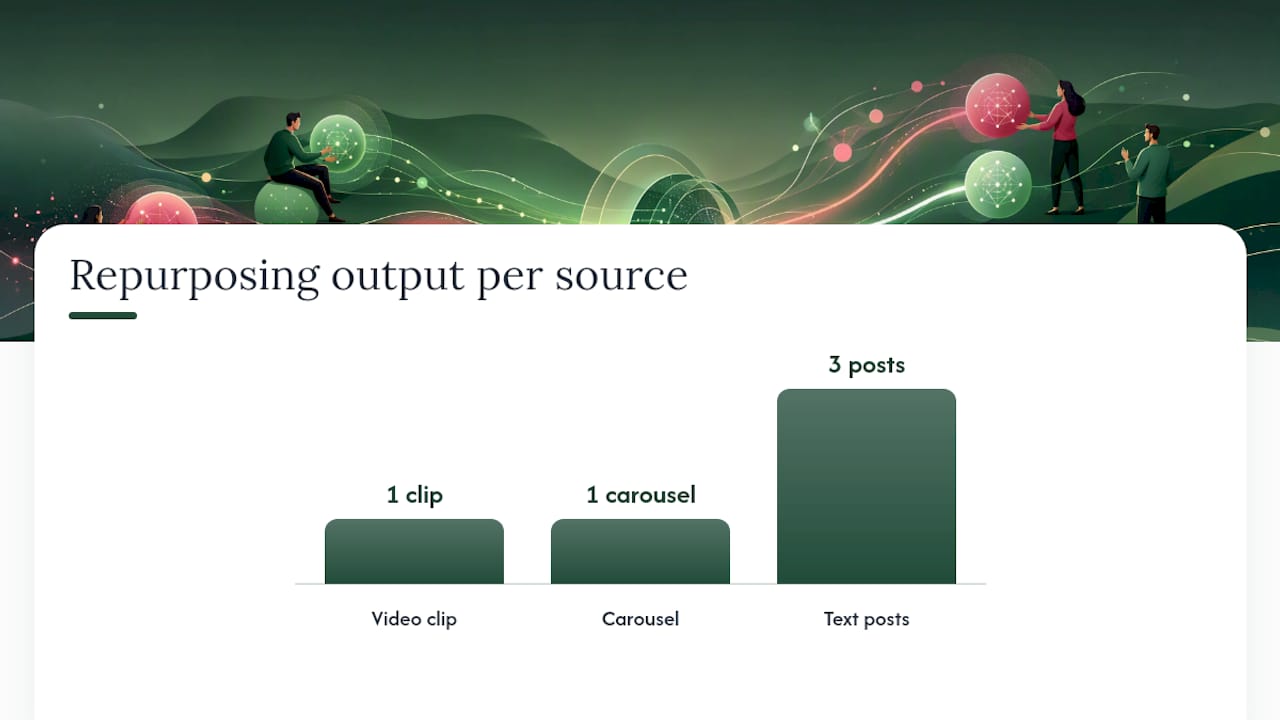
Frequency matters less than consistency. Three to five quality posts a week from a mix of personal profiles beats a daily company-page post that nobody engages with. Build a repurposing framework so one piece of source material, a webinar, a client call, a conference talk, becomes a video clip, a carousel, and three text posts across a month. That’s how lean teams sustain output without burning out the one person who writes everything.
Your creative hook matters more than your CTA. The first two lines of any post decide whether someone stops scrolling, so lead with a specific claim or an uncomfortable question, not a generic setup line. Also, build a content-to-DM play deliberately: when someone comments on a post, that’s an invitation, not just an engagement metric. A short, human follow-up in their inbox converts far better than a cold outreach message ever will.
Pro Tip: Treat every comment on a high-performing post as a warm lead signal. Reply publicly within the first hour, then follow up with a short, non-salesy DM referencing exactly what they said.
For teams building out a broader thought-leadership motion, a structured framework for establishing brand authority can help you decide which topics are worth owning long-term versus which are one-off posts.
How Do You Build an Employee Advocacy System That Scales?
Employee advocacy works because personal profiles carry more algorithmic weight and more human trust than any company account ever will. That’s not a soft claim, it’s structural: LinkedIn’s own distribution rewards substance and individual expertise over corporate broadcast, and the reach gap between the two is significant.
Building the system takes three steps:
- Select your bench. Don’t default to the C-suite. Look for people who already comment thoughtfully, write clearly, and have some appetite for visibility, regardless of title. A solutions engineer who explains technical concepts well often outperforms an executive who posts twice a year.
- Lower the friction to almost zero. Give your bench a weekly prompt, three talking points, or a draft they can edit in five minutes. Nobody sustains a program that requires them to write from a blank page every week.
- Add light governance, not heavy approval. A one-page playbook covering tone, what not to say, and who to tag beats a multi-step approval chain that kills momentum. Case work from B2B campaigns shows that employee sharing paired with lightweight governance produces outsized reach compared to company-only posting.
Pro Tip: Rotate your “employee spotlight” content prompt monthly, ask one question like “What’s a mistake you see clients make?”, and let each person answer in their own words. The variety keeps the program from feeling like a script.
Track advocacy the same way you’d track any channel: reach per employee post, engagement rate, and downstream profile visits or connection requests from target accounts. If nobody is measuring it, the program quietly dies after the second month.
What Does a 90-Day B2B Social Media Content Calendar Look Like?
A 90-day calendar should be built around three or four content pillars, not a rotating grab bag of topics. Each 30-day block gets one dominant theme, with room for reactive posts and customer wins layered in.
Structure it like this:
- Days 1 to 30 — Foundation and audit. Audit your top 10 to 15 employee profiles, fix headlines and about sections, and publish your first theme: usually a problem-education arc that establishes why your category matters.
- Days 31 to 60 — Proof and momentum. Shift the theme toward customer stories, case studies, and data-backed posts. Start your first small paid test running warm audiences against a piece of gated content.
- Days 61 to 90 — Scale what works. Double down on the format and topic that produced the strongest engagement and lead signal, and begin ABM-layered paid campaigns against named accounts.
Operationally, a lean writers’ room, one short weekly meeting to pitch three post ideas per contributor, keeps the pipeline of content fed without a full-time content team. Pair it with a monthly batch shoot day for video, one afternoon producing four to six weeks of clips at once, which is a common operational pattern among B2B teams that sustain output without burning out their best writers.
Watch engagement in the first 60 to 90 minutes after publishing. That early window materially affects how far the algorithm distributes a post, so build a habit of seeding a few thoughtful comments and responding fast. If a post is climbing in that window, that’s your signal to put paid dollars behind it while it’s already proving itself organically.
How Do You Combine Paid and Organic Social With ABM?
Think of paid LinkedIn spend as a three-tier funnel layered on top of what’s already working organically, not a separate campaign running in parallel. Tier one retargets warm website visitors with a low-commitment offer. Tier two runs Lead Gen Forms against a broader ICP audience defined by title and company size. Tier three runs account-based campaigns against a named list of target accounts, using matched audiences pulled directly from your CRM.
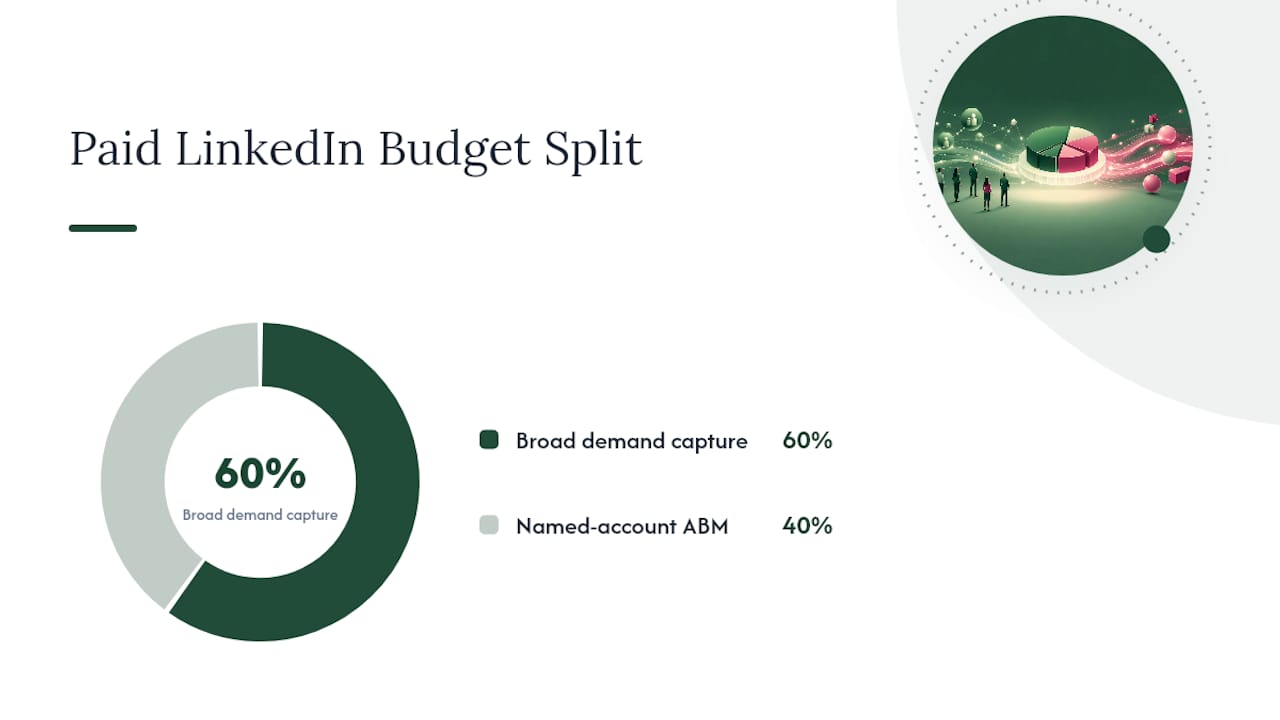
That third tier is where ABM tactics on LinkedIn earn their reputation. Campaigns that combine matched audiences with precise job-function and seniority targeting consistently show better conversion efficiency than broad-audience approaches, because you’re paying to reach people who already fit your ICP instead of hoping the algorithm finds them.
Practical mechanics for combining the two:
- Upload your target account list to LinkedIn’s Matched Audiences, then layer job-title filters on top so you’re only reaching decision-makers within those accounts.
- Use Sales Navigator to identify the specific individuals inside target accounts, then have your sales team engage their posts organically before any ad ever runs.
- Test creative with a small budget first. The right approach is to validate a message with modest spend and scale only the version that performs, not to throw budget at weak creative hoping volume fixes it.
- Split budget roughly 60/40 between broad demand capture and named-account ABM, adjusting based on which produces cheaper qualified leads over a full quarter.
Paid amplification works best as an accelerant on organic proof, not a substitute for it. A post with zero organic traction rarely improves once you pay to push it further.
How Do You Measure and Report Social Media ROI to Leadership?
Attribution starts with clean UTM tagging on every link you post, mapped directly into your CRM so a lead’s first touch, and every touch after it, gets recorded against the campaign that generated it. Without that mapping, you’re reporting activity, not results, and leadership will notice the difference within a quarter.
Build your dashboard around the metrics your CFO and CRO actually care about:
- Cost per qualified lead by channel and campaign, not blended across everything.
- Pipeline influenced, meaning deals where social touched the buyer journey at any stage before close.
- Meeting-to-close rate for leads sourced through social versus other channels, to prove (or disprove) lead quality.
- Engagement-to-conversion flow, tracking how comment and DM engagement translates into booked meetings over a rolling 90-day window.
Statistic to anchor your reporting: Lead Gen Forms convert at 10 to 15 percent, a useful reference point when leadership asks whether a campaign’s conversion rate is actually good or just average.
Report on a monthly cadence for leading indicators, engagement rate, click-through rate, form conversion, but reserve pipeline and revenue claims for a quarterly review, since B2B sales cycles rarely close fast enough for monthly attribution to mean much. Thought leadership content in particular builds influence over quarters rather than weeks, so judging it on a 30-day window will make a genuinely working strategy look like it’s failing.
What Quick Experiments Should You Run First?
Start with tests that take a week or less to read, not months. Small, fast experiments tell you what to scale before you’ve spent a quarter’s budget guessing.
- A/B test short-form video openings. Run the same video with two different opening lines for two weeks each, and compare average watch time and comment rate.
- Run a three-part carousel series on one topic, spaced a week apart, and track whether engagement builds across the series or plateaus.
- Build a comment-to-DM funnel. Ask a direct question in a post’s caption, then manually DM everyone who comments with a relevant follow-up within 24 hours, and track how many convert to a call.
- Test posting times across a two-week window with otherwise identical content types, isolating time-of-day as the only variable.
For sample size, wait for at least 8 to 10 posts per format before declaring a winner. Fewer than that, and one viral outlier will skew your read entirely.
Once you find a winner, scale it by increasing frequency of that exact format, not by changing three variables at once. Add paid budget behind the proven format, and resist the urge to declare victory and move to the next shiny tactic before you’ve squeezed a few more months of value from what’s already working.
How Connection Built Approaches B2B Social Strategy for Clients
Every tactic in this guide only works when it’s tied to a brand message worth amplifying. That’s the gap Connection-built exists to close: social strategy built on top of clear positioning, not bolted onto a logo and a tagline. When a client’s messaging is fuzzy, no amount of posting cadence fixes it. Get the story right first, then social becomes the amplifier instead of the patch.
A typical engagement pairs Social Media Strategy with brand messaging work, so the content pillars in a 90-day calendar trace directly back to a positioning document, not a brainstorm session. For clients who need ongoing execution without a full internal hire, fractional marketing support covers the writers’ room, batch content production, and reporting cadence described above, without the overhead of a full-time content team.
Client work spans small businesses and nonprofit organizations, each with different social dynamics: a nonprofit’s employee advocacy program looks more like board and donor advocacy, while a for-profit client leans harder into founder-led thought leadership. Results from that range of engagements are documented in Connection-built’s success stories.
Where Should B2B Teams Invest Next in 2026?
AI tools now draft faster than any human writer, but the posts that actually earn trust still read like a specific person wrote them. Use AI to speed up first drafts and personalization at scale, never to replace the point of view that makes a post worth stopping for.
Thought leadership and employee advocacy will keep compounding value long after any single algorithm update fades. For teams with limited budget, that’s where the next dollar belongs: fewer platforms, more consistent voices, and a willingness to let the payoff show up in quarter three, not week three.
— Chris
Ready to Build and Run Your B2B Social Strategy?
Most B2B teams don’t fail at social media because they lack ideas. They fail because nobody owns the follow-through, the writers’ room, the batch shoot day, the paid test, the monthly reporting. A holistic approach ties brand messaging, content production, and growth strategy together so your social channels support pipeline instead of running as a disconnected side project.
If your brand story is still fuzzy, that’s the real starting point, and it’s where Connection-built typically begins with new clients. From there, Social Media Strategy work maps your content pillars to actual buyer stages, and fractional marketing support keeps the 90-day calendar running without you hiring a full internal team. Nonprofit leaders can find a version of this same approach built around donor engagement on the nonprofit services page.
Start with a discovery call. Bring your current LinkedIn page, your last quarter of posts, and your honest read on whether social is producing pipeline or just activity. From there, Connection-built maps a plan against the full services list and tells you plainly which pieces you need and which you don’t.
Sources
- B2B LinkedIn Strategy for the New Algorithm — Content Marketing Institute
- LinkedIn marketing strategy for B2B lead gen (AdCreate)
- Hypelab
- Behind Finastra’s award-winning B2B social media campaign — Oktopost
FAQ
How Do You Create a B2B Social Media Strategy?
Start by setting revenue-aligned goals, qualified leads and pipeline influenced, then define your ICP across both buyer role and buying stage. From there, prioritize LinkedIn for organic and paid activity, build an employee advocacy bench, and run your first content on a 90-day calendar with a clear review cadence.
What Is B2B Social Media, and How Is It Different From B2C?
B2B social media uses platforms like LinkedIn to build relationships with buying committees rather than individual consumers, with longer sales cycles and multiple decision-makers involved. Content leans toward proof, expertise, and trust-building rather than impulse-driven engagement, and success is measured in pipeline and meetings rather than direct purchases.
How Long Does It Take to See Results From B2B Social Media?
Paid campaigns and Lead Gen Forms can produce measurable leads within weeks, with typical submission rates of 10 to 15 percent. Organic thought leadership, however, builds influence over quarters and tends to shorten later-stage sales conversations rather than generate immediate leads.
Should Small Teams Focus on LinkedIn Only, or Diversify Across Platforms?
Most B2B teams get the best return by concentrating effort on LinkedIn first, since it combines professional targeting with buying intent that other platforms don’t match. Add a second platform, like YouTube for long-form video, only after LinkedIn is producing consistent engagement and lead signal.
Can Connection-built Help Build and Run a B2B Social Media Strategy?
Yes. Connection-built offers Social Media Strategy alongside brand messaging and fractional marketing support, so content pillars, employee advocacy, and paid amplification all tie back to a consistent brand story. Current service details and pricing are listed on the services page.
Recommended
Want to talk it through? Start a conversation. https://connection-built.com