
September 12, 2026
4–6 Week Brand Audit: Score, Prioritize, and Fund Tier 1 Fixes

A brand audit is a structured evaluation of your strategy, identity, messaging, digital presence, customer experience, and internal alignment. Run correctly, it delivers a prioritized action plan with owners and a timeline, not just a diagnosis. Most mid-size brands can complete one in 4 to 6 weeks.
TL;DR:
- A brand audit should include scoring and ownership for all findings, especially the most critical issues, to ensure actionable follow-through.
- Prioritizing fixes using impact-effort matrices increases the likelihood of leadership support and faster internal implementation.
- Most audits fail because they produce reports without assigned owners or deadlines, rendering them ineffective for growth.
- Conducting a brand audit before rebranding, mergers, or when growth stalls helps clarify messaging, market position, and internal alignment.
- The real value lies in transforming audit insights into a funded, measurable roadmap with clear owners and a 90-day review cycle.
Table of Contents
- What Does a Brand Audit Actually Cover?
- When Should You Run a Brand Audit?
- The Five-Step Framework: Inventory to Action
- Which Metrics and Tools Actually Matter?
- The 4–6 Week Runbook: Who Does What, When
- Turning Findings Into a Roadmap That Gets Funded
- What Most Audits Get Wrong
- Case Studies: What a Prioritized Audit Actually Changes
- A Practitioner’s Take on Why Most Audits Underperform
- Get Your Brand Audit Turned Into a Funded Roadmap
- Sources
- FAQ
What Does a Brand Audit Actually Cover?
A brand audit examines six connected dimensions: strategy, visual identity, messaging and voice, digital presence, customer experience, and internal alignment. Each one feeds a business decision, so skipping any of them leaves blind spots.
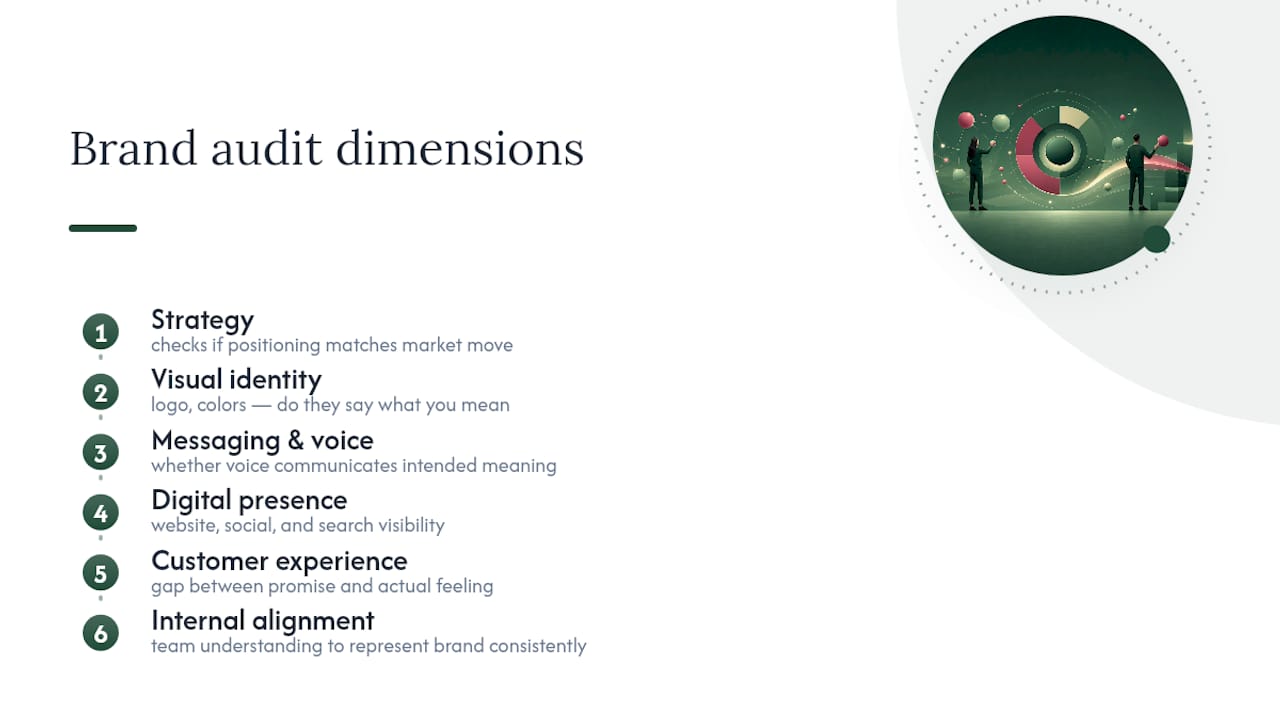
Strategy tells you whether your positioning still matches where the market moved. Visual identity and messaging reveal whether your logo, colors, and voice still say what you mean. Digital presence covers your website, social channels, and search visibility. Customer experience shows the gap between what you promise and what people actually feel when they interact with you. Internal alignment checks whether your team even understands the brand well enough to represent it consistently.
This is why Shopify frames the audit as a comprehensive evaluation of performance and market position, not a design review. Every one of these dimensions connects to a business decision: a rebrand, a repositioning, a product launch, or simply a growth plateau that needs an explanation. Skip internal alignment, and you’ll fix the logo while your sales team still describes the company in three different ways.
When Should You Run a Brand Audit?
You don’t need a calendar reminder to know it’s time. A handful of moments make the case on their own:
- Annual health check. Even a healthy brand drifts. A yearly review catches small inconsistencies before they compound.
- Before a rebrand or reposition. You can’t fix what you haven’t measured. An audit gives you a baseline to design against.
- After M&A or a major product launch. New offerings and merged identities create overlap and contradiction fast.
- When growth stalls. Flat engagement, falling conversion, or rising churn often trace back to brand confusion, not product problems.
- When messaging conflicts across channels. If sales, marketing, and customer service describe you differently, customers notice before you do.
Marketing leadership typically owns the process, with input from sales, customer service, product, and a handful of loyal customers. For a small business, this might be one person pulling together five perspectives. For a larger organization, expect a cross-functional team and a steering group that signs off on findings.
The Five-Step Framework: Inventory to Action
A brand audit works best as a linear process. Skipping steps or reordering them tends to produce a report nobody trusts. Here’s the sequence that holds up in practice.
-
Inventory everything. Pull together your website, social profiles, paid ads, packaging, sales collateral, and a sample of customer service transcripts. If it carries your name or logo, it belongs in this pile. Most teams underestimate how scattered their assets are until they try to collect them in one place.
-
Run internal interviews. Talk to 5 to 10 stakeholders across departments, using the same core questions for each: What do we stand for? Who is our customer? What makes us different? The value isn’t in any single answer. It’s in the pattern of disagreement. When your VP of sales and your head of product describe your target customer differently, that gap is the story.
-
Collect customer research. Combine a short survey (Net Promoter Score plus two or three open-ended questions) with 8 to 12 one-on-one interviews and a pass through social listening tools. Surveys tell you what customers think in aggregate. Interviews tell you why. Social listening catches the unscripted language people use when they’re not being asked a formal question, which is often more honest than anything a survey captures.
-
Review the competitive landscape. Build a positioning map plotting your top 4 to 6 competitors against the two attributes that matter most to your buyers (price versus quality, innovation versus reliability, whatever applies). Layer a SWOT analysis on top to catch what the map misses, particularly emerging threats that haven’t gained visible market share yet.
-
Score and prioritize. This is the step most audits skip, and it’s the one that determines whether the whole exercise produces change. Rate each dimension on a simple scale (say, 1 to 5) for both current performance and strategic importance. Findings with low performance and high importance become Tier 1. Everything else waits.
Pro Tip: Score findings the moment you identify them, not after the whole audit wraps. Waiting to prioritize at the end means recency bias creeps in, and the last three problems you found end up ranked higher than they deserve.
This mixed-methods approach, blending analytics with customer and employee interviews, is what closes the gap between how you think you’re perceived and how you actually are.
Which Metrics and Tools Actually Matter?
Brand audits generate a lot of qualitative material, but numbers keep the findings honest. Split your metrics into three buckets: external, experience, and digital.
External metrics measure whether the market notices you at all. Track aided and unaided awareness, Share of Voice against your top competitors, branded search volume, and media impressions. Launchmetrics recommends pairing these external visibility measures with experience metrics like Net Promoter Score and retention, since visibility without loyalty is a leaky funnel.
Experience metrics tell you what happens after someone notices you. NPS, churn rate, customer satisfaction scores, and sentiment pulled from your interview transcripts all belong here.
Digital metrics round out the picture: website traffic, engagement rate, bounce rate, and asset download activity from your digital asset management platform. Frontify notes that DAM analytics reveal which brand assets actually get used internally, a strong early signal of adoption gaps that predict inconsistent execution.
For ongoing tracking beyond the audit itself, tools like web analytics platforms, native social analytics dashboards, and continuous brand-tracking products fill different gaps. YouGov BrandIndex tracks 16 brand health metrics daily, giving you a benchmark to measure movement against long after the audit wraps. Teams with more data infrastructure are increasingly using automated share decomposition to explain shifts in market share by distribution, pricing, or velocity, turning “what happened” into “why it happened” in days instead of a full reporting cycle.
The 4–6 Week Runbook: Who Does What, When
A brand audit doesn’t need to stretch into a quarter-long project. A focused team can move through the full process in about a month to a month and a half, assuming you have buy-in and access to the right people from day one.
| Week | Focus | Lead Participants | Deliverable |
|---|---|---|---|
| 1 | Asset inventory and collection | Marketing lead, one coordinator | Centralized asset library, gap list |
| 2 | Internal stakeholder interviews | Marketing lead, 5 to 10 stakeholders | Interview summary, alignment gaps |
| 3 | Customer research and surveys | Marketing/research lead, 8 to 12 customers | Survey results, interview themes |
| 4 | Competitive review and scoring | Marketing lead, leadership input | Positioning map, SWOT, scorecard |
| 5 | Findings synthesis | Marketing lead, project sponsor | Draft findings report |
| 6 | Action plan and handoff | Full team, executive sponsor | Prioritized roadmap with owners |
Plan for roughly 3 to 5 hours a week from your core team, with a heavier lift in weeks 2 and 3 when interviews are running. The acceptance criteria for a finished audit is simple: every Tier 1 finding has a named owner and a deadline before the project is considered closed. A report with no owners attached is a document, not an audit.
Turning Findings Into a Roadmap That Gets Funded
Raw findings don’t move budgets. A prioritized roadmap does. The impact × effort matrix is the fastest way to sort a long list of recommendations into something a leadership team will actually approve.
- Tier 1: urgent fixes. High impact, low effort. Inconsistent logo usage, broken website links, contradictory messaging on your homepage. Fix these in the first month.
- Tier 2: system improvements. Medium impact, medium effort. Updated brand guidelines, a messaging refresh, staff training on brand voice. These typically run a couple of months.
- Tier 3: strategic shifts. High impact, high effort. Repositioning, a visual identity overhaul, a new customer experience model. These belong on a 6 to 12 month roadmap with executive sponsorship.
Assign an owner to every item, not just every tier. A repositioning effort might sit with the CEO or head of strategy, while a messaging refresh belongs with a marketing manager. Set a 90-day validation window and track two or three KPIs, such as branded search volume or NPS, to confirm the fixes are actually moving the numbers instead of just looking good in a slide deck.
What Most Audits Get Wrong
The most common failure isn’t a bad audit. It’s a good audit that dies as a PDF. Teams run a thorough diagnosis, produce a polished report, and then never assign owners or deadlines. The value of an audit lives in the roadmap that follows it, not the report itself.
The second failure is checking only what’s visible. Logos, color palettes, and website design are easy to evaluate and easy to fix, so they get disproportionate attention. Internal alignment and customer experience gaps take longer to surface and longer to fix, which is exactly why they get skipped.
The third failure is treating the audit as a one-time event instead of a baseline. A finding without a score, an owner, and a follow-up date isn’t a finding. It’s a note. Effective audits are structured around scored, owned, time-boxed actions, as that structure is what separates a report from a program.
Case Studies: What a Prioritized Audit Actually Changes
The pattern across well-run audits is consistent: the brands that see measurable movement are the ones that treated the audit as the start of a program, not the end of a project.
A regional service business running an annual health check discovers its social content and its sales collateral describe two different value propositions. Internal interviews surface the split immediately: sales emphasizes speed, marketing emphasizes affordability. Once that Tier 1 finding gets a single owner and a 30-day messaging fix, branded search volume and inbound lead quality both improve within the following quarter, because prospects finally hear one consistent story before they ever talk to a salesperson.

A nonprofit facing a post-merger identity crisis runs a full six-week audit ahead of a rebrand. The competitive review reveals it’s the only organization in its region using cold, clinical language in a category where donors respond to warmth and personal connection. That single insight reshapes the entire messaging tier, and post-launch tracking shows donor retention climbing over the following two quarters.
Neither result comes from the audit report itself. It comes from what happened after: a scored list, a named owner, and a deadline that someone was actually held to. That’s the difference between an audit that sits in a folder and one that changes how a business grows.
A Practitioner’s Take on Why Most Audits Underperform
Most brand audit advice focuses on what to look at. Almost none of it focuses on what to do with what you find, and that’s the gap that actually costs businesses money.
The conventional wisdom treats an audit like a health screening: check the vitals, hand over the results, move on. But a screening without a treatment plan is just anxiety with a price tag. The businesses that get real value from an audit are the ones that build scoring into the process from day one, so the output is a ranked list with owners, not a forty-page document that reads like a wish list.
Here’s what I’d tell any owner starting one: don’t chase completeness. Chase prioritization. A rushed audit that produces three funded Tier 1 fixes beats a exhaustive one that produces sixty unranked observations nobody acts on. Score early, assign owners before the report is even finished, and set your 90-day check-in date before you start week one. The audit itself is cheap. The follow-through is where the value actually lives, and it’s the part almost everyone skips.
— Chris
Get Your Brand Audit Turned Into a Funded Roadmap
Running the audit is only half the work. Turning findings into a scored, owned, funded roadmap is where most internal teams stall, and this is the service that the company offers. We handle audit scoping, full audit delivery, and prioritized implementation, so the Tier 1 fixes from week one don’t sit untouched for six months.
If you’re a small business owner or nonprofit leader wondering whether your brand’s public perception still matches your original intent, a scoping call is the fastest way to find out. We’ll walk through your current assets, flag the obvious gaps, and tell you honestly whether you need a full audit or a lighter touch. Visit our marketing services for small businesses page to see how we structure audit-to-implementation engagements, or browse our client success stories to see how prioritized findings turned into measurable growth for other organizations. Book a scoping call and get a clear answer on what your brand actually needs next.
Sources
For deeper frameworks, see Shopify’s 8-step audit process, Frontify’s KPI measurement guide, and this guide on AI-assisted brand awareness measurement.
- How To Do a Brand Audit: 8-Step Framework (2025)
- Brand Audit Guide: How to Audit Your Brand in 2026 (Free Framework)
- Brand Performance: A Complete Guide - Launchmetrics
FAQ
What Is a Brand Audit?
A brand audit is a structured evaluation of your strategy, visual identity, messaging, digital presence, customer experience, and internal alignment, producing a prioritized action plan rather than a simple report.
What Are the 7 Pillars of Branding?
Definitions vary across sources, but most branding frameworks converge on purpose, positioning, personality, identity, communication, experience, and consistency as the recurring elements worth auditing.
Can You Give an Example of a Brand Audit in Action?
A regional business discovering that its sales team and marketing team describe its value proposition differently is a common audit finding; fixing that single misalignment often improves lead quality within one quarter.
What Are the 5 C’s of Branding?
Common versions of this framework include company, customers, competitors, collaborators, and climate, used to frame the competitive and market context an audit should examine.
How Long Does a Brand Audit Take?
Most mid-size brands can complete a thorough audit in 4 to 6 weeks, covering inventory, interviews, customer research, competitive review, and a prioritized action plan.
Recommended
Want to talk it through? Start a conversation. https://connection-built.com