
August 28, 2026
Community Led Growth for SMBs: Narrow Focus, ROI in 6–18 Months

Community-led growth makes your customers and their interactions the primary engine for acquisition, retention, and advocacy. Instead of paying for every new lead, you build a space where members solve problems together, create content, and bring the next customer in the door. The result: lower acquisition costs, stickier retention, and a growth channel that compounds instead of resetting every quarter.
TL;DR:
- Building a small, targeted community with clear identity and outcomes accelerates trust and engagement, leading to faster peer-driven growth and retention.
- Successful community models include support, feedback, advocacy, educational, and campaign communities, often blending multiple types for maximum impact.
- Measuring relevant metrics like activation rate, churn delta, and community-attributed revenue provides meaningful insights into the program’s contribution to growth.
- Avoid common pitfalls such as broad audiences, early monetization, lack of measurement, and unclear governance to ensure community health and alignment with brand values.
- Ensuring legal compliance, transparent moderation, and balanced brand control fosters trust and longevity within the community ecosystem.
Table of Contents
- What Is Community-Led Growth, and How Does It Fit With Other Growth Models?
- Why Does Community-Led Growth Actually Work?
- What Are the Main Types of Community Models?
- How Do You Build a Community-Led Growth Engine From Scratch?
- How Do You Measure Community-Led Growth?
- What Do Real Community-Led Growth Examples Teach Us?
- What Mistakes Derail a Community-Led Growth Program?
- What Legal and Ethical Rules Apply to Online Communities?
- How Do You Balance Community Autonomy With Brand Control?
- Author Perspective: Why Alignment Beats Tactics
- Ready to Build Your Community-Led Growth Program?
- Sources
What Is Community-Led Growth, and How Does It Fit With Other Growth Models?
Community-led growth (CLG) is a strategy where a brand builds a structured space, a forum, a Discord server, a Circle community, an in-app hub, where customers interact with each other and with the product, and those interactions become the primary driver of new business. It’s not a marketing channel bolted onto your existing playbook. It’s a system that runs alongside, and often ahead of, your other motions.
CLG doesn’t replace product-led growth (PLG) or traditional marketing. It reinforces both. PLG gets someone to try your product; community gets them to stay, contribute, and recruit others. Marketing-led growth pushes messages out; community pulls people in through peer conversation, which tends to convert at a higher rate.
CLG is the right fit when:
- Your product creates a sense of identity or shared practice (developers, marketers, designers, patients)
- Peer learning solves a real problem faster than your support team can
- Members have something to create, templates, plugins, tutorials, that others want
If none of those apply, a community will feel forced. If even one does, it’s worth testing.
Why Does Community-Led Growth Actually Work?
The mechanism is simple: people trust other people more than they trust brands. A community marketing strategy shifts the entire model from reach to participation. Members co-create content and vouch for the product in their own words, and that kind of advocacy converts better than most paid channels ever will.
Three forces drive the payoff:
- Peer trust closes deals faster. A recommendation from another user carries more weight than an ad, because it comes without a sales incentive attached.
- Support deflection cuts costs. When members answer each other’s questions, your support team fields fewer repetitive tickets, and user-generated answers often outlast any help-desk article.
- Belonging drives retention. Customers who feel part of something are slower to churn, and many stay specifically to keep contributing.
Companies running active communities consistently report retention gains and lower support costs when members help each other, a pattern strong enough that HubSpot’s research on community marketing treats it as a baseline benefit rather than an outlier. The compounding part matters most: user-generated templates, plugins, and referrals reduce customer acquisition cost over time, building what the PLG Handbook calls a flywheel, each contribution making the next one easier to attract.
What Are the Main Types of Community Models?
Not every community should look the same. The model has to match the outcome you’re chasing.
- Support communities. Peer-to-peer help and onboarding assistance. Best on forums or dedicated help hubs where searchability matters more than real-time chat.
- Feedback and beta communities. Product input and roadmap collaboration. Works well in a closed Circle group or Slack channel where trust runs high and the group stays small.
- Advocacy and ambassador programs. Referrals and user-generated content. Needs a recognition system, badges, early access, or revenue share, to keep momentum going.
- Educational communities. Cohort-based learning tied to your product category. Fits live events, structured courses, or a Discord with scheduled sessions.
- Campaign communities. Short-term, high-energy groups built around a launch or seasonal push. Best on fast-moving platforms like Discord where urgency drives participation.
Most mature CLG programs blend two or three of these rather than picking just one.
How Do You Build a Community-Led Growth Engine From Scratch?
Sequencing determines whether your community becomes a growth engine or a ghost town. Here’s the order that actually works.
- Define a narrow identity and a specific outcome. Don’t build a community “for our customers.” Build one for a specific role, revenue band, or use case, and name the exact problem it solves. Narrow segmentation speeds up trust formation because members immediately recognize each other as peers, a pattern Alex Berman’s community marketing framework points to directly.
- Recruit 20 to 50 founding members by hand. Skip the public launch. Personally invite a small, carefully chosen group and get them talking before you open the doors. This creates recurring pull, real conversations, real questions, real momentum, so new members walk into something alive, not empty.
- Design activation and recognition systems before you need them. Build a champion program, highlight top contributors publicly, and make contribution visible through leaderboards, badges, or shoutouts. People show up more when they can see their name attached to something.
- Assign real ownership inside your org. Someone needs to own community outcomes the way a sales leader owns pipeline. Without a named owner, community work becomes everyone’s part-time job and nobody’s priority.
- Set a realistic timeline. Durable ROI from community programs typically takes 6 to 18 months to show up. Track early activation rate and qualitative signals, not revenue, in the first two quarters.
Pro Tip: Have your first piece of recurring content, a weekly thread, a monthly call, a content drop, ready before you invite a single founding member. A community with nothing scheduled feels like an empty room, no matter how many people you invite in.
How Do You Measure Community-Led Growth?
Vanity metrics kill community budgets. Track the numbers that actually connect to revenue and retention.
Community health metrics tell you whether the engine is running:
- Activation rate (percentage of new members who take a meaningful first action)
- Response rate to posts or questions within a set window
- DAU/MAU ratio among active members, a sharper stickiness signal than total membership size
Business metrics tell you whether the engine is worth the investment. The single most persuasive one is the churn delta between community members and non-members, tracking that gap is the clearest way to prove ROI, according to guidance on measuring community-led growth for startups. Pair it with community-attributed revenue (CAR), product-qualified leads (PQLs) sourced from community activity, and the CAC differential between community-sourced and paid-sourced customers.
| Metric | What it measures | Where it lives |
|---|---|---|
| Activation rate | New members taking a first meaningful action | Community platform analytics |
| Churn delta | Retention gap between members and non-members | CRM + lifecycle analytics |
| Community-attributed revenue (CAR) | Revenue tied to community-sourced leads or expansions | CRM with community source tagging |
| CAC differential | Cost gap between community and paid acquisition | Finance/marketing ops dashboard |
None of this works without integration. Tie community events, posts, and logins to CRM fields so lifecycle analytics can actually see the connection between a forum thread and a closed deal.
What Do Real Community-Led Growth Examples Teach Us?
The clearest patterns show up wherever contribution turns into distribution.
- Template and plugin marketplaces. Users build tools for each other inside the product ecosystem, and every shared template becomes a small advertisement for the platform underneath it.
- Champion-led Discord servers. A handful of power users answer questions faster than any support team, and new members join because someone already vouched for the product publicly.
- Tutorial and education hubs. Members teach other members how to use advanced features, which does the onboarding work a product team would otherwise have to build from scratch.
The common thread across all three: visible recognition and consistent measurement. Companies that publicly credit top contributors and track their output see faster contributor economy growth than those that let good work go unnoticed. If you want to see how this plays out in an organization’s actual growth trajectory, Connection-built’s success stories show what happens when community and brand strategy move in the same direction.
What Mistakes Derail a Community-Led Growth Program?
Most failures trace back to a handful of sequencing errors.
- Audience too broad. A community “for all our customers” has no shared identity. Fix it with role-based or outcome-based segmentation from day one.
- Monetizing too early. Selling before delivering value kills trust before it forms. Build peer value first; introduce revenue asks later, once the build-first approach has had time to work.
- Skipping measurement. Waiting until year two to track anything means you have no baseline to prove impact. Wire community data into CRM from the first month.
- No governance. Undefined conduct rules and unclear escalation paths let small conflicts spiral into member exits.
Pro Tip: Write your code of conduct and escalation process before you recruit your first founding member, not after your first moderation crisis.
What Legal and Ethical Rules Apply to Online Communities?
Running a branded community means taking on responsibilities most marketing teams haven’t had to think through before. Get ahead of them rather than reacting to a problem after it happens.
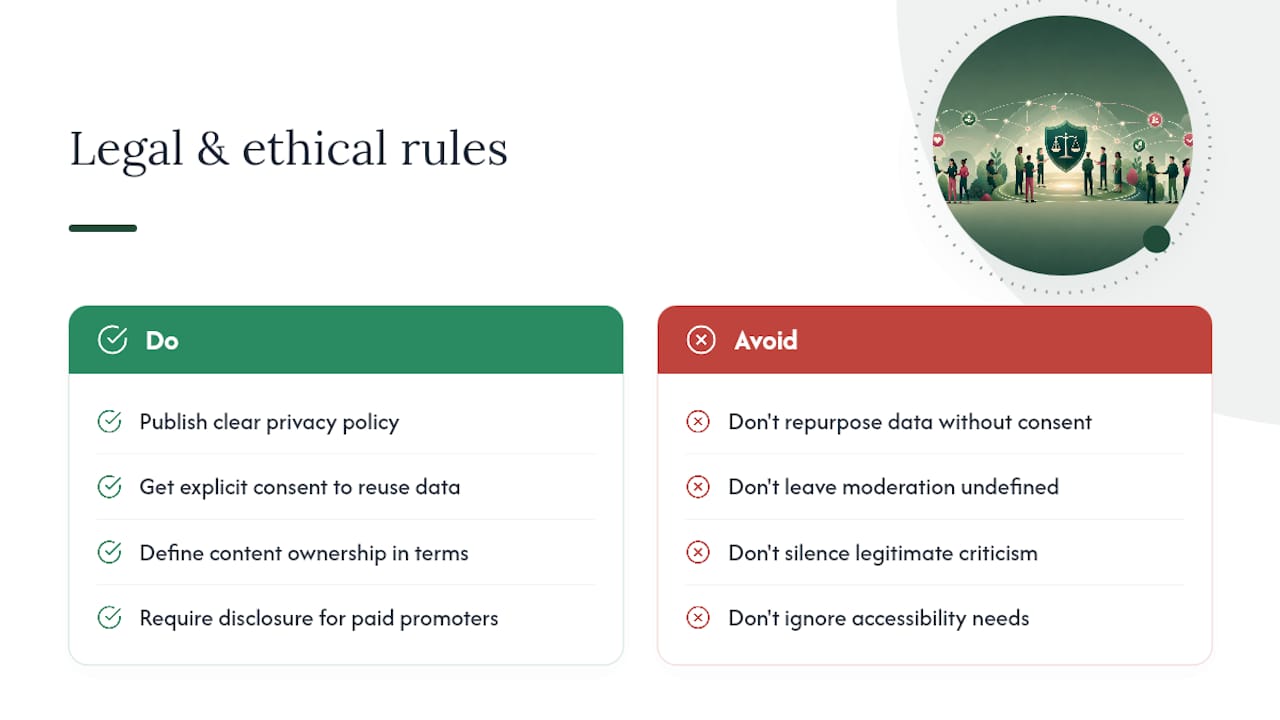
Data privacy sits at the top of the list. Any community platform that collects emails, profiles, or behavioral data has to handle that information according to the privacy laws that apply in each member’s jurisdiction, which for a global audience can mean GDPR-style consent requirements in some regions and different standards elsewhere. Publish a clear, findable privacy policy and never repurpose community data for marketing without explicit consent.
Content ownership and moderation need clear terms of service before launch, not after a dispute. Spell out who owns user-generated templates, tutorials, and posts, and what happens if a member leaves. Moderation policies should draw a bright line between removing harassment or spam and silencing legitimate criticism of the product; communities that only tolerate praise lose credibility fast.
Disclosure and transparency matter most in advocacy and ambassador programs. If members receive free products, credits, or payment for promoting your brand, most consumer protection regulators require clear disclosure of that relationship in any public post. Build disclosure language into your ambassador agreements rather than leaving it to individual members to figure out.
Accessibility deserves attention too. A community platform that excludes people using screen readers or older devices quietly shrinks your own growth engine before it starts.
How Do You Balance Community Autonomy With Brand Control?
The tension is real: too much control and the community feels like a marketing channel with extra steps; too little and it drifts away from the brand’s purpose entirely. The healthiest communities sit somewhere in the middle, with clear guardrails and generous room to move inside them.

Start by separating what’s non-negotiable from what’s open to member direction. Codes of conduct, safety rules, and legal disclosure requirements aren’t up for debate. Everything else, discussion topics, event formats, the tone of casual conversation, can and should be shaped by the members themselves. A community that only ever discusses what the brand wants discussed stops feeling like a community and starts feeling like a focus group.
Give members real decision-making power somewhere visible. Let them vote on event topics, elect moderators from within the group, or shape a chunk of the content calendar. Ownership over even a small piece of the experience makes members defend the space instead of just occupying it.
Brand control should show up as infrastructure, not commentary. Set the platform, the rules, the escalation path. Then step back from moment-to-moment conversation and let members run it. The brands that struggle most with this balance are the ones that treat every off-topic thread as a crisis instead of a normal sign of a living community.
Watch for the warning signs on both ends: near-silence in a channel usually means members feel too controlled to speak freely, while a moderation team constantly stepping in to redirect conversation usually means the brand hasn’t let go of enough.
Author Perspective: Why Alignment Beats Tactics
Most community programs fail from disconnection, not tactics. Connection-built’s approach ties community strategy to a brand’s actual narrative and internal systems, so contribution and message reinforce each other. See how that plays out in our success stories and service offerings.
— Chris
Ready to Build Your Community-Led Growth Program?
Connection-built gives you strategic planning and hands-on execution in one place, so you’re not stitching together a community platform, a content cadence, and a measurement system on your own. We help you define the narrow identity that makes a founding cohort want to show up, build the recognition systems that keep members contributing, and connect community data to the CRM fields that prove it’s working.
If you’re a small business owner or a nonprofit leader trying to figure out where community fits inside a broader growth plan, our small business marketing services cover the strategic alignment work this article describes, from brand messaging to the growth systems that support it. Want proof before you commit? Browse our success stories to see how strategic alignment has worked for organizations like yours. When you’re ready to talk specifics, reach out through Connection-built and tell us what you’re trying to build.
Sources
- Community marketing strategy (Hootsuite blog)
- Community marketing (Alex Berman)
- Community marketing (HubSpot)
- Community-Led Growth (PLG Handbook)
- Community-Led Growth for startups (Udit blog)
Recommended
Want to talk it through? Start a conversation. https://connection-built.com