
September 15, 2026
3–5 Content Pillars That Turn Ideas Into a Weekly Content Engine

Content pillars are the 3 to 5 core themes that every piece of content you publish should connect back to. They give your brand a repeatable structure instead of a blank page every week. Most brands do best with three to five — no more — because that range balances focus with enough variety to avoid repetition. Get the pillars right, and content planning stops being a scramble.
TL;DR:
- Focusing on 3 to 5 narrowly defined content pillars allows brands to build recognition and topical authority faster than spreading across many themes.
- Each pillar should have a clear, specific definition that enables new team members to create content independently and consistently.
- Tagging all content by pillar at publish time is essential for measuring performance and optimizing based on relevant metrics like engagement and conversions.
- Overlapping or vague pillars hinder planning and should be merged or clarified to maintain focus and strategic coherence.
- Platforms and formats should be tailored to each pillar, with educational content thriving as long-form videos and promotional content performing best in short-form social and email.
Table of Contents
- What Are Content Pillars, Exactly?
- Why Do Content Pillars Actually Matter?
- How Do You Create Content Pillars?
- How Do You Map Pillars to Formats and Channels?
- How Do You Measure and Optimize Content Pillars?
- What Mistakes Should You Avoid With Content Pillars?
- Why Most Brands Get Pillars Half Right
- Ready to Turn Pillars Into a Working Content Engine?
- Sources
- FAQ
What Are Content Pillars, Exactly?
Think of content pillars as the load-bearing beams of your strategy: broad themes like “product education” or “customer wins” that hold up everything else. Each pillar breaks into clusters (specific subtopics) and those clusters get produced as formats: a blog post, a reel, an email, a carousel. Content pillars structure this way on purpose. Skip the structure, and you get a feed full of one-off posts with no throughline.
Most brands draw from five recurring pillar types, as social platforms have standardized them:
- Educational — how-to content, tips, and explainers that solve a real problem.
- Promotional — product features, offers, and service announcements.
- Community — testimonials, user-generated content, social proof.
- Behind-the-scenes — culture, process, the people behind the brand.
- Entertaining — trend-based, lighter content that earns reach.
A sharper pattern has emerged for social-first brands: one narrow core pillar you own completely, paired with one or two adjacent pillars that let you expand reach without diluting your authority. For example, a financial coach’s core pillar might be “debt payoff strategy,” with adjacent pillars in “budgeting mindset” and “client wins.” Narrow beats broad almost every time.
Why Do Content Pillars Actually Matter?
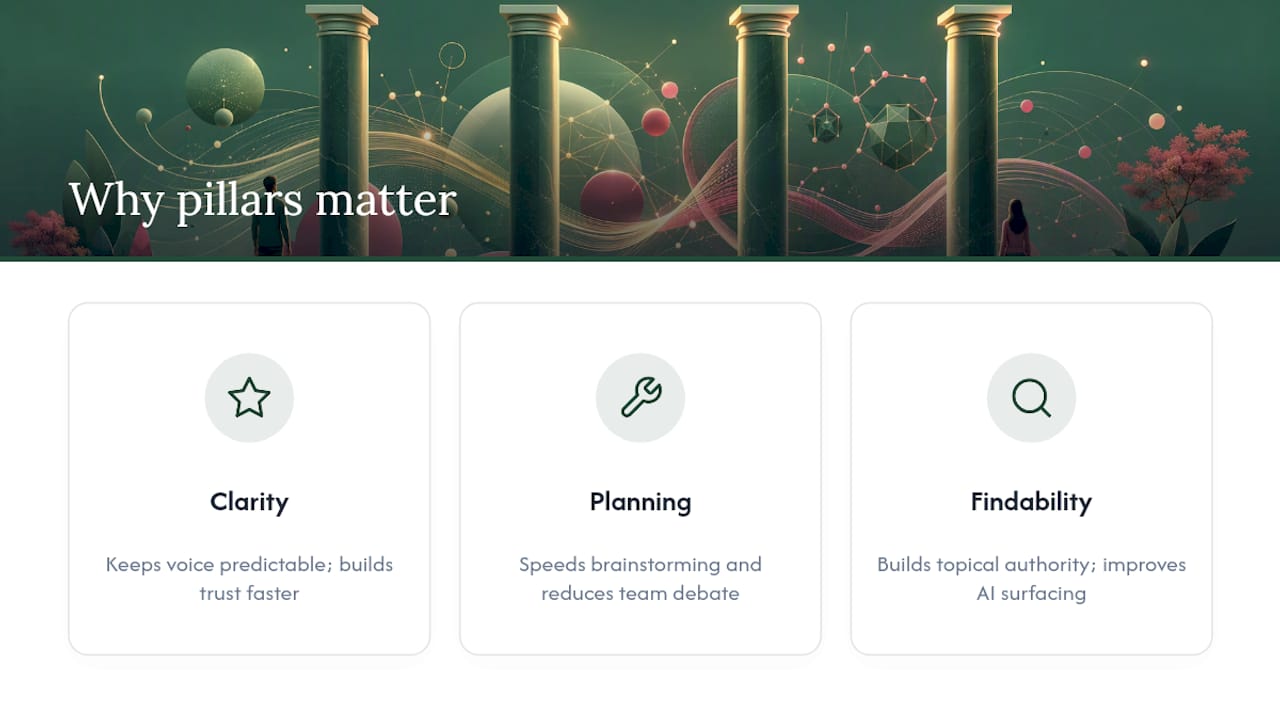
Pillars solve three problems at once: brand clarity, planning speed, and findability. Skip them and you’re reinventing your message every single post, which is exhausting and inconsistent.
On the clarity side, a defined set of pillars keeps your voice recognizable across every channel. Your audience should be able to predict, roughly, what kind of value they’ll get from you. That predictability builds trust faster than variety does.
On the discovery side, pillars build what search engines and AI tools call topical authority. Clustering content under pillars and linking between them signals expertise to search algorithms far more effectively than scattered, unrelated posts. A narrow core pillar, in particular, accelerates how quickly AI-driven surfacing tools recognize your account or site as a go-to source on that topic.
There’s a planning payoff too. Pillars work like creative guardrails rather than scripts, speeding up brainstorming while keeping your voice consistent across every format. Teams that plan by pillar spend less time debating “what do we post” and more time producing.
Pro Tip: If you can’t explain a pillar to a new team member in one sentence, it’s not a pillar yet. It’s still an idea.
How Do You Create Content Pillars?
Building pillars is a sequence, not a brainstorm. Skip a step and you’ll end up with themes that sound good in a meeting but fall apart in practice.
- Start with audience and goals. Who are you actually talking to, and what business outcome does this content need to drive? Awareness, leads, retention, and reputation each point toward different pillars.
- Audit what you already have. Pull your last 6 to 12 months of content and tag it by rough theme. You’ll usually find two or three themes already performing, buried among a dozen one-off posts.
- Choose 3 to 5 pillars and write a one-sentence definition for each. This is where most brands get vague — “lifestyle content” is not a pillar. “Practical outfit formulas for petite frames” is.
- Build a cluster and sample post bank per pillar. Draft 3 to 5 post ideas under each pillar before you touch a calendar. If you can’t generate five ideas easily, the pillar is probably too narrow, or too vague to spark ideas at all.
- Assign KPIs and a review cadence. Every pillar needs a way to measure whether it’s working, and a set date to check.
This process mirrors the framework most content strategists now recommend: audience first, definitions second, formats third, calendar fourth, review last. Following the order matters more than moving fast through it.
How Do You Map Pillars to Formats and Channels?
Not every pillar belongs on every platform, and not every format suits every pillar. Educational content thrives as long-form video or carousel posts. Promotional content works best as short-form social or email, where a direct call to action doesn’t feel out of place. Community content shines in Stories, testimonials, and comment-driven posts.
A workable starting mix looks like this:
- Educational → blog, YouTube, LinkedIn carousel, email newsletter
- Promotional → Instagram Stories, email, paid social, product pages
- Community → Reels, Stories, comments, user-generated reposts
- Behind-the-scenes → TikTok, Stories, casual video
- Entertaining → Reels, TikTok, trend-based short-form
Push promotional content past that ratio and engagement usually drops.
Five hooks work across nearly every pillar: a bold claim, a relatable problem statement, a number or statistic, a before/after contrast, and a direct question. Build a content calendar around your pillars first, then slot hooks in second. Calendar-first thinking without pillars is how brands end up posting on autopilot with nothing to say.
How Do You Measure and Optimize Content Pillars?
Each pillar needs its own success metric, because they’re not trying to do the same job. Educational content should be judged on saves and shares. Promotional content lives or dies on click-through rate and conversions. Community content is measured by comments and repost volume.
The mechanical part matters just as much as the metric: tag every piece of content by pillar at publish time so your analytics dashboard can report on pillar performance, not just individual post performance. Without tagging, you’re guessing which theme actually moves the needle.
Set a quarterly review and ask three questions:
- Which pillar consistently underperforms across every format it’s tried?
- Which pillar’s content is hardest to produce relative to its results?
- Has audience feedback or comments signaled a theme you’re missing entirely?
If a pillar fails two quarters running, retire or merge it rather than forcing it. Pillars should evolve as your audience and goals shift.
What Mistakes Should You Avoid With Content Pillars?
The most common failure is simply having too many pillars. Past five, teams lose the planning speed pillars are supposed to create, and the overlap between pillars becomes noticeable to your audience.
- Too many pillars. Cut back to 3 to 5, and prioritize the narrow core pillar over breadth.
- Overlapping pillars. If two pillars produce interchangeable content, merge them.
- Ignoring platform differences. A pillar that works on LinkedIn may flop on TikTok. Adjust format, not the pillar itself.
- Vague definitions. “Lifestyle” isn’t a pillar. Rewrite until a new hire could execute it without asking questions.
- Not measuring by pillar. Without tagging, you can’t tell which theme is earning its place.
| Mistake | Quick Fix |
|---|---|
| Too many pillars | Cut to 3–5, prioritize the core pillar |
| Overlapping themes | Merge pillars with interchangeable content |
| Ignoring platform fit | Adjust format per channel, keep the pillar |
| Vague one-line definitions | Rewrite until a new hire could execute it |
| No pillar-level tracking | Tag content at publish, review quarterly |
Why Most Brands Get Pillars Half Right
Most brands treat content pillars as a naming exercise. They pick three words, slap them on a slide, and call the strategy done. That’s the gap between what pillars promise and what they actually require: definitions specific enough that a new hire could execute them without a follow-up question.
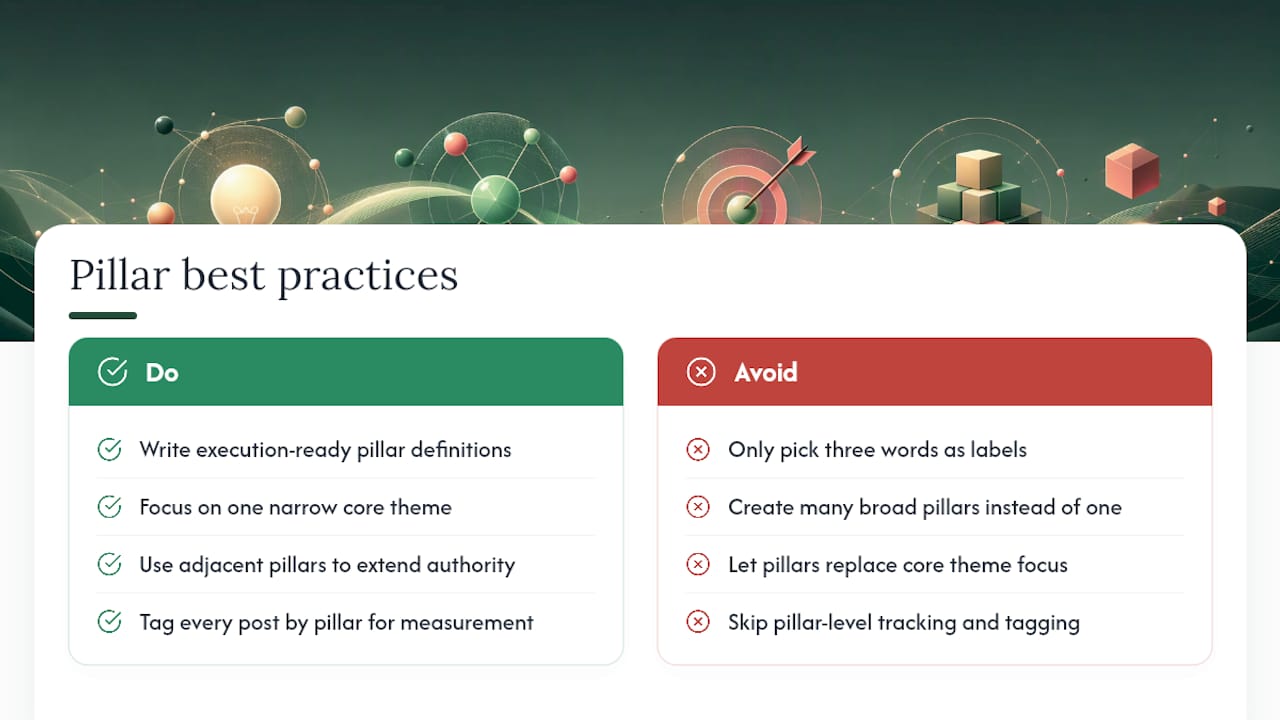
The narrow core pillar approach gets underrated because it feels counterintuitive. Brands assume more pillars means more reach, when the opposite tends to be true. A single narrow theme, executed relentlessly, builds recognition and topical authority faster than five broad ones ever will. The adjacent pillars exist to stretch that authority outward, not to replace it.
The other overlooked piece is measurement. Plenty of brands define pillars beautifully and never tag a single post by theme. Then, a year later, they can’t say which pillar actually drove leads versus which one just felt good to make. Pillars without pillar-level data are just vibes with a name attached.
— Chris
Ready to Turn Pillars Into a Working Content Engine?
Defining pillars on a whiteboard is one thing. Turning them into a working calendar, a KPI dashboard, and content your team can actually produce every week is another. A focused workshop can help you get there: clear pillar definitions, content clusters mapped to formats, a sample calendar built out for the next few months, and KPIs assigned per pillar from day one.
You walk away with a system, not just a strategy document that sits in a shared drive. If you’re a small business owner or marketing lead who wants this built rather than pieced together on your own, explore Connection-built’s marketing services for small businesses and see what a done-with-you pillar rollout looks like for your brand. Start by outlining your goals and audience, then reach out to map your first 3 to 5 pillars together.
Sources
- Content Pillars | What They Are, Tips & Examples
- Content Pillars: What They Are & How to Build Them for SEO
- A Guide to Social Media Content Pillars
- How to use content pillars to build your social strategy | Later
- Content Pillars Strategy: Framework That Works
FAQ
What Are the Five Content Pillars?
The five most common pillar types are educational, promotional, community, behind-the-scenes, and entertaining content, though your specific pillars should reflect your own brand and audience rather than copying this list exactly.
Can You Give an Example of a Content Pillar?
A fitness coach might use “beginner strength training” as a core pillar, producing how-to videos, form-check carousels, and client progress posts all under that single theme.
What Are the 7 Pillars of Digital Marketing?
That figure refers to broader marketing channels, such as SEO, content, social media, email, paid media, and analytics, rather than content pillars specifically; content pillars are a strategy within the content marketing pillar itself.
What Is Pillar Content?
Pillar content is the core theme or topic that anchors your content strategy, with smaller clusters and individual posts branching off it across formats and channels.
How Many Content Pillars Should a Brand Have?
Most brands should stick to 3 to 5 pillars, often built around one narrow core pillar with one or two adjacent themes to expand reach without losing focus.
Recommended
Want to talk it through? Start a conversation. https://connection-built.com