
September 2, 2026
Small Business: Make Social Media Doable With Plug and Play 3–5 Pillars

Content pillars are the repeatable themes that guide everything you post, so your feed builds recognition instead of random noise. The move: pick a few key pillars, each tied to one primary outcome per channel, and use them to structure your calendar. Marketing teams that follow this model, including pillar frameworks HubSpot recommends, report more consistency and less last-minute scrambling for post ideas.
TL;DR:
- Choosing only a few content pillars aligned with business goals and audience interests ensures consistency, efficiency, and long-term authority.
- Each pillar type, such as educational, community, or promotional, should be validated through an audit of audience demand and team capabilities.
- Successful strategies require platform-specific adaptation of pillars and formats, with clear metrics like saves for education or click-throughs for promotions.
- Implementing templates, calendars, and guardrails helps teams produce aligned content efficiently and maintain visual and tone consistency.
- Regular performance reviews and pilot testing over six to eight weeks are essential for refining and scaling a sustainable pillar-driven content system.
Table of Contents
- What Are Content Pillars, and Why Do They Matter?
- Common Content Pillar Types (With Post Ideas You Can Steal)
- How Do You Actually Create Your Content Pillars?
- Which Pillars Belong on Which Platform?
- Templates, Calendars, and Creator Briefs That Actually Get Used
- How Do You Measure Whether a Pillar Is Working?
- Why Your Brand Needs a Social Media Style Guide
- What Do Successful Pillar Strategies Look Like in Practice?
- What Actually Matters Once the Pillars Are Set
- How Connection-Built Helps You Put Pillars Into Action
- Sources
What Are Content Pillars, and Why Do They Matter?
A content pillar is a strategic theme, not a format. Think “customer education” or “behind-the-scenes culture,” not “carousels” or “Reels.” The term picked up steam as brands moved from reactive posting to structured planning, and it now sits at the center of most social media content strategy work.
Here’s where people get confused: pillars and buckets aren’t the same thing. A pillar is what you talk about; a bucket is how you organize or format it. “Educational content” is a pillar. “Carousel posts” is a bucket. You can run one pillar through five different buckets and still stay on message.
Content pillars work best when there are only a few of them, commonly a small number, and each one connects directly to a business goal and something your audience actually wants. That constraint is the whole point. Too many themes and you’re back to posting whatever comes to mind that week.
Three benefits show up almost immediately once pillars are in place:
- Consistency. Your audience starts to recognize what you stand for, because the same themes recur in a predictable rhythm.
- Efficiency. Your team stops staring at a blank content calendar wondering what to post next.
- Authority. Repeated themes compound. One post about an industry topic is forgettable. Ten posts over three months build a reputation.
Pillar-driven planning also cuts down on team burnout and makes monthly reporting far less painful, since you’re measuring performance against defined themes instead of a pile of unrelated posts.
Common Content Pillar Types (With Post Ideas You Can Steal)
Most brands can build a full pillar system from a short menu of proven categories. Semrush’s breakdown of pillar types covers the six that show up again and again across industries. Here’s how each one translates into an actual post.
- Educational. Teach your audience something useful about your industry. Example: a carousel titled “3 mistakes people make when hiring a contractor,” with each slide breaking down one mistake.
- Inspirational or thought leadership. Share a perspective, prediction, or hard-won opinion. Example: a talking-head video where the founder explains why a common industry practice is outdated.
- Promotional. Highlight your product or service directly. Example: a before-and-after post showing a client transformation, with a clear call to action in the caption.
- Community or user-generated content. Feature your customers, followers, or clients. Example: a repost of a client’s tagged photo, paired with a short caption thanking them by name.
- Behind-the-scenes. Show the people and process behind the brand. Example: a day-in-the-life Reel following one team member through a project.
- Entertaining or edutainment. Blend humor with a lesson. Example: a trending audio format used to poke fun at a common customer misconception, then correct it in the caption.
Choosing which pillars to run isn’t about picking your favorites. Match pillars to what your audience already asks you and what your business can realistically produce every single week. A solo consultant probably can’t sustain a heavy UGC pillar with no existing customer base to draw from, but they can absolutely own thought leadership and education.
How Do You Actually Create Your Content Pillars?
Building content pillars isn’t a brainstorming exercise. It’s an audit followed by a validation test. Here’s the sequence that keeps teams from picking pillars that sound good in a meeting but die in week three.
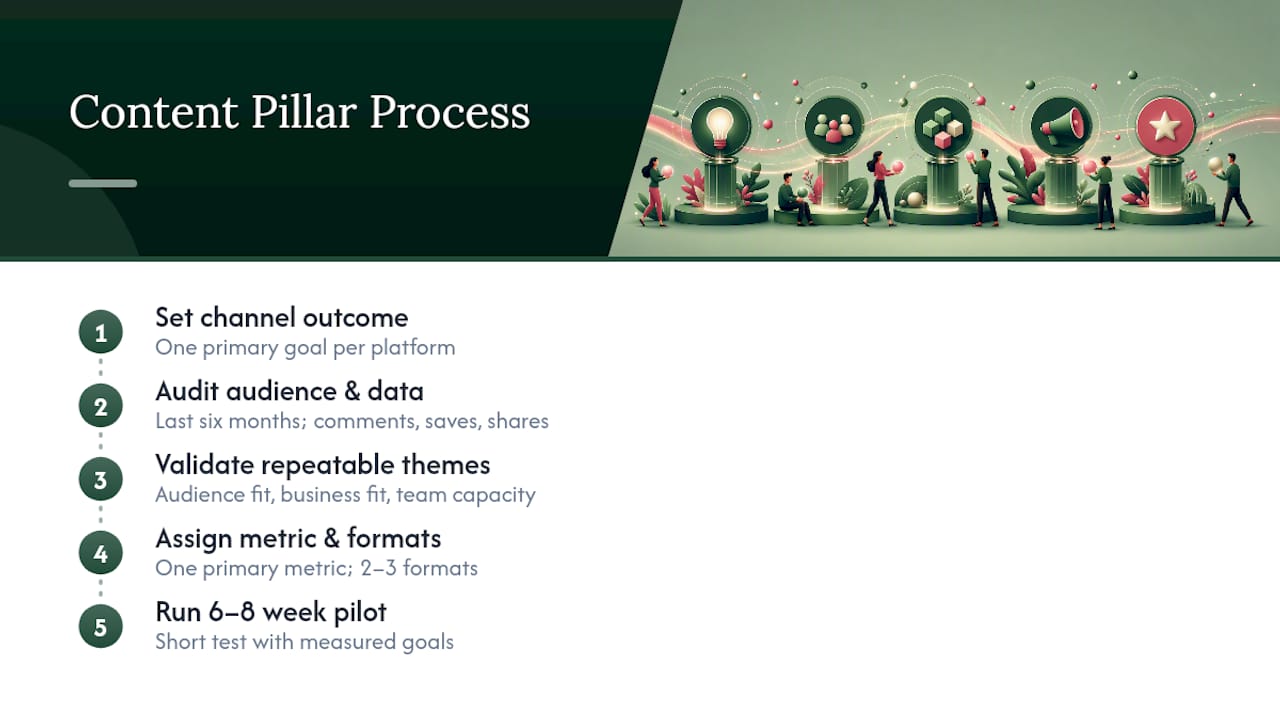
Step 1: Set one primary outcome per channel. Before you touch a single theme idea, decide what each platform is for. Instagram might exist to build brand awareness. LinkedIn might exist to generate leads. Trying to make one channel do everything is how content strategies collapse under their own weight. A focused framework starts with exactly this: one goal, one channel, no exceptions.
Step 2: Audit your audience and your own performance data. Look at what your followers actually ask you in comments and DMs. Pull your last six months of post performance and flag what got saved, shared, or commented on the most. This is where a lot of “obvious” pillar ideas get killed off. You might think your audience wants promotional content; the data might say otherwise.
Step 3: Identify repeatable themes and run them through a checklist. A theme only qualifies as a pillar if it passes three tests: does it fit your audience’s interests, does it fit your business’s actual capabilities, and can you produce it repeatably without burning out your team? This repeatability check is the single most skipped step in pillar planning, and it’s the reason so many “strategies” quietly die after a month.
Step 4: Assign a primary metric and sample formats to each pillar. Every pillar needs one number that tells you if it’s working. Educational content might live or die on saves. Promotional content lives or die on click-through rate. Pair each pillar with two or three go-to formats (carousel, Reel, static image) so your creative team isn’t reinventing the wheel every time.
Step 5: Run a 6 to 8 week pilot before you commit. Don’t roll out a full year of pillar-based content on faith. A short pilot with clearly measured goals tells you more in two months than a gut feeling tells you in a year.
Pro Tip: Build your pilot calendar in a spreadsheet with a column for “pillar,” not just “topic.” If you can’t label every post with one of your 3 to 5 pillars, that post probably doesn’t belong in the plan.
Which Pillars Belong on Which Platform?
The same pillar can show up on Instagram, LinkedIn, and X, but it needs to look different on each one. Platform-native behavior isn’t optional anymore. Post a dense text caption formatted for LinkedIn onto Instagram Reels, and it will underperform no matter how good the underlying idea is.
- Instagram and TikTok reward entertaining, behind-the-scenes, and short educational content delivered through Reels or carousels. Attention spans are short; the hook needs to land in the first two seconds.
- LinkedIn favors thought leadership and educational pillars, especially in longer-form text posts or short talking-head videos that establish expertise.
- X works best for quick takes, community engagement, and real-time commentary tied to your inspirational or thought-leadership pillar.
- Facebook still performs well for community and UGC pillars, particularly among older demographics who engage heavily with groups and shared posts.
Frequency should track the pillar’s purpose, not a blanket posting schedule. Educational content can run weekly since it’s evergreen. Promotional content should stay lighter, maybe once or twice a week, so it doesn’t crowd out everything else.
Pairing pillar types with platform-native formats like video, carousel, and live sessions keeps repurposing systematic instead of a scramble. When you repurpose a pillar across channels, keep the core message identical even as the format changes. A LinkedIn thought-leadership post can become an Instagram carousel, but the underlying point should be recognizable in both.
Templates, Calendars, and Creator Briefs That Actually Get Used
Theory doesn’t fill a calendar. Templates do. Here are three you can copy into your next planning session.
- Education carousel template: Slide 1 states the problem. Slides 2 to 4 break down the solution, one point each. Slide 5 delivers a recap and a soft call to action.
- Community prompt template: Ask a direct question tied to your niche, feature a follower’s answer or photo in the next post, and tag them publicly.
- Product micro-video brief: 15 to 30 seconds. Hook in the first three seconds, one clear benefit stated on screen, a closing shot of the product or service in use.
For calendar structure, two patterns work well for small teams. The one-pillar-per-day pattern assigns Monday to education, Wednesday to community, Friday to promotional, and so on, which simplifies planning at the cost of some flexibility.
A creator brief keeps every post aligned to its pillar before a single frame gets shot. At minimum, include: objective, assigned pillar, format, required assets, the call to action, and the KPI that post will be judged on.
Pro Tip: A content matrix that pairs pillar, format, and platform in one grid removes decision fatigue almost entirely. Building one reduces the friction of repurposing because your team stops asking “what do we post today” and starts asking “which cell in the matrix is due.”
How Do You Measure Whether a Pillar Is Working?
Every pillar needs its own success definition, because judging a community pillar by click-through rate, or a promotional pillar by saves, tells you nothing useful.
- Educational pillar: saves and shares. If people aren’t saving it for later, it isn’t landing as useful.
- Community/UGC pillar: comments and reply rate. Engagement depth matters more than raw reach here.
- Promotional pillar: click-through rate and conversions. This is the one pillar where a direct business outcome is fair to expect.
- Behind-the-scenes pillar: reach and follower growth. It’s a trust builder, not a conversion driver.
- Thought leadership pillar: comments, shares, and profile visits, which signal that your perspective is spreading beyond your existing audience.
Set up a simple dashboard with columns for pillar, post date, format, and the assigned KPI, reviewed monthly rather than daily. Reviewing too often leads to overreacting to a single slow week.
A 6 to 8 week pilot with a monthly review loop gives you enough data to make real decisions: keep a pillar that’s hitting its metric, pivot the format if the theme is right but execution is off, or retire a pillar that consistently underperforms after two full review cycles.
Why Your Brand Needs a Social Media Style Guide
Pillars tell you what to post about. A style guide tells you how it should look, sound, and behave once it’s live, and skipping this step is how a clean pillar strategy turns into a mixed-message feed within a few months.
A complete social media style guide should cover ten core elements: voice and tone rules, visual specs (colors, fonts, logo placement), hashtag conventions, content approval policies, AI-generated content guardrails, platform-specific dos and don’ts, caption structure, response/comment guidelines, crisis communication protocol, and rights clearance requirements for any third-party or UGC content.
Before anything publishes, run it through a short pre-release checklist:
- Test the asset against each platform’s actual crop ratios, not just the original design.
- Confirm rights clearance on any customer photo, testimonial, or third-party asset.
- Check for sensitive content that could trigger platform enforcement, following the kind of explicit restrictions enterprise brand guides already build in around graphic or flagged imagery.
Pro Tip: Testing assets against platform cropping before publishing catches more brand-damaging mistakes than any other single step in the process, since a mismatched crop can cut off a logo, a face, or a call to action without anyone noticing until it’s already live.
Without these guardrails, a pillar strategy drifts. Different team members interpret “educational content” differently, visual identity gets inconsistent, and platforms start flagging content the brand never meant to be risky.
What Do Successful Pillar Strategies Look Like in Practice?
Three quick playbooks show how the same 3 to 5 pillar structure flexes across very different business types.
- Education-first brand: A financial advisory firm builds around three pillars: educational tips, client success stories, and thought leadership on market trends. Weekly carousel breaking down one financial concept, monthly client spotlight, biweekly founder take on market news.
- Community-driven brand: A fitness studio leans into UGC, behind-the-scenes, and entertaining content. Member transformation reposts, trainer day-in-the-life Reels, and trending-audio workout humor rotate through the week.
- Product-first brand: An e-commerce skincare line runs promotional, educational, and UGC pillars. New product features, ingredient education, and customer reviews reposted from tagged photos.
Solo creators and small teams can run this exact structure with fewer posts per week; the pillar count stays at three to five regardless of team size, only the volume changes. For a closer look at how recurring content categories translated into measurable outcomes for clients, see the Success Stories page for examples.
What Actually Matters Once the Pillars Are Set
Most teams overthink the pillar list and underthink everything downstream of it. Three priorities matter more than the pillar names themselves: define the goal before the theme, run every candidate pillar through a repeatability test, and lock in guardrails before your team scales output. Skip any of those three, and the framework looks solid on a slide and falls apart in week four.
Two mistakes show up constantly. The first is picking too many pillars, usually six or seven, because everything sounds important in a planning meeting. Cut it down. Five is already a lot to sustain. The second is choosing metrics that don’t map to the pillar’s actual job, then getting confused when a community post “underperforms” on a sales metric it was never built to move.
A brand voice on social media is only as strong as the discipline behind it. Pillars without guardrails drift. Guardrails without clear goals become bureaucracy for its own sake. The two have to move together.
— Chris
How Connection-Built Helps You Put Pillars Into Action
Knowing your pillars is one thing. Building the templates, briefs, and review cadence to run them every week without burning out your team is another. Some consultants help small businesses and nonprofits that want a real social media content strategy, not just a list of themes on a whiteboard.
A typical approach includes a sequence: an audit of current content and audience, selection of 3 to 5 pillars tied to business goals, a pilot rollout with templates and a creator brief system, and ongoing monthly support to review performance and adjust. That structure mirrors what this guide walks through, minus the trial and error of figuring it out solo.
If you’d rather have a team build the calendar, the style guide, and the reporting loop while you focus on running your business, start with a look at West Michigan small business marketing services to see how an audit and pilot engagement typically works. The next step is simple: request an audit, define your first pilot, and get a real system in place before your next content calendar is due.
Sources
- Social media style guide: Template, examples & tips for 2026
- Content pillars for social media: Reaching your audience with the content they need
- Content Pillars for Social Media: How to Create & Use Them
- Social Media Content Strategy: Practical Framework for 2026 | ReplyWisely Blog
Recommended
Want to talk it through? Start a conversation. https://connection-built.com