
September 10, 2026
Fix One Process: Small Business Digital Transformation in 4–8 Weeks

Digital transformation for a small business means replacing scattered spreadsheets, sticky notes, and disconnected apps with connected workflows built around one source of truth for customer and operations data. The first move isn’t buying software. It’s picking your single highest-friction, highest-volume process (usually how you turn a lead into a paid invoice) and fixing that one thing first. Businesses that start there typically see time savings or faster payment within weeks, not quarters.
TL;DR:
- Small businesses should focus on fixing their highest-friction, high-volume process first, such as automating quotes or invoicing, to see measurable improvements within weeks.
- Digital transformation involves redesigning workflows, consolidating data, and changing team operations, with success measured by faster payments, reduced errors, and improved customer retention.
- Starting with cloud infrastructure and CRM systems is essential, followed by automation of scheduling, lead follow-up, and invoicing, before adding analytics and AI layers.
- The transformation roadmap emphasizes assessing, prioritizing, digitizing, automating, and measuring in short, time-boxed phases to prevent stalled efforts and ensure steady progress.
- Common barriers include cost, skills gaps, and change resistance, which can be mitigated through monthly subscriptions, vendor support, and running new processes alongside existing ones.
Table of Contents
- What Digital Transformation Actually Means for a Small Business
- What Are the Real Benefits of Going Digital?
- A Phased Roadmap: From Assessment to Scale
- Which Technologies Should You Adopt First?
- Why Do Small Business Transformations Stall, and How Do You Avoid It?
- How Do You Choose Your First Digital Project?
- What Do Real Wins Look Like? Three Quick Sketches
- How Connection-built Approaches a Small Business’s First 90 Days
- An Editorial Take: What Actually Matters in the First 90 Days
- Ready to Turn a Roadmap Into a Working System?
- Sources
- FAQ
What Digital Transformation Actually Means for a Small Business
Digital transformation isn’t the same as digitization. Digitization is scanning a paper invoice into a PDF. Transformation is redesigning how that invoice gets created, sent, tracked, and paid, so the process itself changes and not just its format.
Real transformation touches three things at once: process flow, data consolidation, and how your team works day to day. A business that swaps a filing cabinet for Google Drive has digitized. A business that connects its scheduling tool, CRM, and invoicing so a booked appointment automatically triggers a follow-up and an invoice has transformed something.
You know it’s working when specific numbers move, not when you feel busier with new apps. Track:
- Time saved on repetitive tasks (data entry, follow-up emails, appointment reminders)
- Days-to-payment, from invoice sent to cash in the bank
- Customer retention, especially for service businesses where a faster response wins repeat work
- Error rate on orders, bookings, or billing, which often drops the moment a process stops relying on manual re-entry
If none of those move in 90 days, the tool changed. The business didn’t.
What Are the Real Benefits of Going Digital?
The efficiency case is well documented. The U.S. Chamber’s report on small business technology found that small businesses adopting digital tools report higher productivity and stronger optimism about their prospects, with many saying technology helps them hold prices steady instead of passing costs to customers.
Digital adoption and business performance: small businesses using cloud and CRM tools consistently report efficiency gains, according to the U.S. Chamber’s small business technology report, which also tracks rising AI use among small firms.
Beyond raw time savings, three benefits compound over the first year:
- Customer experience improves fast. A unified CRM means every team member sees the same customer history, so callbacks stop starting with “can you remind me what you ordered?”
- Cost stays predictable. Cloud subscriptions replace unpredictable IT repair bills and let you scale seats up or down as your team changes.
- Competitive parity happens quietly. You stop losing bids to competitors who simply respond faster, because your quote-to-cash cycle now moves at the same speed as theirs.
The real payoff is sequencing. A small win, like automating appointment reminders, frees up staff hours that fund the next project. Momentum builds itself once the first phase proves out.
A Phased Roadmap: From Assessment to Scale
Small businesses that succeed at transformation don’t buy software first. They diagnose the problem, then buy. Practitioner guidance on phased small business transformation consistently shows that starting with a process inventory, not a shopping list, reduces the odds of wasted spend.
The roadmap breaks into five phases, each with its own timeline and output:
- Assess (weeks 1 to 2). Map every process from lead to payment. Flag where work stalls, gets duplicated, or lives only in one person’s head. Output: a one-page process map with bottlenecks circled.
- Prioritize (week 3). Score each bottleneck by friction, volume, and dollar value (more on the formula below). Output: a ranked shortlist of two or three candidate projects.
- Digitize (weeks 4 to 8). Move the highest-priority process onto a single connected platform, usually cloud storage plus a CRM. Output: one process now runs on shared, trackable data.
- Automate and integrate (weeks 9 to 16). Connect tools so triggers fire automatically, a signed quote creates an invoice, a booked appointment sends a reminder. Output: two automation wins live and measured.
- Measure and scale (ongoing). Track the KPIs tied to phase one’s problem, then repeat the cycle on the next bottleneck. Output: a documented ROI case that justifies phase two’s budget.
A realistic three-sprint plan for a typical small team migrates customer records to a cloud CRM first, then automates invoicing and reminders, followed by dashboard tracking, managing budget through subscriptions rather than large upfront capital, which keeps risk low if the first sprint doesn’t pan out as expected.
Pro Tip: Time-box every phase. A “prioritize” phase that drags on for two months isn’t careful, it’s stalling. Set a hard deadline and pick from what you have.
This sequencing mirrors what Aviy’s small business roadmap guide recommends: start with the highest-friction, highest-volume task, because that’s where a small team’s limited hours pay off fastest.
Which Technologies Should You Adopt First?
Cloud infrastructure and a CRM come before everything else, because they create the single source of truth every later phase depends on. Microsoft’s guidance for small business transformation points to cloud platforms and CRM systems as the foundation layer precisely because they give a small team enterprise-grade record keeping without enterprise-grade cost.
Once that foundation exists, automation delivers the fastest visible wins:
- Scheduling automation that lets customers book their own appointments and get automatic reminders
- Lead follow-up sequences that email or text a new inquiry within minutes instead of days
- Invoicing automation that generates and sends a bill the moment a job closes, shrinking days-to-payment
Simple analytics dashboards come next, not complicated business intelligence software, just a shared view of the few numbers that matter: time saved, days-to-payment, and error rate.
AI belongs last, and only after the process it touches is already digitized. SBE Council’s technology use survey found a high share of small businesses already using AI tools, often for content, research, or marketing tasks, but the same data suggests AI works best layered onto workflows that already run on clean, structured data. Bolt AI onto a messy process and it just automates the mess faster.

Why Do Small Business Transformations Stall, and How Do You Avoid It?
Cost, time, skills gaps, and change resistance sink more transformation efforts than bad software choices do. The DBT/Ipsos SME technology adoption report identifies cost, ease of use, and compatibility as the top factors small businesses weigh, and found that personalized demos and direct human support meaningfully raise adoption rates compared to self-serve trials.
Practical mitigation for each barrier:
- Cost: favor monthly subscriptions over big upfront licenses, and run a small pilot before committing to a full rollout.
- Skills: train one “champion” per team who then trains everyone else, and lean on vendor-led demos instead of generic tutorials.
- Change resistance: run the new process alongside the old one for two weeks, and post the improved metric somewhere visible so the team sees the win, not just the disruption.
- Integration and data quality: before migrating records, build a short checklist: dedupe customer entries, standardize date formats, and spot-check 10% of migrated records against the source.
Pro Tip: Ask vendors for a demo using your actual data, not their sample dataset. That’s the fastest way to tell if a tool fits your workflow instead of a hypothetical one.
How Do You Choose Your First Digital Project?
Score every candidate process on three factors: friction (how painful it is today), volume (how often it happens), and value (what it’s worth in time or dollars if fixed). Multiply the three, and whichever process scores highest goes first.
Typical high scorers for small businesses include:
- Quote-to-cash. Touches sales, delivery, and accounting, and gives you an immediate, felt KPI: days-to-payment.
- Appointment scheduling. High volume for service businesses, and easy to automate with visible time savings within a week.
- Invoicing and follow-up. Often the single biggest source of late payment, and one of the easiest wins to automate.
Track these KPIs for the first 30 to 90 days: hours saved per week, days-to-payment before and after, and error rate on the process you touched. If none move, you scored the wrong project, pick the next one on the list.
What Do Real Wins Look Like? Three Quick Sketches
A service business (a small HVAC contractor) had quotes sitting in a paper binder for days before anyone typed them up. After digitizing quote-to-cash onto a shared CRM, days-to-payment dropped from an average of 21 days to 9.
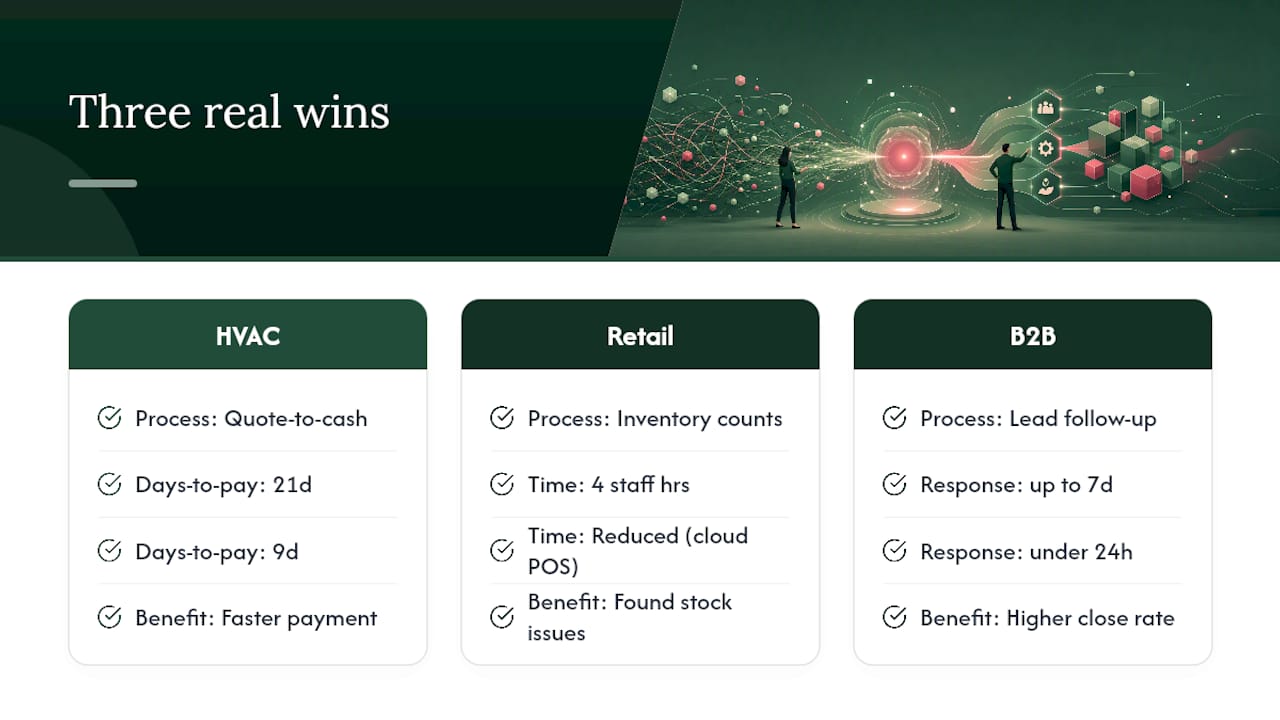
A retail shop ran inventory counts by hand every week, a task that ate four staff hours. Using a cloud point-of-sale system drastically reduced inventory time and uncovered unnoticed stock discrepancies
A B2B supplier lost leads because follow-up emails went out inconsistently, sometimes same-day, sometimes a week late. Automating lead follow-up brought response time under 24 hours and lifted close rate on new inquiries.
The lesson across all three: the win came from fixing one process end to end, not from adopting more tools at once.
How Connection-built Approaches a Small Business’s First 90 Days
Technology alone doesn’t transform a business if the brand message, customer story, and marketing systems behind it stay disconnected. Digital transformation benefits from integrating both branding and operations considerations, since improving operational cycles pays off when customer experience is consistent and clear.
An initial engagement typically includes:
- A discovery session mapping your current process flow and where messaging or workflow breaks down
- A written process map identifying the single highest-friction bottleneck
- A 90-day pilot plan targeting one measurable win, tied to a specific metric like days-to-payment or response time
Coming into a discovery call with a rough list of your current tools, your busiest process, and one metric you wish moved faster makes the first session far more productive.
An Editorial Take: What Actually Matters in the First 90 Days
Most owners overthink the software choice and underthink the sequencing. The businesses that get traction fastest pick one painful, high-volume process, fix it, and measure the result before touching anything else.
Realistically, expect four to six weeks before you see a number move, not days, and not a full year either. The contrarian tip: resist the urge to redesign your website, your CRM, and your invoicing all at once. Parallel projects dilute attention on small teams and stall out. Sequential wins compound. Scattered ones rarely finish.
— Chris
Ready to Turn a Roadmap Into a Working System?
You could try to run this roadmap solo with a stack of new subscriptions and a spreadsheet of good intentions, or you could hand the sequencing, the branding, and the execution to a team that’s already mapped this path for other small businesses. Some firms combine strategic branding and marketing work with process and people planning to help digital transformations stick, instead of stalling out after the first tool purchase.
An initial consultation typically starts by reviewing your current process map, customer messaging, and one key metric you want to improve. From there, the team builds a 90-day pilot plan around your highest-friction process, the same phased approach outlined above, but with someone else driving the sequencing. Explore Connection-built’s services for small businesses or browse real client outcomes to see what a first 90 days can look like, then get in touch to schedule your discovery session.
Sources
For deeper, sector-specific numbers, three reports anchor most of the research above: the U.S. Chamber’s small business technology impact report, the DBT/Ipsos SME technology adoption study, and the SBE Council technology use survey. Each covers a different angle, business performance, adoption barriers, and AI usage, so check the one closest to your sector before finalizing budget.
- The Impact of Technology on U.S. Small Business — U.S. Chamber report
- Understanding technology adoption among UK SMEs — DBT/Ipsos report
- SBE Technology Use Survey — SBE Council (2026)
- Digital Transformation for Small Business in 2026: The Practical Roadmap That Actually Works | Nexuron Insights
- Digital Transformation Roadmap for Small Businesses (2026 Guide) | Aviy
FAQ
What Are the 7 Pillars of Digital Transformation?
Frameworks vary by source, but most cover strategy, customer experience, data and analytics, technology infrastructure, process automation, culture and skills, and leadership alignment. For a small business, the practical version collapses to three: a single source of truth for data, one automated process, and a way to measure the result.
What Are the Four Types of Digital Transformation?
The commonly cited categories are process transformation, business model transformation, domain transformation, and cultural or organizational transformation. Most small businesses start with process transformation, redesigning how work flows, before touching the other three.
What Are the 5 Pillars of Digital Transformation?
A common five-pillar version includes customer experience, operational agility, culture and leadership, workforce enablement, and digital technology integration. Small businesses get the most immediate return from operational agility and technology integration, since those directly touch cash flow.
Which Companies Do Digital Transformation Well?
Rather than naming specific companies, the more useful benchmark for a small business is process, not brand: companies that succeed typically digitize one high-volume workflow completely before expanding, rather than adopting many tools shallowly.
How Long Does Small Business Digital Transformation Take?
A single-process pilot, like automating quote-to-cash, usually shows measurable results (days-to-payment or hours saved) within four to eight weeks. Full transformation across multiple processes typically unfolds over six to twelve months in phased sprints.
Recommended
Want to talk it through? Start a conversation. https://connection-built.com