
August 29, 2026
90 Day Onboarding Experience for SMBs That Builds Employer Brand

Employee onboarding is the structured journey from offer letter to full productivity, not a single orientation session. Orientation is a meeting; onboarding is a process that runs 90 days or longer. The single highest-impact move HR can make right now is naming one onboarding owner and standardizing that 90-day workflow instead of leaving it to whichever manager remembers to send a calendar invite.
TL;DR:
- Onboarding should be a structured process lasting at least 90 days, with clear ownership to prevent tasks from falling through gaps between departments.
- A well-designed sequence includes preboarding, onboarding check-ins at 30, 60, and 90 days, and ongoing engagement to reduce early attrition.
- Implementing a buddy system and early peer connections significantly improve belonging and retention over superficial perks or info dumps.
- Automated reminders, hybrid training methods, and AI chat assistants can enhance efficiency while maintaining personalized cultural context.
- Regular pulse surveys at 30, 60, and 90 days provide crucial early indicators for course corrections and improving overall onboarding effectiveness.
Table of Contents
- What Employee Onboarding Experience Actually Means
- Building the End-to-End Onboarding Process
- Preboarding and First-Day Checklist Items That Prevent Chaos
- Designing a 30-60-90 Role Ramp That Actually Ramps
- Why Peer Connection Drives Retention More Than Perks
- Where AI Fits in the New Hire Onboarding Process
- Measuring Onboarding Effectiveness Beyond Gut Feel
- Templates That Turn Good Intentions Into Consistent Execution
- Keeping New Hire Onboarding Compliant From Day One
- Onboarding Remote and Hybrid Employees Without Losing the Human Touch
- Training Delivery Methods That Actually Stick
- Connection-built’s Take: Onboarding Is Employer Brand in Action
- Get Onboarding Right With Connection-built
- Sources
What Employee Onboarding Experience Actually Means
Onboarding and orientation get treated as synonyms, and that mix-up quietly wrecks retention. Orientation is the paperwork day: badge photo, benefits enrollment, a tour of the break room. The employee onboarding experience is everything that happens from the moment someone signs an offer through the point they’re contributing at full capacity, often 90 days to six months later. SHRM frames it as a multi-month process built on preboarding, orientation, foundation building, mentoring, and continued learning, not a one-day event.
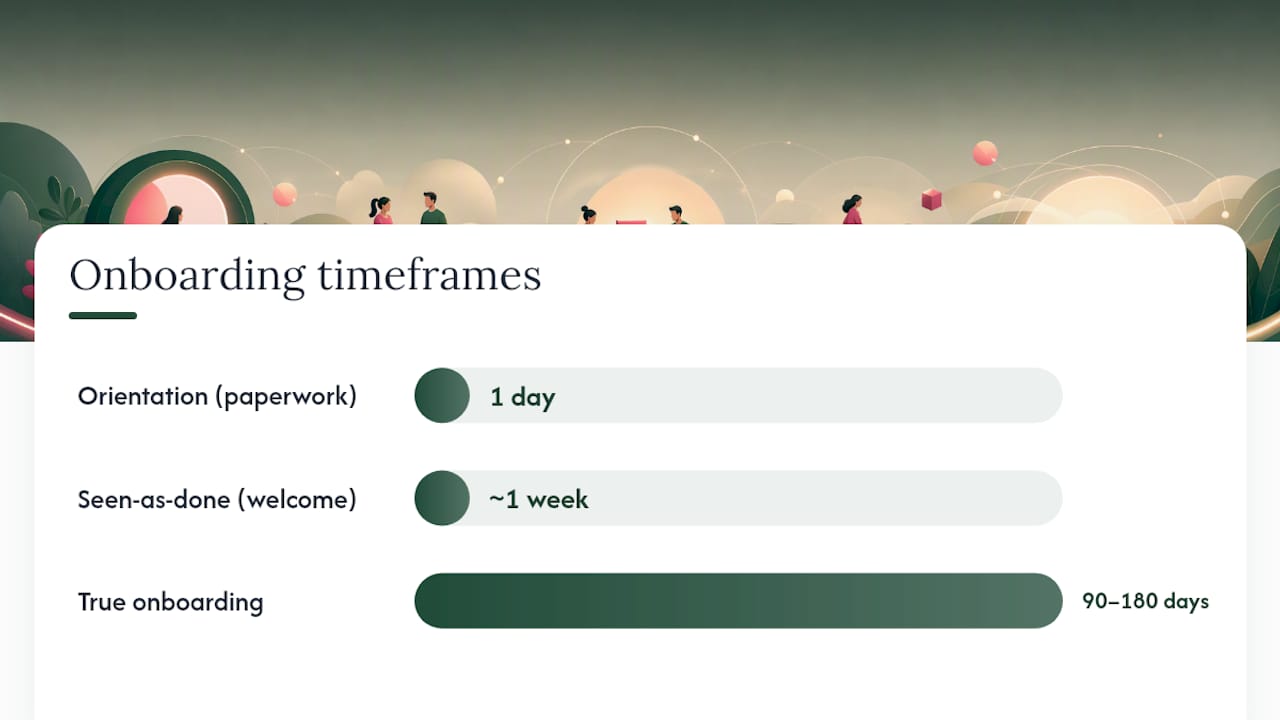
The stakes are higher than most HR teams assume. Enboarder’s 2024 State of Employee Onboarding Report found that a significant portion of new hires rated their onboarding as sub-par, and many said the entire experience wrapped up within a week of starting. That’s not onboarding. That’s a welcome packet. Meanwhile, McKinsey data cited by D2L shows less than half of new hires remain with their employer after six months in the groups they sampled, which puts the pre-offer to six-month window squarely in the danger zone for attrition.
Three misconceptions keep organizations stuck:
- Believing onboarding ends after week one, when engagement and role clarity typically take a full quarter to solidify
- Treating onboarding as an HR-only task, when hiring managers drive most of the day-to-day experience
- Assuming a good candidate experience automatically continues into a good onboarding experience, when the two are managed by entirely different teams with different incentives
Get the distinction right, and the rest of the process gets easier to design.
Building the End-to-End Onboarding Process
A workflow beats a checklist because it assigns ownership at every handoff. Moxo’s research on onboarding operations found that structured workflows with clear owners and automated reminders reduce the handoff failures that stall new hires, things like a laptop that never got ordered or system access that shows up on day 12 instead of day one.
Here’s the sequence that works across most organizations, regardless of size:
- Preboarding (offer to start date): IT provisions equipment and system access, HR sends paperwork and a welcome message, the hiring manager schedules a first-week 1:1.
- Day one: Orientation logistics happen alongside a warm welcome, not instead of one. Introduce the buddy, confirm the workstation is ready, and give the new hire one small, completable task.
- Week one: Role-specific training begins, expectations get documented in writing, and the manager checks in daily, even if briefly.
- 30 days: First formal check-in against the ramp plan, early feedback survey, adjustment of workload if needed.
- 60 days: Deeper role ownership, expanded responsibilities, second survey checkpoint.
- 90 days: Full performance conversation, transition from “new hire” to “team member,” final onboarding survey.
- Ongoing engagement: Quarterly check-ins through the first year to catch late-stage disengagement before it becomes a resignation.
Why does a single owner matter so much? Because onboarding touches IT, facilities, HR, and the hiring manager, and each of those teams optimizes for their own timeline. Without one person tracking the whole flow, tasks fall into the gaps between departments. That owner doesn’t have to do every task personally. They just have to know the status of every task and escalate when something stalls.
Preboarding and First-Day Checklist Items That Prevent Chaos
The gap between offer acceptance and start date is where most onboarding failures originate, and it’s almost entirely preventable with a checklist.
Preboarding, complete before day one:
- Send a welcome email confirming start date, time, location, and what to bring
- Order equipment and confirm system access will be active on day one
- Assign a peer buddy and introduce them by email before the start date
- Share a short “what to expect” document covering dress code, parking, and first-day agenda
- Loop in the team with an announcement so coworkers know a new person is arriving
First-day priorities:
- Have the workstation fully set up and tested before the new hire arrives
- Schedule a welcome lunch or coffee with the immediate team
- Give one small, achievable task that produces a visible result by end of day
- Confirm the manager, not HR alone, personally welcomes the new hire
Small gestures carry outsized weight here. A handwritten note at the desk, a team Slack channel already populated with introductions, a first assignment scoped to be finished in an afternoon. These aren’t fluff. Enboarder’s research links these early “wow” moments to measurably higher confidence and engagement scores in the following weeks.
Pro Tip: Test the new hire’s laptop and login credentials yourself two days before start date. IT tickets submitted the morning someone starts almost never resolve before lunch.
Designing a 30-60-90 Role Ramp That Actually Ramps
A 30-60-90 plan only works if the milestones are specific enough to measure, not vague enough to reinterpret. “Get comfortable with the role” is not a milestone. “Independently handle three client tickets without escalation” is.
Structure the plan like this:
- First 30 days: Learn. The new hire absorbs systems, processes, and team norms. Success looks like completing required training modules and shadowing key workflows, not producing finished output yet.
- Days 31 to 60: Contribute. The employee takes on real work with support, handles a defined slice of responsibilities independently, and starts participating in team meetings with actual input rather than just listening.
- Days 61 to 90: Own. Full ownership of the role’s core responsibilities, minimal oversight needed on routine tasks, and a formal performance conversation that sets goals for the next quarter.
Forbes HR Council contributors recommend pairing this structure with early mentor access and role-specific learning paths rather than generic company-wide training, since a sales rep and a software engineer need almost nothing in common from their first 90 days.
Manager check-ins should happen weekly for the first month, then biweekly through day 90. Keep the questions consistent so you can track sentiment over time:
- What’s one thing that’s going well this week?
- What’s one thing that’s confusing or unclear?
- Do you have what you need to do this job well?
- Is there anyone on the team you haven’t connected with yet?
Turn milestones into checkpoints by writing them down before day one, not improvising them at the 30-day mark. A manager who reviews the plan against reality every two weeks catches drift long before it turns into disengagement.
Why Peer Connection Drives Retention More Than Perks
The single most overlooked retention lever in onboarding isn’t software or swag. It’s a buddy assigned in week one. D2L’s onboarding research identifies structured peer buddy programs as consistently correlated with higher belonging and lower early attrition, and yet most organizations treat the buddy assignment as an afterthought instead of a designed program.
A buddy program works when it has actual structure:
- The buddy is a peer, not the manager, so the new hire has someone to ask “dumb questions” without worrying about performance optics
- The relationship has a defined duration, typically 90 days, with a clear handoff back to normal team dynamics afterward
- Buddies get light training on what to cover: unwritten norms, who to ask about what, where the good coffee is
- HR checks in with the buddy separately to catch issues the new hire might not raise directly
Beyond the one-on-one buddy relationship, culture transmits through shared experience. Team lunches in the first two weeks, a rotating “coffee chat” schedule with people outside the immediate team, and inclusion in one cross-functional meeting even before it’s strictly necessary all do more to build belonging than a slide deck about company values ever will.
Pro Tip: Ask your buddy program participants for feedback at day 30, not day 90. If the relationship isn’t working, you want time to reassign it.

Where AI Fits in the New Hire Onboarding Process
The right question isn’t whether to use AI in onboarding. It’s which tasks to automate and which ones still need a human. Microsoft’s design research on early-experience design lays out a useful principle: show value first, disclose complexity progressively, and deliver information tied to what the person is doing right now rather than everything at once.
Applied to onboarding, that means:
- Automate: reminders for paperwork deadlines, scheduling of recurring check-ins, FAQ-style policy questions (“How much PTO do I have?”), and routine system-access requests
- Personalize with AI: just-in-time answers delivered through a chat assistant when a new hire has a question at 9 p.m. the night before their first presentation, instead of making them wait for business hours
- Keep human: cultural context, manager feedback, and anything involving judgment calls about how the organization actually operates versus what the handbook says
The most effective setups pair a human buddy for cultural and judgment questions with an AI assistant for the repeatable policy and workflow questions, which cuts wait time without replacing the relationship-building that actually drives retention. Progressive disclosure matters just as much as automation. Dumping the entire employee handbook, every tool login, and a 40-slide culture deck on day one guarantees none of it sticks. Sequence information to match what the new hire actually needs that week.
Measuring Onboarding Effectiveness Beyond Gut Feel
You can’t improve what you don’t measure, and most organizations only measure onboarding through exit interviews, which arrive far too late to fix anything. The fix is a short cadence of pulse surveys layered with a few hard metrics.
D2L’s guidance recommends pulse surveys at 30, 60, and 90 days specifically because they function as early-warning indicators. A dip in the 30-day survey gives you 60 days to reassign a buddy, adjust workload, or clarify expectations before the person starts job hunting. Report these numbers monthly to leadership in a simple dashboard: satisfaction trend line, retention rate by cohort, and time-to-productivity by department. That combination catches problems while there’s still time to fix them.
Templates That Turn Good Intentions Into Consistent Execution
Good onboarding design fails without something repeatable behind it. A few short templates, used consistently, do more than a beautifully designed program that only gets followed the first time.
- Welcome email (sent 3 to 5 days before start): Confirms logistics, introduces the buddy by name, and includes one photo of the team so the new hire recognizes a face on day one.
- Buddy kickoff script: A five-question conversation starter covering “what surprised you most in your first month here” and “who should I definitely meet.”
- First-week 1:1 checklist: Manager confirms equipment works, reviews the 30-60-90 plan together, and asks what’s unclear before the new hire has to ask.
- 30-day survey: Three questions max. Longer surveys get abandoned or rushed.
The pattern across all of these: small, specific, and timed to land exactly when the new hire needs it. Scaling this across teams doesn’t require a massive platform. It requires a shared drive folder with the templates and a manager who’s expected to use them, tracked the same way any other management responsibility gets tracked.
Keeping New Hire Onboarding Compliant From Day One
Onboarding paperwork isn’t just administrative overhead. It’s where legal exposure concentrates if it’s rushed or skipped. Employment eligibility verification, tax withholding forms, and jurisdiction-specific new-hire reporting requirements all typically need to happen within the first few days of employment, and the exact deadlines and forms vary by country and, within countries like the United States, by state.
A few areas deserve deliberate attention rather than assumption:
- Classification accuracy. Confirm exempt versus non-exempt status and contractor versus employee classification before the offer goes out, not after onboarding starts. Misclassification discovered mid-onboarding creates far more work than getting it right up front.
- Required notices and postings. Many jurisdictions require new hires to receive specific written notices about wage rates, workplace rights, or safety policies within a set window after hire. Confirm what applies in your specific location and industry rather than relying on a generic template built for a different jurisdiction.
- Data privacy in onboarding systems. New hires hand over sensitive personal information during preboarding: bank details, tax identification, sometimes health information for benefits enrollment. Whatever onboarding platform or file system holds that data needs access controls that match its sensitivity.
- Documentation retention. Keep records of completed training, signed policy acknowledgments, and verification forms for as long as your jurisdiction requires, since these documents are often the first thing requested in a wrongful termination or discrimination claim.
None of this replaces qualified legal counsel for your specific jurisdiction and industry. Build compliance steps into the same 90-day workflow that handles culture and training, so they don’t become a separate, easily-forgotten checklist that only gets attention when something goes wrong.
Onboarding Remote and Hybrid Employees Without Losing the Human Touch
Remote onboarding fails in different ways than in-person onboarding. The paperwork usually gets handled fine. What breaks down is the informal, hallway-conversation layer that in-person new hires absorb without anyone designing it.
A few adjustments make the difference:
- Ship equipment early, and confirm it arrived. A remote new hire with a laptop stuck in transit on day one has nothing to do but sit on hold with IT.
- Over-communicate schedules. A hybrid or fully remote first week needs an explicit hour-by-hour agenda, because there’s no office layout to passively signal what happens next.
- Assign a remote-specific buddy check-in. Video calls, not just Slack messages, in the first two weeks. Text-based communication alone makes it far too easy for a remote hire to quietly disengage without anyone noticing.
- Build deliberate video facetime with leadership, even a 15-minute welcome call, since remote hires often go weeks without ever seeing a senior leader in person.
Practical guidance on onboarding distributed teams points to the same core issue: remote and international hires need more structure, not less, because the ambient cues that in-office employees pick up automatically simply don’t exist over a video connection. Hybrid employees sit in a trickier middle ground. They need the remote structure for the days they’re not in the office, plus a plan for making in-office days feel purposeful rather than random.
Training Delivery Methods That Actually Stick
The format of onboarding training matters almost as much as the content. A three-hour lecture on day one produces near-zero retention by day three, no matter how well-written the slides are.
Mix delivery methods based on what the content actually requires:
- Self-paced e-learning works well for policy and compliance material that doesn’t need real-time interaction, letting new hires move at their own speed.
- Live instructor-led sessions make sense for material that benefits from questions in the moment, like a walkthrough of a complex internal tool.
- Shadowing and hands-on practice teach role-specific skills far better than any slide deck, especially for customer-facing or technical roles.
- Microlearning modules, five to ten minutes each, delivered over the first few weeks rather than crammed into day one, match how adults actually retain new information.
The sequencing matters as much as the format. Front-load only what’s needed immediately, save the rest for when it becomes relevant. A new hire doesn’t need the full expense reporting policy on day one; they need it before their first business trip. Matching delivery timing to actual need, rather than administrative convenience, is what separates training that sticks from training that gets forgotten by Friday.
Connection-built’s Take: Onboarding Is Employer Brand in Action
Onboarding is where your employer brand either holds up or falls apart. Every promise made during recruiting, culture, growth, flexibility, gets tested in the first 90 days, and new hires notice the gap between pitch and reality faster than almost anyone else in the organization.
Most companies treat onboarding as an HR checklist and their employer value proposition as a marketing exercise, run by two teams that rarely talk to each other. That’s backwards. The onboarding experience is the first sustained proof point of whatever story you told in the interview, and it should be designed with the same intentionality as your brand messaging.
For small organizations without a dedicated HR function, the starting point doesn’t need to be complicated: one named owner, one written 90-day plan, one onboarding template used consistently. That’s the entire foundation, and everything else in this article builds on top of it.
— Chris
Get Onboarding Right With Connection-built
You’ve now got the framework. The harder part is building it into something your managers actually use every quarter, not just the first time HR rolls it out. That’s the gap Connection-built closes: instead of a generic template pulled from a blog post, we design onboarding systems tied directly to your actual employer brand, your actual roles, and your actual team’s capacity to execute.
For small businesses and nonprofits without a dedicated people-ops team, that means one clear system instead of a patchwork of half-finished spreadsheets and forgotten Slack channels. Connection-built builds the onboarding workflow alongside the people strategy and talent planning work that makes it stick, so the 90-day plan you launch in month one is still the plan managers are using in month twelve. If you’ve read this far because your current onboarding process feels more improvised than intentional, start a conversation with our team about what a designed onboarding system could look like for your organization.
Sources
For HR teams building out their own onboarding program, these sources go deeper on the data and frameworks referenced throughout this guide:
- 2024 State of Employee Onboarding Report
- Complete Employee Onboarding Guide – SHRM
- Designing the first five minutes – Microsoft Design
- 14 ways to create an onboarding experience employees want to stay for – Forbes
- Employee onboarding ultimate guide for 2026 – D2L
Recommended
Want to talk it through? Start a conversation. https://connection-built.com