
September 3, 2026
Assemble a Fractional Marketing Team for SMBs That Feels Embedded

A fractional marketing team is a part-time, senior-led group you retain to run specific marketing functions, from strategy to execution, without adding full-time payroll. It fits small and mid-sized businesses that need experienced marketers now, not after a six-month hiring cycle. The core trade-off is simple: you get faster access to senior talent and flexible scale, in exchange for less day-to-day ownership than a full-time hire provides.
TL;DR:
- A fractional marketing team provides senior expertise with a typical engagement span of three to six months, costing between $4,000 and $20,000 monthly depending on scope and roles.
- Success depends heavily on clear onboarding, documented goals, defined decision rights, and structured governance to prevent strategic drift and misalignment.
- Most SMBs start with one or two roles, such as a fractional CMO plus a specialist like paid media or SEO, focusing on immediate bottlenecks rather than multiple roles simultaneously.
- A well-structured 30 to 60 day onboarding process including access, research, and a few prioritized projects is critical for delivering meaningful results early in the engagement.
- The primary risks involve launching fractional support prematurely, without internal clarity, which hampers performance; a solid foundation of goals and metrics is essential before hiring.
Table of Contents
- What Is a Fractional Marketing Team, and How Do the Models Differ?
- What Should You Actually Expect Once the Team Starts Working?
- What Do SMBs Actually Gain, and Where Are the Trade-Offs?
- Which Fractional Roles Do SMBs Hire Most, and For How Long?
- When Does Fractional Marketing Support Make Sense, and When Doesn’t It?
- How Do You Actually Assemble and Budget a Fractional Marketing Team?
- How Do You Onboard a Fractional Team So It Feels Embedded, Not Outsourced?
- Fractional vs. In-House vs. Agency: What Actually Fits an SMB?
- How Connection Built Approaches Fractional Marketing Support
- How Do You Measure Whether a Fractional Marketing Team Is Working?
- What Goes Wrong With Fractional Marketing, and How Do You Prevent It?
- What Contract Terms Matter Most in a Fractional Marketing Agreement?
- For SMBs, the Real Risk Isn’t the Fractional Model. It’s Skipping the Groundwork.
- Ready to Build a Fractional Marketing Team That Actually Fits Your Business?
- Sources
What Is a Fractional Marketing Team, and How Do the Models Differ?
Not every fractional engagement looks the same. Some businesses hire a single specialist for one problem. Others bring in a coordinated group that functions closer to a full internal department.
Fractional arrangements generally split into three depths of engagement. Individual specialists handle a narrow task, such as paid media management or email campaigns, and typically split their time across two to four clients at once. Coordinated teams combine two or three specialists (say, a strategist plus a content lead) around a specific initiative, like a product launch or rebrand. Virtual marketing departments go further, acting as your entire marketing function, covering strategy, content, paid channels, analytics, and reporting under one retainer.
The right choice depends on what’s missing internally, not on what sounds most impressive.
- Specialist model: best when you have marketing direction already and need execution horsepower in one channel.
- Coordinated team model: best for a defined initiative with a start and end date, like a website relaunch or a seasonal campaign.
- Virtual department model: best when marketing has no internal leadership at all and needs someone setting strategy, not just running tasks.
Responsibility splits vary by model. With a specialist, your internal team still owns strategy and approvals. With a virtual department, the fractional group often owns strategy too, reporting to a single internal point of contact (usually the owner or a general manager) rather than a marketing director who doesn’t yet exist.
What Should You Actually Expect Once the Team Starts Working?
Fractional does not mean slow, but it does mean structured. Knowing the shape of the engagement before you sign anything prevents the most common frustration: expecting agency-speed results on day one.
- Access, not headcount. You get senior-level thinking (the kind you’d pay six figures for in a full-time hire) shared across a roster of clients, priced through a monthly retainer or hourly block rather than a salary.
- A short runway before real output. Most fractional and virtual teams estimate a few weeks to reach basic productivity, with meaningful results showing up after the team has run at least one full campaign cycle.
- Regular, structured reporting. Expect a recurring cadence, usually weekly check-ins and a monthly performance review, with dashboards covering the metrics tied to your goals rather than vanity numbers.
Pro Tip: Ask any fractional provider for a sample 30 day report before signing. If they can’t show you one, they probably don’t have a repeatable reporting process yet, and you’ll be the one building it for them.
Deliverables typically include a written strategy document, a content or campaign calendar, channel-specific execution, and a monthly results summary. That’s the baseline. Anything less should raise questions.
What Do SMBs Actually Gain, and Where Are the Trade-Offs?
The financial case is the easiest one to make. A full-time CMO commands a salary well into six figures once you factor in benefits and overhead, and executive compensation benchmarking tools show senior marketing leadership costs scale fast, even before bonuses. A fractional CMO delivers similar strategic input at a significantly lower annual cost, scoped to the hours you actually need.
Cost isn’t the only advantage.
- Faster access to senior thinking. You’re not training a junior hire into strategic competence over 18 months; you’re hiring someone who’s already done it elsewhere.
- Specialized execution on demand. Need advanced SEO work for one quarter? Add the specialist for one quarter. No severance, no awkward performance conversation.
- Room to test before committing. You can trial a new channel or a new positioning angle with fractional support before deciding whether it earns a permanent internal role.
- Built-in creative discipline. Senior fractional marketers tend to bring tested creative and audience-insight frameworks rather than reinventing the wheel on your budget.
Global spending on digital advertising and marketing keeps climbing, according to industry market research, which raises the cost of guessing wrong on channel strategy. That’s exactly the kind of judgment call a fractional senior marketer is hired to make well.
The trade-offs are real, too. A fractional hire splits attention across other clients, so you won’t get the same instant availability as an employee at the next desk. Institutional memory builds more slowly when someone isn’t in your Slack all day. The fix is straightforward: define decision rights early, document your brand and audience knowledge instead of relying on someone absorbing it by osmosis, and treat the relationship as a structured partnership, not an on-call favor.
Which Fractional Roles Do SMBs Hire Most, and For How Long?
Most fractional engagements start with one or two roles, not a full roster. Knowing the standard roles and rough time bands helps you scope a realistic budget before talking to anyone.
- Fractional CMO or marketing director: sets strategy, owns the annual plan, and coordinates specialists. Usually engaged 8 to 20 hours a month.
- Paid media specialist: manages ad spend and channel optimization across platforms. Commonly scoped by ad budget size plus a monthly management fee.
- SEO specialist: handles technical fixes, content optimization, and search visibility tracking. Often billed as a flat monthly retainer for ongoing work.
- Content lead or writer: produces blog posts, email campaigns, and website copy on a set cadence. Frequently scoped by deliverable count per month.
- Analytics or reporting specialist: builds dashboards and interprets performance data. Often bundled into a CMO or virtual department retainer rather than hired separately.
Published market benchmarks from fractional providers put senior retained roles in a range of roughly $4,000 to $20,000 per month, depending on scope, hours, and seniority. That’s a wide band, and where you land inside it depends entirely on how many roles you combine and how many hours each one requires.
The most common combination for a growing SMB is a fractional CMO plus one execution specialist, usually paid media or SEO depending on which channel drives the most revenue. That pairing covers direction and output without stacking five specialists you don’t yet have the workflow to manage.
When Does Fractional Marketing Support Make Sense, and When Doesn’t It?
Fractional support fits best when you have real revenue pressure but no internal marketing leadership yet, or when a full-time hire would sit idle half the time. It fits worse when marketing needs are unpredictable and constant, or when your business depends on someone deeply embedded in daily operations.
Signals that favor fractional:
- You need senior strategic input but can’t justify (or fund) a six-figure full-time salary yet.
- Your marketing needs are seasonal, campaign-based, or tied to a specific launch.
- You already have some internal marketing capacity and need a gap filled, not a whole department built.
Signals that favor an in-house hire instead:
- Marketing has become a daily, always-on function that needs someone physically present for constant collaboration.
- You have the budget and pipeline to justify a full-time salary with room to grow the role.
Before hiring fractional, run this short readiness check: Do you have documented past marketing results to build on? Is your ideal customer profile written down and agreed upon internally? Do you have (or can you quickly build) a measurement plan tied to revenue, not just clicks? If you answered no to any of these, expect the first month of a fractional engagement to focus on building that foundation first.
How Do You Actually Assemble and Budget a Fractional Marketing Team?
Hiring fractional works best as a sequence, not a scramble. Skipping steps is the single biggest reason engagements underperform.
- Clarify your goals and the metrics that define success. Revenue target, lead volume, brand awareness lift. Pick one primary metric before you talk to anyone.
- Inventory what you already have internally. List every marketing task currently being done, by whom, and how well. The gaps left over are what fractional should fill.
- Prioritize roles against those gaps. Resist hiring five specialists at once. Start with the one or two roles that address your biggest bottleneck.
- Agree on time commitments up front. Get specific hours or deliverable counts per month in writing, not vague language like “ongoing support.”
- Set your budget shape. Retainer for predictable, recurring work; hourly for narrow, occasional tasks; project-based for one-off initiatives like a rebrand or website launch.
- Lock down contract essentials. A scope of work, a defined retainer structure, and a clear exit clause protect both sides if the fit isn’t right.
Pro Tip: Budget for a 90-day minimum before judging results. Marketing campaigns need at least one full cycle to generate data worth acting on, and virtual team providers commonly build a three-month minimum into their standard engagements for exactly this reason.
If you’re weighing where fractional marketing spend fits against other business investment priorities, a resource like Capital For Business’s guide on competitive spending can help frame the decision alongside other growth expenses.
How Do You Onboard a Fractional Team So It Feels Embedded, Not Outsourced?
The difference between a fractional team that delivers generic work and one that delivers results tied to your business almost always comes down to onboarding. A rushed setup produces a rushed strategy.
A solid 30 to 60 day onboarding checklist covers:
- Shared access to analytics, CRM, ad accounts, and content management systems from day one.
- A documented brand voice guide, past campaign results, and customer research handed over up front.
- An initial slate of two or three prioritized, measurable projects rather than a vague “get started” mandate.
- A defined decision-maker on your side who can approve work without a five-person committee.
Governance rhythm matters just as much as the initial setup. Weekly or biweekly check-ins keep priorities aligned, a shared dashboard keeps everyone looking at the same numbers, and a clear escalation path (who decides what, and how fast) prevents small disagreements from stalling campaigns.
Pro Tip: Treat your fractional team like a department, not a vendor. Invite them to internal planning conversations they’re relevant to. Teams that feel embedded ask better strategic questions than teams that only receive instructions.
Fractional vs. In-House vs. Agency: What Actually Fits an SMB?
Each model wins on different axes, and no single one wins on all of them.
| Factor | Fractional Team | In-House Hire | Traditional Agency |
|---|---|---|---|
| Cost | Lower than full-time senior salary | Highest fixed cost | Often higher retainer, less flexible |
| Speed to start | Weeks | Months (recruiting cycle) | Weeks to months |
| Seniority access | High | Depends on hire | Variable, often junior execution |
| Business knowledge depth | Builds over time with onboarding | Deepest, embedded daily | Shallower, split across clients |
| Scaling path | Easy to add or remove roles | Slower, requires new hires | Contract renegotiation |
A hybrid model often works best as a business matures: fractional strategic leadership paired with one internal marketing coordinator who owns day-to-day execution and knowledge continuity. Early-stage businesses typically start pure fractional. Growing businesses often shift toward hybrid. Mature businesses with predictable, high-volume marketing needs tend to eventually bring roles in-house, using the fractional period as training wheels and knowledge-transfer runway rather than a permanent arrangement.
How Connection Built Approaches Fractional Marketing Support
Fractional engagements should be built around alignment first: clarifying what a business actually stands for before assigning tactics to execute. That sequencing matters. Marketing built on an unclear message just accelerates confusion.
The approach draws on work across for-profit small businesses and non-profit organizations, each with different budget realities and different definitions of success. Onboarding can follow a structured alignment process: understanding the business’s actual goals, auditing what’s already working, and building a prioritized plan before initial campaigns launch. Results from that approach are documented in Connection Built’s success stories.
How Do You Measure Whether a Fractional Marketing Team Is Working?
ROI on a fractional engagement should be judged against the metric you defined before hiring, not against activity levels. A fractional team that publishes constantly but never moves your revenue metric isn’t performing, no matter how busy the reporting looks.
Start with a baseline. Before the engagement begins, document where you stand: traffic, lead volume, conversion rate, customer acquisition cost, whatever ties most directly to revenue. Without a baseline, every report afterward is just a number with no context.
From there, track three layers of performance. Leading indicators (traffic, engagement, ad click-through rates) show whether activity is happening. Mid-funnel indicators (lead volume, cost per lead, email list growth) show whether that activity is converting interest. Lagging indicators (revenue, customer acquisition cost, retention) show whether it’s actually paying off. Most SMBs make the mistake of judging fractional performance only on leading indicators because they’re the first numbers available. Give the engagement a full cycle, typically 90 days, before drawing conclusions from lagging indicators.
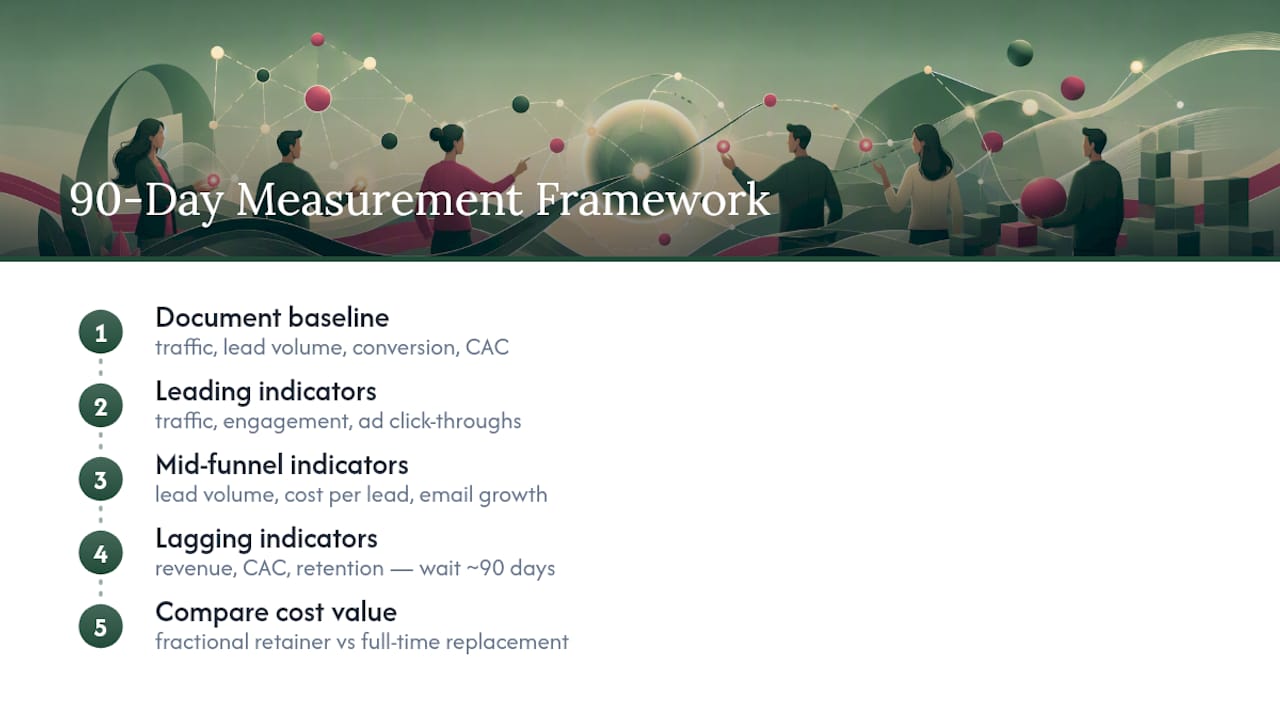
Compare cost against replacement value, too. If a fractional retainer runs a fraction of a full-time senior salary and produces comparable strategic output, that’s the return worth tracking, not just campaign-level metrics in isolation.
What Goes Wrong With Fractional Marketing, and How Do You Prevent It?
The most common failure mode isn’t skill. It’s misalignment. A fractional team executing against the wrong priorities, or without a clear decision-maker on your side, produces polished work that doesn’t move the business forward.
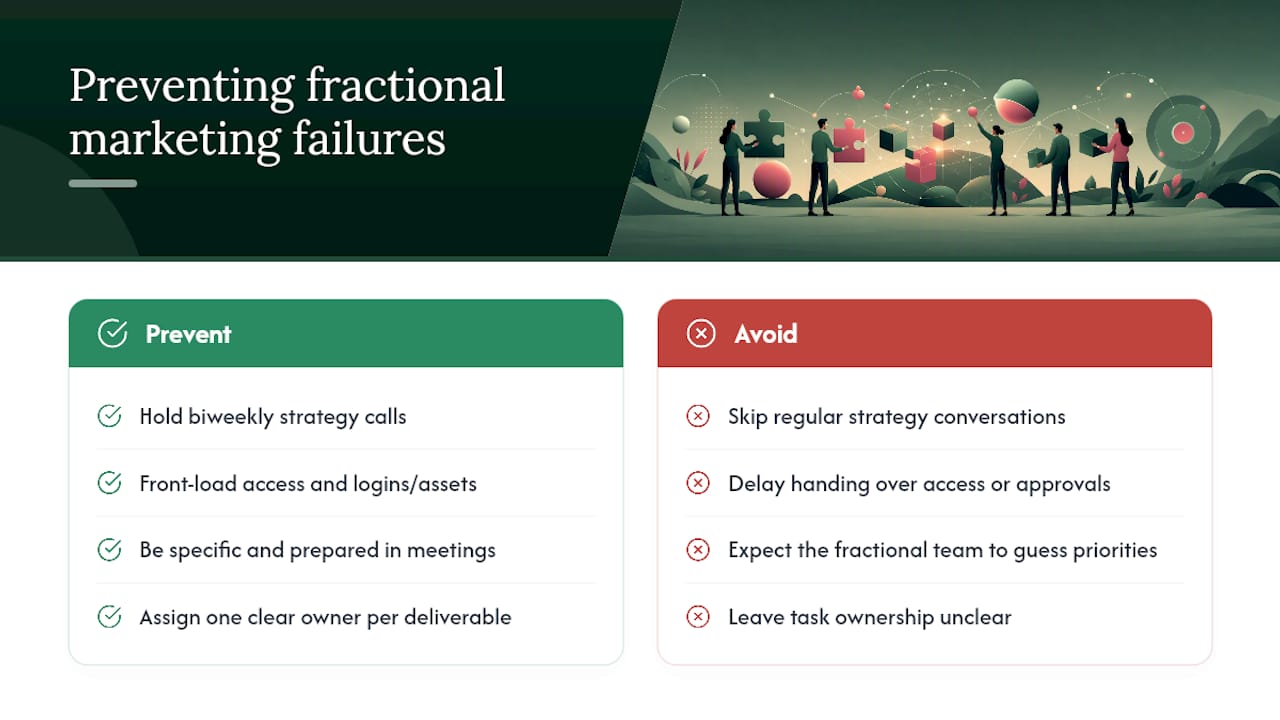
Strategic drift happens when nobody holds a regular strategy conversation, and the fractional team defaults to generic best practices instead of your specific goals. The fix is a standing biweekly strategy call, not just a status update.
Access bottlenecks slow everything down when a fractional team is waiting on logins, approvals, or brand assets that should have been handed over during onboarding. Front load access requests before day one, not during week three.
Attention splitting is real. Specialists serve multiple clients, and yours won’t always be the loudest voice in the room. Combat it by being specific and prepared in every meeting, rather than expecting the fractional team to guess your priorities.
Unclear ownership causes the most friction. When it’s unclear whether the fractional team or an internal employee owns a task, work either duplicates or falls through entirely. Assign one clear owner per deliverable, documented in writing, from the first week.
None of these are inherent flaws in the fractional model. They’re onboarding and governance gaps, and every one of them is preventable with the checklist covered earlier.
What Contract Terms Matter Most in a Fractional Marketing Agreement?
A fractional marketing contract should protect both the speed you’re hiring for and your ability to exit cleanly if the fit isn’t right.
Start with a clear scope of work that defines deliverables, not just hours. “20 hours a month of marketing support” invites disputes; “one strategy document, four blog posts, and weekly ad optimization” doesn’t. Pin down the retainer structure, including what happens if scope changes mid-engagement, since scope creep is the fastest way a fixed retainer starts feeling unfair to either side.
Intellectual property terms deserve specific attention. Confirm in writing that campaign assets, brand messaging, and strategy documents belong to your business, not the fractional provider, once paid for. Confidentiality clauses matter more with fractional teams than most business owners assume, since these providers often work with competing businesses in the same market.
Finally, negotiate an exit clause with a defined notice period, typically 30 days, so you’re never locked into an underperforming relationship indefinitely, and never left scrambling if a specialist needs to leave suddenly. A fractional agreement without a clean exit path defeats the flexibility that made fractional attractive in the first place.
For SMBs, the Real Risk Isn’t the Fractional Model. It’s Skipping the Groundwork.
Most of the skepticism around fractional marketing teams misses the actual failure point. The model itself works. What breaks engagements is businesses hiring fractional support before they’ve done the internal thinking a fractional team needs to succeed: no documented goals, no clarity on the ideal customer, no baseline metrics to measure against.
Conventional advice treats fractional hiring like a staffing decision. It’s closer to a partnership decision, and it deserves the same diligence you’d apply to bringing on a co-founder in a narrow domain. The businesses that get the most value aren’t the ones that hire the flashiest fractional CMO. They’re the ones that show up with a clear goal, a documented history, and one internal person empowered to make fast decisions.
If you take one thing from this: don’t hire fractional support to figure out your strategy from scratch. Hire it once you know roughly where you’re headed and need senior hands to help you get there faster. That distinction determines whether the engagement pays for itself in the first quarter, or spends three months rebuilding a foundation you could have documented yourself in a week.
— Chris
Ready to Build a Fractional Marketing Team That Actually Fits Your Business?
Fractional marketing providers often work as embedded partners, rather than a rotating cast of freelancers, to provide small businesses with senior marketing direction without the overhead of a full executive hire. One advantage over piecing together specialists independently is having coordination through a single team handling brand messaging, web development, SEO, and growth strategy under one aligned plan, rather than managing multiple vendors.
That alignment work starts with understanding what your business actually stands for before a single campaign launches, which is why Connection Built’s services span strategy, web, and people planning rather than just ad management. Small businesses can explore the for-profit marketing page to see how engagements are typically scoped, and nonprofit leaders can review the non-profit marketing services built around mission-driven budgets. If you want to see what results have looked like for other businesses first, the success stories page is worth a look. When ready to discuss specifics, booking a discovery call through provider marketing pages with current goals is recommended. That’s the fastest path to a scoped, realistic plan.
Sources
- What Makes Some Ads So Powerful | Harvard Business Review
- Digital Advertising and Marketing Global report | Research and Markets
- Salary
- Fractional Marketing: What It Costs & How to Hire (2026) | Go Fractional
- Virtual Teams For SMEs | ZOPPLY
Recommended
Want to talk it through? Start a conversation. https://connection-built.com