September 6, 2026
Build Pipeline on LinkedIn: Five Step Content Strategy for SMBs

Post 3 to 4 times a week around a tight set of topics, favor story or framework formats over generic tips, and show up hard in the first hour after publishing. That combination consistently outperforms random posting. Everything else follows a five-step playbook: set goals, define your audience, pick pillars, build a calendar, and measure what actually ties back to revenue.
TL;DR:
- Posting three to four times weekly around specific topics and showing up early after publishing improves engagement and reach more than irregular activity.
- Aligning content pillars and formats with audience personas helps produce relevant interactions that drive leads, meetings, and qualified connection requests.
- Engaging actively in the first 60 to 90 minutes after posting, including commenting and replying to comments, significantly boosts content visibility.
- Focusing on outcome KPIs like inbound DMs, booked meetings, and qualified requests provides clearer insight into content’s contribution to revenue than basic vanity metrics.
- Avoiding engagement bait, off-topic posts, and links in post bodies prevents reach suppression, while a disciplined batching and scheduling process sustains consistent growth.
Table of Contents
- Why Your LinkedIn Content Strategy Matters More in 2026
- The Five-Step LinkedIn Content Strategy Framework
- Choosing the Right Format for Each Type of Post
- Writing Posts That Actually Get Read
- When to Post: A Data-Backed LinkedIn Posting Strategy
- Why the First 60 to 90 Minutes Decide Your Reach
- Measuring What Matters: KPIs That Tie Back to Revenue
- Mistakes That Quietly Kill Your LinkedIn Reach
- How Connection-Built Puts This LinkedIn Playbook Into Practice
- A Practical Way to Get This Running Without Doing It Alone
- A Short Note From Chris
- Sources
Why Your LinkedIn Content Strategy Matters More in 2026
LinkedIn isn’t rewarding raw activity anymore. The platform’s prediction engine now builds a topic and behavior profile for every account, and it rewards consistency in format and subject matter while penalizing erratic shifts between unrelated topics, according to Taplio’s 2026 algorithm analysis. Post about sales leadership on Monday and your kid’s soccer game on Tuesday, and the algorithm struggles to know who to show you to. Clarity in what you post about becomes clarity in who sees it.
That shift changes what “success” looks like. A post that gets 40 likes from people who will never buy from you is a worse outcome than a post that gets 12 comments from prospects, even though the second post looks smaller on paper. The 2026 algorithm weighs engagement quality, profile-content alignment, and how fast a post gathers real reactions in its first 60 to 90 minutes. Reach follows relevance now, not volume.
For a business building a LinkedIn content marketing engine, that means picking outcomes before picking topics. The metrics worth tracking include:
- Inbound DMs from people who weren’t already in your network
- Qualified connection requests from your actual buyer persona, not random recruiters
- Meetings booked that trace back to a specific post or comment thread
- Saves and substantive comments, which signal a post is worth returning to
Likes and impressions still show up in your analytics dashboard, and they still feel good. They just don’t predict whether anyone is going to buy from you. A post that reaches 20,000 people but generates zero replies is not a strategy failure by accident. It’s usually a sign the content skipped straight to broad appeal instead of specific value for a specific reader. Effective LinkedIn posting in 2026 means accepting smaller, sharper numbers in exchange for the kind of engagement that actually moves a deal forward.
The Five-Step LinkedIn Content Strategy Framework
Nearly every credible playbook on content marketing for LinkedIn converges on the same sequence: goals, audience, pillars, calendar, measurement, according to Sprout Social’s framework. The order matters. Skip the goal-setting step and you’ll spend months producing content that looks good but proves nothing.
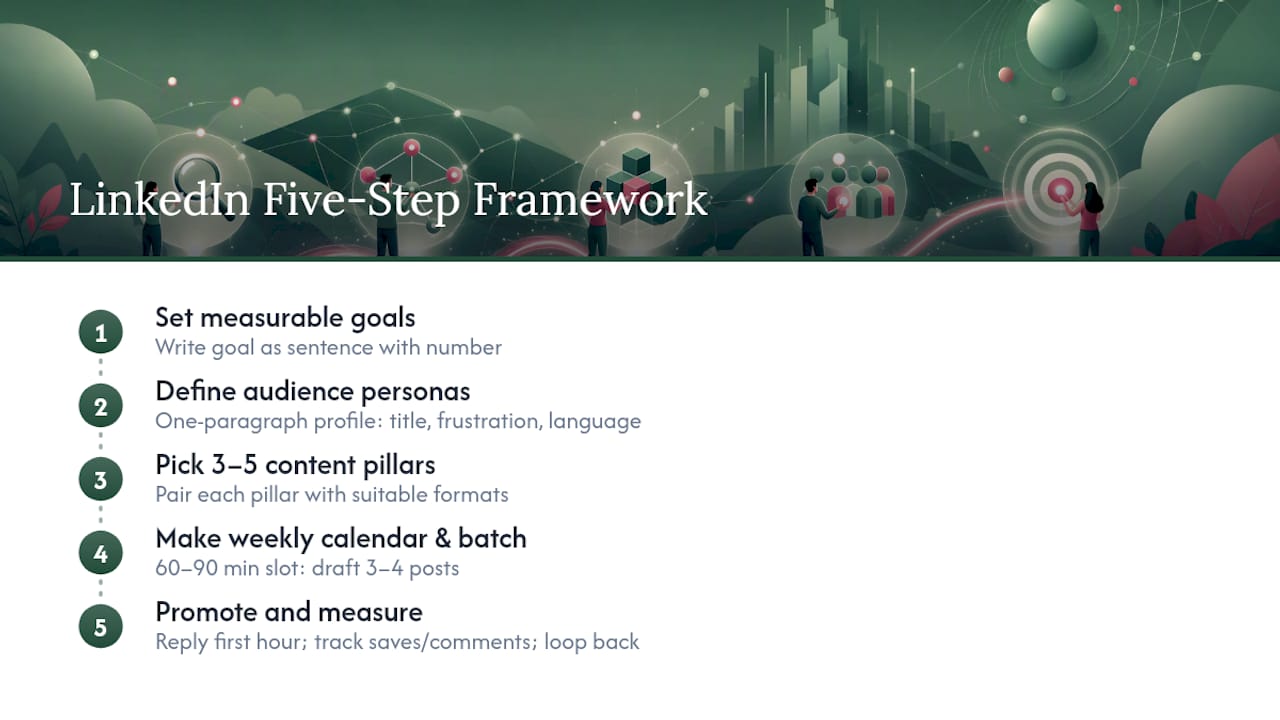
1. Set goals you can actually measure. Decide upfront whether you’re building authority, generating leads, hiring talent, or some mix of the three. Each goal points to different outcome metrics. Lead generation lives or dies by inbound DMs and meetings booked. Authority-building shows up in saves, shares, and unsolicited mentions from people in your industry. Write the goal down as a sentence with a number attached, like “Generate 8 qualified sales conversations per month from LinkedIn by Q3.” Vague goals produce vague content.
2. Build audience personas and align your profile to them. Before you write a single post, know who you’re writing for. Most B2B accounts serve two or three buyer types at most, not a general “professional audience.” Write a one-paragraph profile for each: their job title, their biggest frustration, and the language they use to describe their problem. Then check your LinkedIn profile itself. Your headline, banner, and About section should speak directly to those personas, because a strong post with a mismatched profile still loses the click. This is the step most people skip, and it’s why a lot of otherwise decent content underperforms.
3. Choose 3 to 5 content pillars and a format mix. Pillars are the recurring topics that define your account, things like “hiring lessons,” “pricing strategy,” or “client onboarding mistakes.” Pick enough to avoid repetition but few enough that the algorithm can categorize you cleanly. Pair each pillar with formats that fit it: a hiring story works as a narrative post, a pricing framework works as a document carousel, a quick opinion works as plain text.
4. Build a weekly calendar and a batching rule. Block one time slot each week, ideally 60 to 90 minutes, to draft three or four posts at once instead of writing under deadline pressure daily. Batching protects quality and consistency, both of which the algorithm tracks over time. A structured content calendar also makes it easier to spot when you’re leaning too hard on one pillar and neglecting another.
5. Run the promotion and measurement loop. Publishing is the midpoint, not the finish line. Spend the first hour after a post goes live replying to every comment and engaging with a handful of peer posts before and after. Keep external links out of the post body; put them in the first comment instead, since link-in-body posts see reduced distribution. Then close the loop weekly by reviewing which posts drove saves, comments, and DMs, and feed that back into next week’s pillar mix.
Pro Tip: Batch your comment replies the same way you batch your writing. Set two 15-minute blocks a day to respond across all active posts instead of checking notifications all day. You’ll reply faster in the critical first hour and stop the constant app-checking that eats your actual work time.
Choosing the Right Format for Each Type of Post
Not every idea deserves the same format, and matching format to intent is one of the fastest ways to improve performance without changing your topics at all.
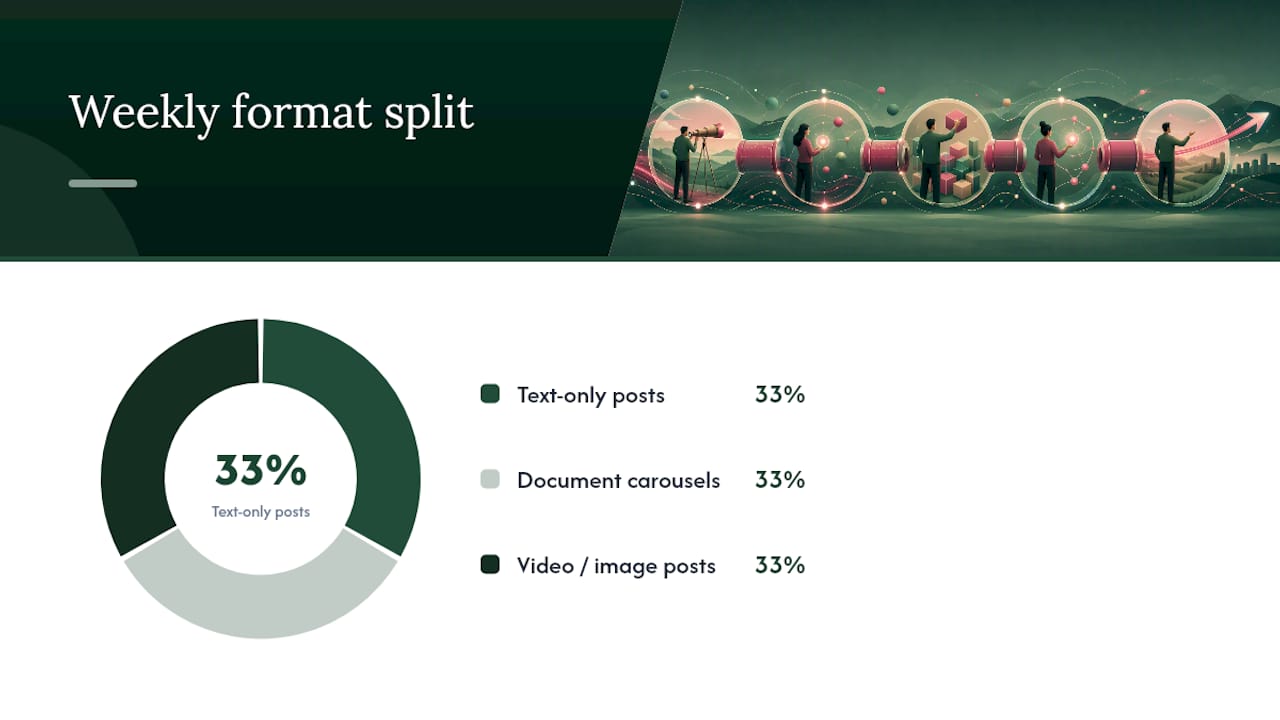
Text-only posts work best for opinions, quick lessons, and personal stories. They take the least time to produce and read fastest on mobile, which makes them a good default for maintaining cadence when you’re short on time. They tend to underperform, though, when the idea needed a visual to land, like a process with five distinct steps.
Document carousels (LinkedIn’s swipeable PDF posts) are the strongest format for tutorials, frameworks, and anything with a clear sequence. They demand more production time, often an hour or two per carousel, but they generate outsized saves because readers treat them as reference material they’ll come back to. If your goal is building a library of saved content people return to, carousels are worth the investment.
Native video earns attention differently. It’s the best format for demos, behind-the-scenes moments, and anything where seeing your face or your product builds trust faster than reading about it would. Video takes real production time and rarely produces the same save rate as a document, but it builds a different kind of familiarity that text can’t.
Images and simple graphics sit in the middle: quick to produce, useful for quotes, single stats, or before-and-after visuals, but rarely as save-worthy as a full carousel.
Polls are the fastest to build and genuinely useful for audience research, though they rarely drive meetings booked on their own. Treat them as a listening tool, not a lead-generation engine.
A sample weekly rotation that balances variety against topical consistency might look like this:
- Monday: Text post, opinion or lesson tied to pillar one
- Wednesday: Document carousel, a framework or step-by-step from pillar two
- Thursday or Friday: Video or image post, demo or personality-driven content from pillar three
That rotation keeps your topics recognizable to the algorithm while giving readers enough variety that the feed doesn’t feel repetitive.
Writing Posts That Actually Get Read
The first one to three lines of your post are the entire game on mobile, since that’s all LinkedIn shows before the “see more” cutoff. Aim for a hook between roughly 140 and 210 characters that either states a specific claim, poses a real question, or opens mid-story. “I made a mistake that cost us a client” beats “Here are 5 tips for client retention” nearly every time, because the first one creates a question the reader wants answered.
Two structures do most of the heavy lifting in effective LinkedIn posting:
- Story → Lesson: open with a specific moment (a client call, a hiring mistake, a number that surprised you), then pull out the one lesson a reader can apply immediately.
- Framework or list: state the problem in one line, then walk through a numbered or bulleted method, closing with the outcome the method produces.
A study of 895 LinkedIn posts found that specificity, concrete numbers, named tools, exact dollar figures, and emotional pull were the strongest predictors of a post beating its author’s own baseline. The same research found posts under roughly 400 characters consistently underperformed, meaning the instinct to keep everything short can work against you when the topic deserves more room.
Formatting mechanics matter almost as much as the words themselves:
- Keep paragraphs to one or two sentences; LinkedIn’s feed rewards white space over dense blocks.
- Use line breaks generously, but don’t force artificial breaks mid-thought just for rhythm.
- Limit emojis to a handful used with purpose, not as bullet substitutes.
- Use 3 to 5 hashtags, placed at the end, not scattered through the body.
- Put any external link in the first comment rather than the post itself, since posts with links embedded in the body see measurably reduced reach.
Close with a call to action that invites a real answer, not a hollow prompt. “Agree or disagree?” gets a thumbs-up. “What’s the one metric you stopped tracking because it wasn’t telling you anything?” gets a paragraph back, and paragraph-length comments are exactly what the algorithm treats as a strong signal.
Pro Tip: Write your hook last. Draft the full post first, then go back and pull the single sharpest line from the body up to the top. The best hooks are almost never the sentence you started with.
When to Post: A Data-Backed LinkedIn Posting Strategy
Posting several times a week is the cadence that holds up across most professional accounts, and it beats both extremes. Posting once a week rarely gives the algorithm enough signal to build a reliable topic profile. Posting daily often burns out the account owner and dilutes quality, which shows up fast in declining engagement per post.
Timing backs up the case for a mid-week rhythm. Buffer’s 2026 analysis of 4.8 million LinkedIn posts found that Wednesday through Friday, especially in the late afternoon to evening window between roughly 3 p.m. and 8 p.m., produced the strongest engagement, with Wednesday at 4 p.m. standing out as one of the single best slots measured. That timing lines up with how people actually use LinkedIn: fewer people are checking the feed during a Monday morning inbox crunch, but plenty are scrolling as the workday winds down.
Treat that data as a starting point, not gospel for your account. Every audience skews slightly differently depending on industry, time zone, and seniority level. Post at your best-guess times for four to six weeks, then check your own analytics for which specific days and hours produced the highest comment-to-impression ratio. Adjust from there.
A batching workflow makes the whole cadence sustainable:
- Block one weekly session to write three or four posts at once, using your content pillars as the source list.
- Schedule them through LinkedIn’s native scheduler or a third-party tool so publishing doesn’t depend on remembering at the right hour.
- Leave one slot flexible each week for a timely reaction post, something tied to news in your industry, since those often outperform planned content because they feel current.
- Review the week’s results before your next batching session, so lessons from last week shape next week’s topics instead of getting lost.
Consistency compounds here in a way that’s easy to underestimate. An account that posts reliably three times a week for three months builds a recognizable topic profile the algorithm can act on. An account that posts in bursts, heavy one month and silent the next, keeps resetting that signal.
Why the First 60 to 90 Minutes Decide Your Reach
Engagement velocity in the window right after you hit publish carries outsized weight in how far a post travels, according to Neal Schaffer’s 2026 guide to LinkedIn posting. The platform uses that early window to decide whether to keep showing your post to more people or let it fade. That makes the first hour the highest-leverage stretch of your entire posting routine.
Here’s a practical sequence for that window:
- In the 15 minutes before you publish, spend a few minutes commenting thoughtfully on two or three posts from people in your target audience or industry. This warms up your own visibility and puts you in front of people right before you post.
- Publish at your planned time, ideally one of the mid-week afternoon windows your own data supports.
- Reply to every comment within the first 30 minutes, and do it with substance, not a thumbs-up emoji. A reply that adds a new detail or asks a follow-up question keeps the comment thread alive, and active threads are exactly what signals engagement quality to the algorithm.
- Tag or mention someone directly relevant if the post touches their work, but only when it’s genuinely relevant, not as a growth hack.
- Check back at the 60 and 90 minute marks to catch any late comments before momentum fades.
Comments and saves outweigh reactions because they require actual effort from the reader. A Mylance study on post performance backs this up: the posts that beat a creator’s own baseline weren’t the ones with the most likes, they were the ones with concrete, specific content that gave readers a reason to comment or save for later. Design your post to invite that kind of response, a genuine question, a checklist worth bookmarking, an opinion that has a natural counterpoint, and the first-hour numbers tend to follow.
One caution worth repeating: coordinated engagement schemes, sometimes called engagement pods, are largely a dead end now. LinkedIn’s systems detect the coordinated pattern and suppress it rather than reward it, so the only approach that scales is real interaction with real people who care about your topic.
Measuring What Matters: KPIs That Tie Back to Revenue
Your weekly report should answer one question: is this content producing business outcomes, or just activity? Split your tracking into two tiers.
Outcome KPIs are the numbers that justify the time investment:
- Inbound DMs from people outside your existing network
- Qualified connection requests, meaning people who match your buyer persona
- Meetings booked that trace back to a specific post
- Leads or opportunities sourced directly from a comment thread or DM conversation
Treat these as your real signal, but expect them to move slower than on-platform metrics. A single post rarely produces a meeting the same day. Track outcome KPIs on a monthly view, not a daily one.
Leading indicators move faster and tell you whether a given post is working before the outcome numbers catch up:
- Saves per post, since saves indicate reference-worthy content
- Comment depth, meaning the average length and substance of replies, not just count
- Shares, which extend reach beyond your own network
- Profile visits generated by a specific post
A simple weekly tracker needs only a handful of fields: post date, pillar, format, comment count, save count, DMs generated, and one line of interpretation. That last field matters more than it sounds. After a few weeks, patterns emerge, maybe carousels in your “pricing strategy” pillar consistently outsave everything else, or maybe Thursday posts underperform no matter the topic. That pattern is what should shape next month’s calendar, not gut feeling.
Mistakes That Quietly Kill Your LinkedIn Reach
A handful of habits explain most of the underperforming accounts on LinkedIn, and nearly all of them are fixable once you know what to look for.
- Engagement bait (“comment YES if you agree” style posts) reads as manipulation to the algorithm now, and it suppresses reach rather than boosting it.
- Off-topic posting, jumping between unrelated subjects, confuses the topic profile the algorithm builds for your account, which reduces how precisely it can match your content to the right audience.
- Links pasted directly in the post body consistently see reduced distribution compared to the same link placed in the first comment.
- Generic AI-drafted posts that could apply to any industry tend to underperform because they lack the specificity that actually drives comments and saves. Practitioners consistently point to writing for the reader’s transformation, a concrete lesson or takeaway, rather than writing to sound impressive.
- Coordinated engagement pods get detected and suppressed rather than rewarded.
If your reach has dropped sharply without an obvious cause, run a quick diagnostic: check whether your last five posts spanned unrelated topics, whether any included a link in the body, and whether your comment replies in the first hour have been thin or generic. Fixing those three things over two to three weeks of consistent, on-pillar posting is usually enough to rebuild the algorithm’s confidence in your account.
Pro Tip: If you’re not sure whether a draft counts as engagement bait, read the last line out loud. If it sounds like a command (“Tag a friend who needs this”), rewrite it as an actual question instead.
How Connection-Built Puts This LinkedIn Playbook Into Practice
We run this exact framework for clients, and the process holds up because it forces discipline most internal teams struggle to maintain on their own. It starts with an audit: current posting history, profile alignment, and a clear read on which content pillars actually match what the business sells.
From there, we move into pillar definition and a working content calendar built around the client’s real sales cycle, not a generic template. Production follows a batching rhythm, several posts drafted and reviewed at once, so quality stays consistent even during busy weeks. Reporting closes the loop weekly, tracking the same outcome and leading indicators covered above so a client always knows whether the content is producing conversations, not just impressions.
A few things tend to separate a managed content strategy from a solo effort:
- Scaling first-hour engagement is easier with a second set of eyes monitoring comments across the day, especially for founders who are in client meetings during the exact window that matters most.
- Consistency survives busy weeks, since the calendar and batching process don’t depend on one person’s schedule staying open.
- Measurement stays honest, because an outside process is less tempted to celebrate vanity metrics that don’t tie to pipeline.
Our broader marketing and people strategy services apply the same alignment principle across a client’s entire brand presence, not just LinkedIn, and our success stories walk through how that plays out for different types of organizations.
A Practical Way to Get This Running Without Doing It Alone
Running this playbook well takes real hours: audience research, pillar development, weekly batching, and the first-hour engagement work that most founders don’t have room for between client calls. A for-profit marketing practice exists to support small businesses that need this level of consistency without hiring a full internal marketing team.
Hiring outside help makes the most sense once you’ve outgrown occasional posting but don’t yet have the internal hours to run goals, pillars, calendar, and measurement every single week. A typical engagement starts with an audience audit, mapping your buyer personas and checking profile alignment, then moves into a structured rollout: the first month tests pillars and formats, the middle stretch increases cadence and doubles down on what’s working, and the final month shifts toward outreach follow-up on the leads the content has started generating. That kind of staged approach reliably builds the topic and engagement signal the algorithm rewards, without the burnout that comes from guessing week to week.
Our small business marketing services fold LinkedIn content strategy into a broader growth plan, so your posting supports the same message showing up on your website, your email, and your sales conversations. If you’re ready to stop guessing about what to post next, reach out through our services page and we’ll walk you through what a first 90 days could look like for your business.
A Short Note From Chris
Most LinkedIn advice treats posting like a content problem. It’s really an attention problem, and attention on this platform now goes to accounts that behave predictably: same pillars, steady cadence, real replies in the first hour. Nothing here requires a production budget most small businesses don’t already have. It requires picking a lane and staying in it longer than feels comfortable.
If you try this framework, I’d genuinely like to know what happened. Connect, share your results, or tell me where it broke down.
— Chris
Sources
- Best time to post on LinkedIn | Buffer
- How to Write a LinkedIn Post in 2026 (Complete Guide) | Neal Schaffer
- What actually works on LinkedIn: A 2026 study of 895 posts | Mylance
- How the LinkedIn algorithm works in 2026: complete reach guide | Taplio
- Mastering LinkedIn content marketing: Strategies and examples | Sprout Social
Recommended
Want to talk it through? Start a conversation. https://connection-built.com