
September 13, 2026
Marketers: 3 Marketing Attribution Model Families That Match Your Data

Marketing attribution models are systems for assigning conversion credit across the touchpoints a customer interacts with before buying. The right choice depends on the question you’re asking and the data you actually have: favor data-driven attribution when your volume and identity coverage support it, fall back to rule-based multi-touch models when they don’t, and never treat attribution output as proof of causation without running an incrementality test first.
TL;DR:
- Data quality and identity resolution are crucial, with cross-device tracking and privacy restrictions often causing significant gaps in attribution data.
- Rule-based multi-touch models like linear, time decay, and position-based are accessible for small teams, but data-driven models require higher volume and coverage to be reliable.
- Attribution models should inform testing and planning rather than serve as definitive proof of causation, with validation through holdout tests essential before reallocating budgets.
- Combining digital attribution with offline marketing mix modeling offers a more comprehensive view, especially when offline media influences impact total performance.
- Continuous validation and maintenance are necessary, with regular checks for data drift, tracking issues, and updating the model after major platform or strategy changes.
Table of Contents
- What Marketing Attribution Actually Measures
- Where Attribution Data Comes From and Why It’s Incomplete
- What Attribution Gets You (and Where It Goes Wrong)
- The Three Families of Attribution Models
- Choosing the Right Model: A Decision Framework
- DDA vs. MMM: Reconciling Two Different Truths
- Keeping Your Model Honest: Validation and Maintenance
- Attribution for Mid-Market and Small-Business Teams
- Attribution Should Serve the Story, Not Replace It
- How Connection-built Helps You Put Attribution to Work
- Sources
- FAQ
What Marketing Attribution Actually Measures
Attribution assigns credit for a conversion across the touchpoints that preceded it. That’s the mechanical definition. The harder, more useful one is this: attribution is a modeling exercise that approximates influence, not a measurement of what actually caused the sale.
That distinction separates good analysts from the ones who get budget decisions wrong. Attribution models) are observational. They describe correlation between exposure and conversion across a dataset you already have. Causal incrementality testing, by contrast, deliberately withholds exposure from a control group and measures the actual lift. The two answer different questions, and conflating them is the single most expensive mistake in performance marketing.
Attribution serves three practical goals. It helps you optimize spend by showing where budget is concentrated relative to where conversions originate. It surfaces the functional role each channel plays, whether that’s demand generation at the top of the funnel or closing intent near purchase. And it feeds automated bidding systems that need a conversion signal to optimize against in real time.
None of that replaces experimentation. A model can tell you that a channel touches 40% of converting paths. It can’t tell you what happens to revenue if you cut that channel’s budget in half. For that, you need a holdout test. Attribution informs decisions. It shouldn’t make them alone, and treating a model’s output as a verdict rather than an input is where most attribution programs go wrong before they even start.
Where Attribution Data Comes From and Why It’s Incomplete
Every attribution model runs on the same raw material: touchpoint events tied to an identifier. The quality of that identifier, more than the sophistication of the model, determines how trustworthy your results will be.
Typical data sources include:
- Ad platform pixels and APIs (Google Ads, Meta, LinkedIn) reporting clicks and platform-attributed conversions
- Web and product analytics capturing pageviews, events, and session paths
- CRM systems connecting marketing touches to sales-qualified leads and closed revenue
- Server-side event tracking that survives browser-level blocking and cookie restrictions
- Aggregated or modeled signals, used to fill gaps where individual-level data can’t be observed.
Cross-device and cross-browser identity resolution is the weak link in almost every setup. A prospect who researches on a phone, clicks an ad on a laptop, and converts in-store generates three fragmented signals unless you have a deterministic identity graph tying them together, and most mid-market companies don’t. Privacy regulation has made this worse, not better. Browser-level tracking restrictions and platform-level signal loss mean a meaningful share of touchpoints simply never reach your attribution system.
The practical workaround is imputation: statistical estimation that fills observed gaps using patterns from the data you do have, rather than pretending the missing touchpoints don’t exist. The LiDDA framework developed at LinkedIn, for instance, builds privacy-driven imputation directly into its attribution architecture rather than treating missing signal as noise to ignore.
One more thing analysts underweight: model quality depends on seeing both converting and non-converting paths. A dataset built only from customers who bought will overweight whatever touchpoint happens to sit last in every journey, because that’s all the model has to learn from.
What Attribution Gets You (and Where It Goes Wrong)
Done well, attribution sharpens three things: budget allocation across channels, clarity on which channels open funnels versus which close them, and the conversion signal that feeds automated bidding and demand forecasting. Done poorly, it produces confident, wrong answers that get funded with real dollars.
The most common mistakes:
- Treating attribution credit as causal proof instead of an association worth testing
- Defaulting to last-touch or first-touch models because they’re easy, then making six-figure budget calls on them
- Ignoring elasticity, meaning the assumption that a channel’s marginal return stays flat no matter how much you scale it
- Reading model output in isolation from seasonality, pricing changes, or competitive activity
The American Marketing Association’s overview of multitouch attribution makes a point worth repeating: rule-based and algorithmic methods carry different assumptions and different data requirements, and neither is inherently “more correct.” The right model is the one whose assumptions match your actual customer journey and your actual data.
Pro Tip: Before you reallocate a single dollar based on an attribution report, ask whether the shift would survive a two-week holdout test. If you’re not confident it would, you’re not ready to act on it yet.
Used responsibly, attribution output becomes a prioritization tool for what to test next, not a final answer.
The Three Families of Attribution Models
Every attribution model falls into one of three categories, and the differences matter more than most dashboards let on.
1. Single-touch models: first-touch and last-touch
First-touch gives 100% of the credit to the initial interaction. Last-touch gives it all to the final click before conversion. Both are trivial to implement, which is exactly why they’re still the default in most out-of-the-box analytics tools.
They still make sense in narrow cases: businesses with short sales cycles and one or two active channels, or early-stage companies that need a directional signal fast and don’t yet have the volume to support anything more complex. Outside those cases, single-touch models systematically overvalue whichever channel tends to sit at the start or end of the journey, usually branded search or direct traffic, and undervalue everything in the middle.
2. Rule-based multi-touch models
These spread credit across multiple touchpoints using a fixed weighting logic:
- Linear splits credit evenly across every touchpoint in the path
- Time decay weights recent touchpoints more heavily than early ones, useful when purchase intent builds quickly
- Position-based (U-shaped) assigns a higher proportion of credit to the first and last touchpoints while distributing the remainder evenly across the middle touchpoints
- W-shaped extends that logic to assign significant credit also to a key mid-funnel milestone, like a demo request or lead form, alongside the first and last touchpoints
Rule-based models are a solid middle step. They require no machine learning and no massive dataset, just clean event tracking and a defined conversion path. The IAB’s guidance on measurement notes that many organizations get better return by upgrading progressively, moving from last-click to position-based to data-driven, rather than jumping straight to enterprise algorithmic attribution before the data can support it.
3. Algorithmic and data-driven attribution (DDA)
DDA uses statistical or machine-learning methods, logistic regression, Bayesian modeling, survival analysis, or newer attention-based sequence models, to learn credit weights directly from your own conversion data rather than applying a fixed rule. Google Ads has made data-driven attribution the default for many conversion actions precisely because it adapts to each advertiser’s actual patterns instead of assuming one journey shape fits everyone.
DDA needs real prerequisites to work: enough conversion volume to train a model reliably, reasonably strong identity coverage across channels, and the analytical capacity to interpret and audit outputs rather than treat them as a black box. When those conditions are missing, a data-driven model doesn’t fail loudly. It quietly produces confident, misleading numbers, which is arguably worse than a simple rule-based model that at least fails in predictable ways.
Choosing the Right Model: A Decision Framework
Pick a model in this order: business question first, data maturity second, implementation cost third, and validate before you rely on it.
Start with what you’re actually trying to answer. If the question is “which channels build awareness,” first-touch or position-based weighting will tell you more than last-touch ever will. If the question is “what’s closing deals right now,” time decay or last-touch gets you closer. If the question is “how should I split next quarter’s budget across ten channels,” you need something closer to data-driven attribution or a marketing-mix model, because rule-based logic can’t handle that level of complexity credibly.
Then look honestly at your data:
- Do you have reliable identity resolution across devices and platforms, or significant gaps?
- Is your monthly conversion volume high enough to train a statistical model without overfitting to noise?
- Is coverage consistent across every channel you want to evaluate, or are some channels effectively invisible to your tracking?
Implementation cost matters more than most vendors want to admit. A Google Ads change to your attribution model doesn’t just change a report, it changes what your automated bidding optimizes toward, which can shift spend allocation within days. Google explicitly recommends testing model changes using the model comparison report before letting them touch live bids.
Once you’ve picked a model, validate it. Run elasticity analysis to check whether credited channels behave the way the model predicts when you actually change spend levels. Better still, run a genuine incrementality test, a geographic holdout or a matched-market experiment, before you move a large share of budget based on attribution output alone.
Analytics-driven organizations tend to see stronger marketing ROI than those relying on gut-feel allocation, but that gain shows up only when the underlying model is actually validated, not just installed.
DDA vs. MMM: Reconciling Two Different Truths
Data-driven attribution and marketing-mix modeling (MMM) often disagree about the same channel’s performance, and both can be right at the same time.
DDA works bottom-up from individual touchpoint data. It’s granular, near real-time, and excellent for tactical decisions like which creative or placement is pulling weight this week. MMM works top-down from aggregate spend and revenue data over time, typically using regression against weeks or months of history. It naturally captures offline channels, brand campaigns, and other tactics that never generate a trackable digital touchpoint.
The disagreement usually comes from three sources: MMM captures offline media that DDA simply can’t see, MMM operates at a coarser time scale that smooths out short-term noise DDA picks up, and seasonality effects get absorbed differently by each model’s math. The IAB’s guide to combining MMM and MTA notes that MMM tends to show higher total marketing contribution simply because it counts non-addressable and offline tactics that DDA excludes by design.
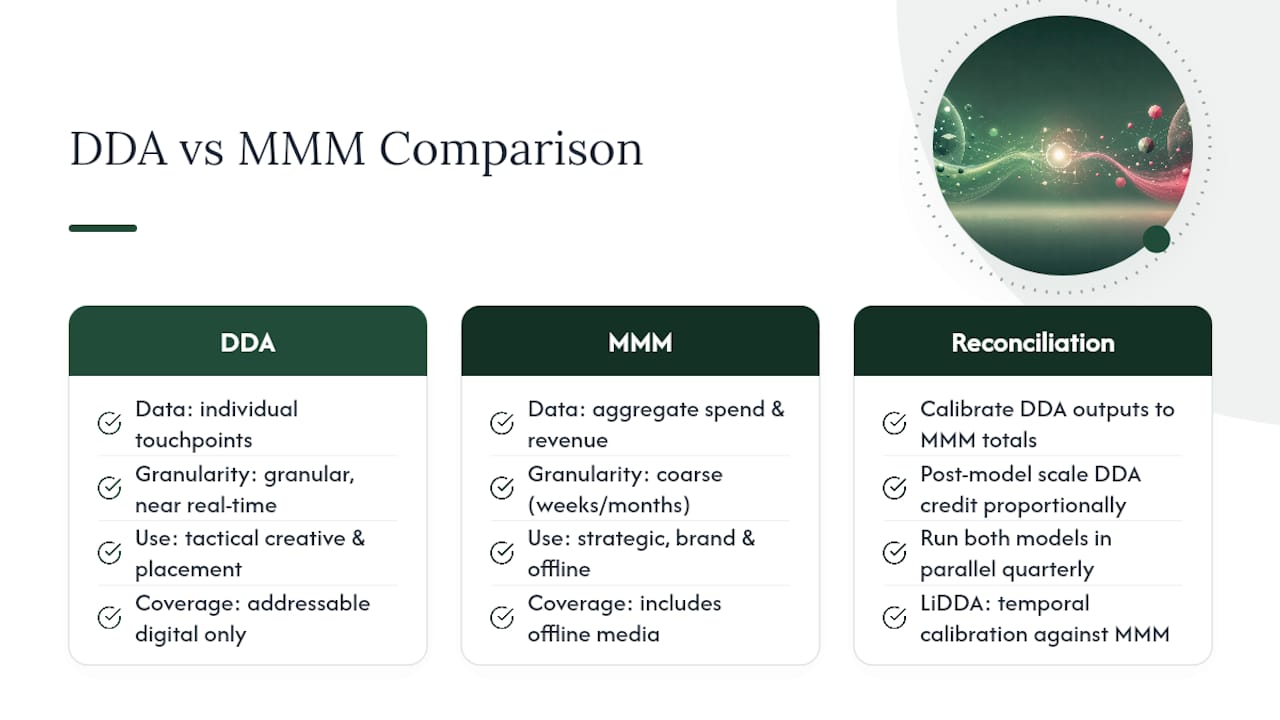
Three alignment techniques show up repeatedly in industry practice. Calibrating DDA outputs against MMM totals keeps channel-level detail while anchoring to a top-level number leadership can trust. Post-model scaling adjusts DDA credit proportionally so it doesn’t over- or under-value upper-funnel channels relative to what MMM independently confirms. Running both models in parallel and reconciling differences quarterly gives you tactical detail and strategic consistency without forcing a false choice.
LinkedIn’s LiDDA framework builds this reconciliation directly into its architecture, using temporal-aware attention modeling paired with a formal calibration step against MMM rather than treating the two models as competitors. If you run both national brand campaigns and addressable digital media, combining the two isn’t a nice-to-have. It’s the only way to get a number you can actually defend in a budget meeting.
Keeping Your Model Honest: Validation and Maintenance
Attribution models decay. Signal availability shifts, channel mix changes, and a model that was accurate in January can quietly mislead you by June if nobody checks it.
Build a maintenance cadence around three intervals:
- Daily: watch for sudden shifts in channel credit or conversion volume that signal a tracking break, not a real behavior change
- Monthly: review credit distribution across the full funnel and compare it against the prior month for drift
- Quarterly: run an incrementality or holdout test on at least one major channel to check whether attribution-assigned credit matches actual causal lift
Retest immediately after any major change, not just on schedule. New channel launches, privacy regulation updates, platform tracking changes, and product launches can all quietly invalidate a model that was performing fine the week before. Practitioner guidance from Salesforce’s work on multi-touch attribution is blunt about this: attribution needs continuous, dynamic validation because data fragmentation and privacy shifts never stop moving the ground underneath the model.
Watch sample size per channel, path-length distribution, and the stability of credit assigned to your top five channels month over month. If a channel’s credit swings more than your actual spend or performance changed, something in the tracking broke.
Pro Tip: Set a calendar reminder tied to your ad platforms’ policy update pages, not just your own campaign calendar. Most attribution breakage traces back to a platform-side tracking change nobody on the marketing team noticed for weeks.
Attribution for Mid-Market and Small-Business Teams
You don’t need enterprise data science to run a credible attribution program. You need discipline about starting simple and upgrading only when the data justifies it.
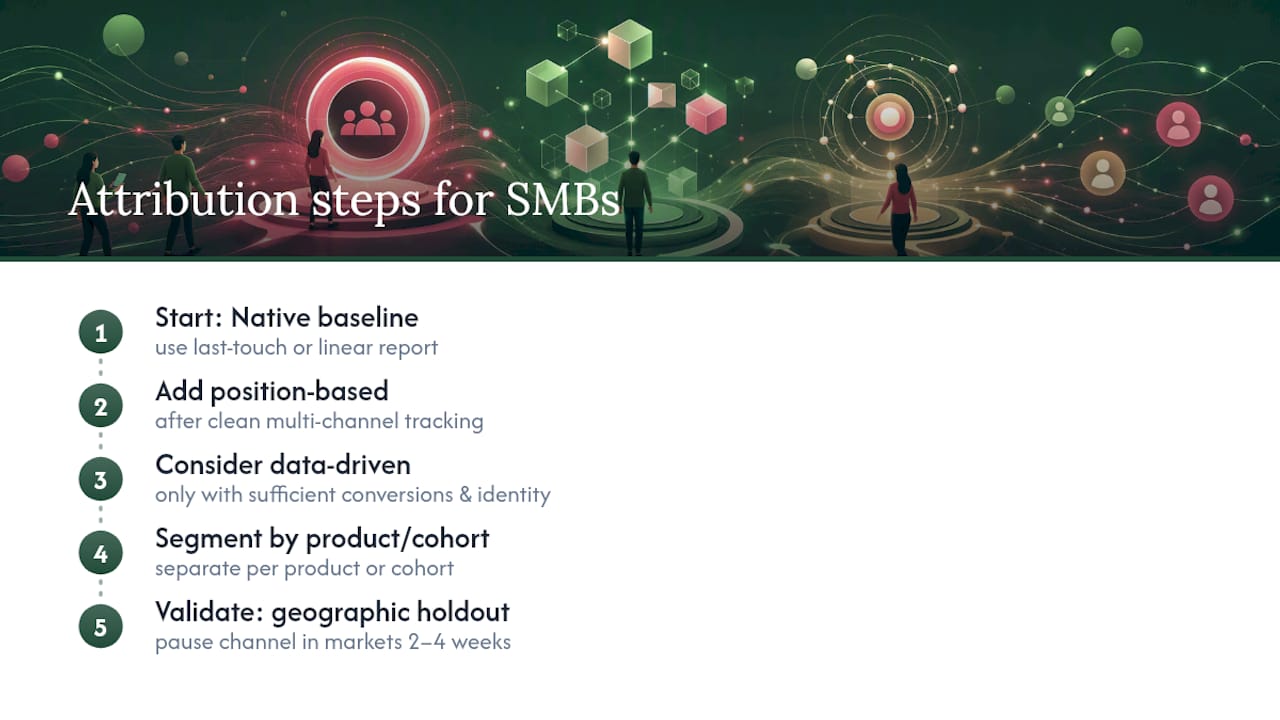
Begin with a baseline: whatever your ad platforms and analytics tools report natively, usually last-touch or a basic linear model, and treat that as your comparison point rather than your final answer. From there, layer in position-based weighting once you have clean multi-channel tracking, and consider data-driven attribution only once conversion volume and identity coverage can actually support it.
Most CRM and ad-platform tools already include attribution reporting that’s good enough for a first pass. Google Ads’ built-in model comparison report, most marketing automation platforms’ multi-touch views, and CRM-level source tracking cover the majority of small-business use cases without a custom build. Save the investment in bespoke DDA for when native tools genuinely run out of runway.
Segmenting by product line or customer cohort simplifies the problem meaningfully. A business selling both a low-cost product and a high-consideration service shouldn’t force both into the same attribution logic. The customer journeys don’t look alike, and neither should the model.
Low-cost validation doesn’t require a data science team. A simple geographic holdout, pausing one channel in a handful of markets for two to four weeks and comparing conversion trends against markets where it kept running, gives you a directional read on whether attribution credit matches real-world impact. That single test often teaches a small business more than a full DDA rollout would.
Attribution Should Serve the Story, Not Replace It
Attribution data means nothing if it isn’t connected to a clear brand message and a consistent customer experience across channels. We’ve seen teams chase model precision while their actual campaigns send conflicting signals, one channel promising speed, another promising premium quality, and no attribution model can fix that kind of misalignment.
Our approach starts with the same discipline this article recommends: define the business question before touching a model, keep data hygiene tight across every platform, and validate with real experiments rather than trusting a dashboard on faith. Attribution should tell you which parts of your story are landing and which aren’t, not just which channel gets the last click.
Channel mix and creative testing decisions only get better when the measurement behind them is honest about its own limits. That’s the standard we hold every measurement and growth strategy engagement to.
— Chris
How Connection-built Helps You Put Attribution to Work
Reading about attribution models is one thing. Building a measurement setup that actually holds up under a real budget conversation is another. Specialized teams work alongside marketing groups to close that gap, avoiding generic dashboard templates that don’t match how customers actually buy.

Our analytics and marketing services cover measurement setup, model selection, and the harder work of aligning data-driven attribution with marketing-mix results so leadership sees one consistent number instead of three competing ones. For small businesses specifically, we build attribution frameworks scaled to the data you actually have today, not the enterprise stack you might have in three years. Nonprofit teams get the same rigor applied to donor and campaign measurement, where every dollar of budget needs to defend itself.
Curious what this looks like against outcomes we’ve already delivered? Browse our success stories or reach out for a measurement audit to see where your current attribution setup is helping you and where it’s quietly steering you wrong.
Sources
- LiDDA: Data Driven Attribution at LinkedIn
- The Essential Guide to Marketing Mix Modeling and Multi-Touch Attribution
- Multitouch attribution in the customer purchase journey
FAQ
What Are Attribution Models in Marketing?
An attribution model is a rule or algorithm that assigns conversion credit across the touchpoints a customer encountered before converting, ranging from simple first-touch or last-touch rules to algorithmic data-driven models.
Which Attribution Model Is Best?
There’s no universal best model. The right choice depends on your business question, your data maturity, and your channel mix. Data-driven attribution tends to perform best when you have sufficient conversion volume and identity coverage to support it.
What Is Attribution Theory in Marketing?
Attribution theory in marketing is the practice of estimating each touchpoint’s contribution to a conversion, using either fixed weighting rules or statistical models trained on historical conversion data.
What Is Attribution Modeling in Performance Marketing?
In performance marketing, attribution modeling determines how conversion credit gets distributed across paid channels, directly shaping reported ROI and, on platforms like Google Ads, how automated bidding allocates budget.
How Often Should I Update My Attribution Model?
Review channel credit stability monthly and run incrementality tests quarterly, then retest immediately after any major change like a new channel launch or a privacy policy shift affecting tracking.
Recommended
Want to talk it through? Start a conversation. https://connection-built.com