
August 30, 2026
90 Day AI Ready Marketing Operating System for Small Teams

A marketing operating system is the managed orchestration of people, processes, data, content, governance, activation, and learning, not a single software product. For small businesses and nonprofits, it means every campaign, decision, and dollar runs through one repeatable system instead of scattered tools and tribal knowledge. The next step is simple: read the diagnostic below, or book a pilot with a team that builds these systems for a living.
TL;DR:
- Most small organizations lack the orchestration layer needed to connect their tools, data, and processes into a single repeatable marketing system.
- Building a marketing operating system typically takes 60 to 90 days and involves establishing seven interconnected layers, including workflow, data, content, governance, AI agents, activation, and measurement.
- To ensure AI tools support business objectives, organizations should define success briefs and set guardrails to prevent off-brand optimization.
- A single source of truth for data and standardized asset libraries are critical to maintaining consistency, accuracy, and effective AI deployment.
- Clear ownership of each layer and a phased implementation plan are essential for team adoption, scalability, and ongoing system improvement.
Table of Contents
- Marketing Operating System vs. a Tool Stack: What’s the Real Difference?
- The Seven Layers of an AI-Ready Marketing Operating System
- How Do You Diagnose Your Current Marketing Workflow?
- How Do You Keep Automation and AI on Brand?
- What KPIs and Review Cadence Make an MOS a Learning Engine?
- Implementation Checklist: Where Do Small Teams Start?
- Where Does Work Actually Enter Your System?
- Why Does Data Need One Single Source of Truth?
- How Should You Organize Content and Assets?
- Who Owns What in a Small-Team Marketing Operating System?
- Can a Marketing Operating System Scale With a Small Organization?
- How Do You Get Your Team to Actually Adopt the New System?
- What Security and Compliance Steps Does an MOS Need?
- Connection Built’s Take: What Actually Makes an MOS Work
- Ready to Build Your Marketing Operating System?
- Sources
Marketing Operating System vs. a Tool Stack: What’s the Real Difference?
Most small organizations already own a tool stack: an email platform, a scheduler, maybe a CRM bolted onto a spreadsheet. That’s not a marketing operating system. A marketing operating system is the orchestration layer that coordinates those tools, the decisions behind them, and the people running them into one repeatable loop. Buy five tools without that orchestration and you get five disconnected habits, not a system.
The distinction matters because tools don’t produce outcomes on their own. Orchestration does. When workflow, data, and governance connect, small teams see:
- Faster campaign turnaround, because intake and approval don’t stall in someone’s inbox
- Consistent brand voice across channels, because every asset traces back to one set of rules
- Compounding learning, because each campaign’s results feed the next decision instead of evaporating
- Lower customer acquisition cost over time, because underperforming channels get cut on a rule, not a hunch
Cost and timeline expectations vary by organization size, but most small teams should plan for a working system inside 60 to 90 days, not a year-long build. Think of it less as a purchase and more as an operating habit you install once and run indefinitely.
The Seven Layers of an AI-Ready Marketing Operating System
An AI-ready marketing operating system runs on seven connected layers, and most small teams are missing at least three of them without realizing it.
- Workflow. Requests enter, get triaged, and get assigned. Failure point: work arrives through five different channels (email, Slack, a form, a hallway conversation) with no single intake point.
- Data. One source of truth for audience, performance, and brand assets. Failure point: the same customer list lives in three spreadsheets, each slightly out of date.
- Content and assets. Modular, reusable pieces instead of one-off files. Failure point: nobody can find last quarter’s approved logo files, so someone recreates them.
- Governance. The rules, templates, and sign-off structure that keep output on-brand. Failure point: a well-meaning team member posts off-message copy because no brief existed.
- Agents. The AI layer that drafts, personalizes, or optimizes at scale. Failure point: AI tools left unmanaged will optimize for whatever a platform rewards, not your business goals.
- Activation. Coordinated deployment across channels rather than sequential, disconnected pushes.
- Measurement and learning. The feedback loop that turns results into the next decision.
These layers aren’t a checklist to complete once. They form a loop: workflow feeds data, data informs content, governance approves it, agents accelerate it, activation deploys it, and measurement sends the results back to workflow for the next round.
The agent layer deserves extra scrutiny. Without governance wrapped around it, AI will optimize for platform objectives instead of business objectives, like maximizing engagement instead of qualified leads. Your operating system has to hand AI a specific definition of success before it hands AI the keys.
Pro Tip: Give your AI tools a one-page “success brief” (target customer, forbidden claims, primary KPI) before letting them touch a live campaign. It takes an afternoon and prevents months of off-brand cleanup.
How Do You Diagnose Your Current Marketing Workflow?
Before building anything, map where work actually enters your organization and where it stalls. Most small teams find the bottleneck isn’t creativity. It’s handoffs.
Run this diagnostic checklist first:
- List every channel where marketing requests currently arrive (email, text, hallway conversations, a shared drive)
- Identify the point where a decision gets stuck waiting on one person
- Flag any asset or approval that lives only in someone’s head or personal inbox
- Note which campaigns get measured consistently and which just… end
For constrained teams, prioritize by leverage, not urgency. Fix the bottleneck that blocks the most work, even if it feels boring, before chasing the flashy campaign idea.
A workable 90-day sequence looks like this:
- Days 1 to 30: Audit intake, data, and existing assets. Identify the single biggest workflow break.
- Days 31 to 60: Fix that one break and stand up quick wins: a shared brief template, a single intake form, a naming convention everyone actually follows.
- Days 61 to 90: Install governance and measurement routines, including your first monthly business review.
When it comes to picking tools, resist the instinct to shop first. Decide the decision you need to make, then the data required to make it, then the tool that delivers that data. Reversing that order is the single most common reason small teams end up with software nobody uses.
How Do You Keep Automation and AI on Brand?
Automation without guardrails drifts off-message fast. The fix isn’t slowing everything down. It’s building a few governance rituals that catch problems before they publish, not after.
Approval queues work best when they’re scoped narrowly: high-risk content (pricing claims, legal language, anything customer-facing at scale) requires human sign-off, while low-risk internal drafts can move faster. A brand operating system turns positioning into a living, versioned system of record, so approvals reference an actual document instead of someone’s memory of “what we usually say.”
Build these governance artifacts once:
- A brief template pre-populated with your positioning, tone rules, and forbidden topics
- A single directly responsible individual (DRI) for each content type, so approval never gets stuck between two people who both assume the other signed off
- A weekly brand audit, ten minutes, checking recent output against the brief
Pro Tip: Assign one DRI per channel, not one DRI for “marketing.” A single owner for email, another for social, keeps accountability sharp instead of diffuse.
What KPIs and Review Cadence Make an MOS a Learning Engine?
A marketing operating system without measurement is just automation with extra steps. The KPI framework has to tie to outcomes your organization actually cares about, not vanity metrics that look good in a slide deck.
For small teams, that usually means tracking cost per qualified lead, campaign turnaround time, and retention or renewal rate rather than raw impressions. Nonprofits often substitute donor reactivation rate or volunteer signup cost for customer acquisition cost, but the discipline is the same.
Build your cadence around a monthly business review (MBR):
- Review the KPI dashboard against target, not against last month alone
- Keep a decision log: what changed, why, and what you expect to happen next
- Set automated alerts that flag or pause spend when a rule trips, such as killing a campaign automatically when cost per acquisition exceeds twice the target for seven straight days
A practical rollout typically includes a KPI framework and accountability matrix built directly into a 60 to 90 day implementation cadence, so measurement isn’t an afterthought tacked onto month four.
Implementation Checklist: Where Do Small Teams Start?
You don’t need a full department to start operating like one. You need three fast wins and a clear line between what you build in-house and what you buy.
- Lock a naming convention. Every file, campaign, and folder follows one pattern. This alone eliminates hours of searching per week.
- Standardize one brief template. Every project starts from the same intake document, no exceptions, so nothing launches without positioning and goals attached.
- Ship a weekly trusted report. One dashboard, reviewed every week, that leadership actually trusts instead of second-guessing.
For build versus buy: buy the infrastructure that handles data and distribution (email platforms, CRMs, analytics), and build the decision rules, brief templates, and approval workflow yourselves, since those need to reflect your specific brand and market. Assign a DRI to each of the seven layers, even if one person covers three of them at a five-person nonprofit. Then set 90-day objectives that are actually measurable: cut campaign turnaround by a set number of days, or raise brand-consistency audit scores by a defined margin, not vague goals like “improve marketing.”
Where Does Work Actually Enter Your System?
Intake is where most small organizations quietly lose control. A request comes in by email, another by text, a third gets mentioned in a hallway, and none of them go through the same review. By the time work reaches someone who can prioritize it, three versions already exist.
A functioning intake process needs exactly one front door. That might be a shared form, a project management board, or even a dedicated inbox, but it has to be the only accepted entry point. Once a request lands, it needs an owner within a defined window, not “whoever gets to it first.”
Assignment rules matter as much as intake. Route by content type and urgency, not by who happens to be free. A rush social post and a quarterly report shouldn’t compete for the same queue slot. Building this into your workflow layer means every request gets triaged against the same criteria: does it support a current priority, does it have a brief attached, and does someone have the bandwidth to own it start to finish.
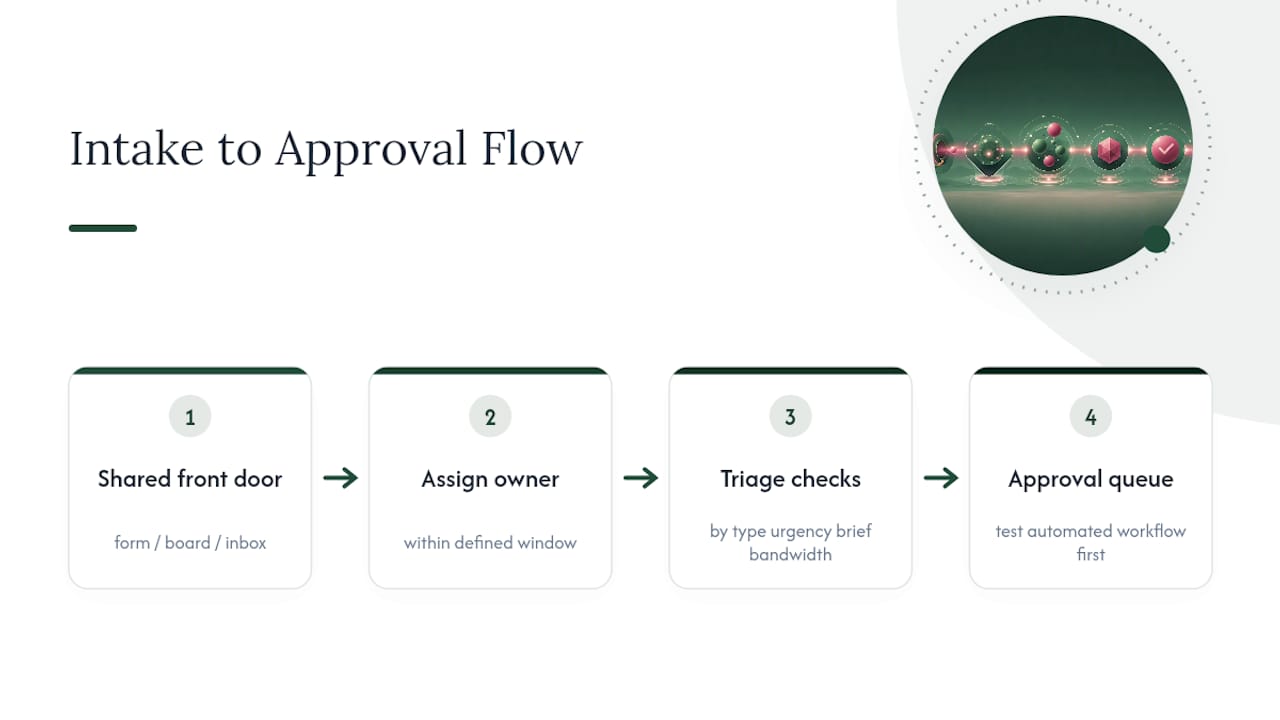
Small teams often resist formalizing intake because it feels bureaucratic for a five-person shop. It isn’t. It’s the difference between marketing that reacts to whoever shouted loudest and marketing that executes against a plan. Testing one automated workflow with an approval queue for a few weeks before expanding it is a reasonable way to build intake discipline without overhauling everything at once.
Why Does Data Need One Single Source of Truth?
Ask five people on a small team where the “real” customer list lives, and you’ll likely get three different answers. That’s the data problem an operating system exists to solve. Not more data. One trusted version of it.
A single source of truth means your audience segments, campaign performance, and brand assets all live in one place that updates consistently, rather than in parallel spreadsheets that drift apart within a month. Without it, every campaign starts with someone reconciling numbers instead of acting on them.
This doesn’t require an enterprise data warehouse. For most small organizations, it means picking one CRM or list-management tool as the record of truth and disciplining every team member to update there first, exports second. Reporting pulls from that one source, not from whichever spreadsheet someone happened to have open.
The payoff compounds. Clean, centralized data is also what makes the agent layer trustworthy. AI tools drafting personalized outreach or optimizing ad spend are only as good as the data feeding them. Feed an AI tool three conflicting customer lists and it will confidently produce three conflicting recommendations. Feed it one clean source, and it can actually optimize toward your specific business objectives instead of guessing.
How Should You Organize Content and Assets?
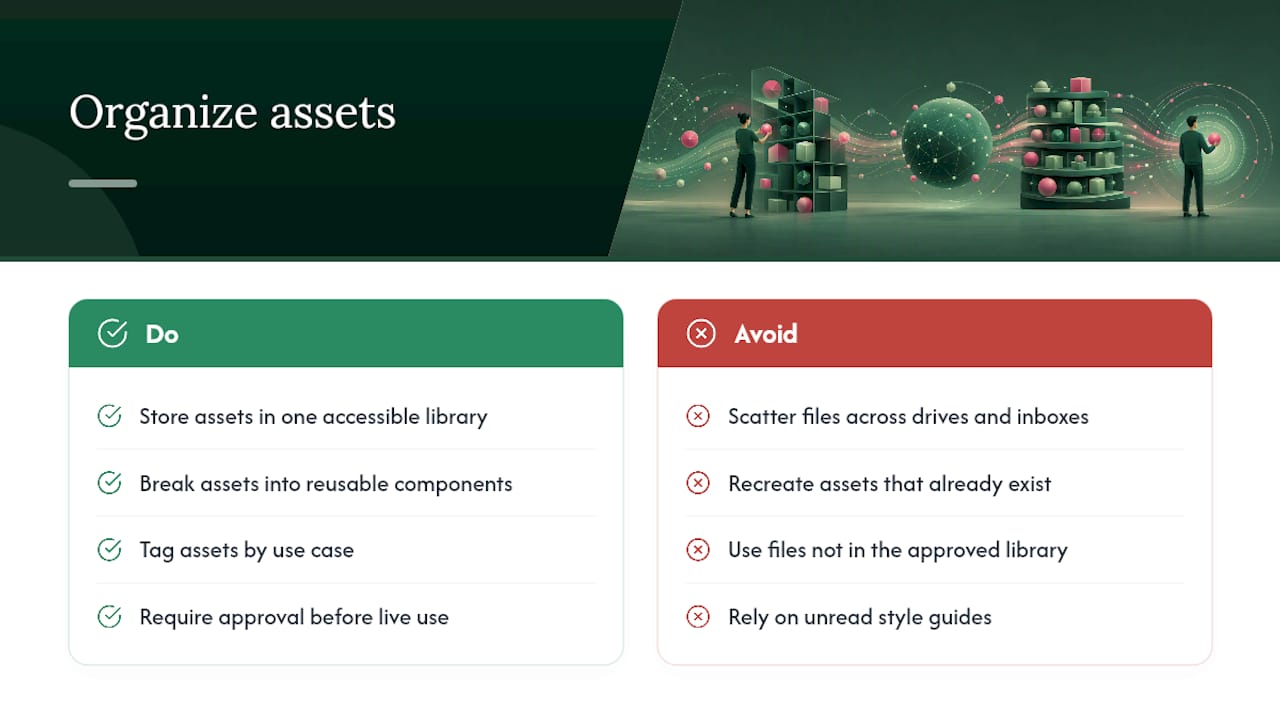
Most small teams store content the way they store old photos: scattered across drives, inboxes, and whoever’s laptop had space at the time. Modular asset management fixes that by treating content as reusable building blocks rather than one-off files.
The core idea is simple. Break assets into components: approved logos, brand photography, boilerplate copy blocks, testimonial snippets, and headline templates. Store them in one accessible library, tagged by use case, so a team member building a social post or a nonprofit assembling a grant deck can grab pre-approved pieces instead of starting from a blank page or, worse, recreating something that already exists.
This matters more once AI enters the picture. Generative tools drafting variations of an ad or email work faster and more accurately when they pull from a defined asset library instead of improvising brand voice from scratch each time. A versioned system of record for brand assets prevents both AI drift and the classic problem of a well-meaning volunteer using an outdated logo because it was the only file they could find.
Set one rule: nothing gets used in a live campaign unless it lives in the approved library first. That single constraint does more to protect brand consistency than any style guide sitting unread in a shared drive.
Who Owns What in a Small-Team Marketing Operating System?
A marketing operating system doesn’t require a big department. It requires clear ownership, even when one person wears three hats.
At minimum, assign a directly responsible individual for each of the seven layers: someone owns workflow and intake, someone owns data integrity, someone owns content and asset approval, someone owns governance sign-off, someone monitors the agent (AI) layer, someone owns activation across channels, and someone owns measurement and the monthly review. In a five-person nonprofit, that might mean the executive director owns governance and measurement while a part-time coordinator owns workflow and content.
What matters isn’t headcount. It’s that no layer sits ownerless, because ownerless layers are exactly where work stalls or drifts off-brand. Document who owns what in a single page everyone can reference, and revisit it every quarter as your team grows or shifts.
Can a Marketing Operating System Scale With a Small Organization?
Yes, and that’s the point. A marketing operating system built correctly for a five-person team doesn’t need to be torn down when the team grows to fifteen. The layers stay the same. What changes is the depth of automation and the number of people touching each layer.
Design for scale from day one by keeping governance and data structures simple enough to survive growth without a rebuild. A naming convention that works for ten campaigns should still work for two hundred. A brief template built around your actual positioning doesn’t need to change when you hire your first dedicated marketer; it just gets used more often.
The mistake most small organizations make is building a system so lightweight it can’t absorb growth, or so complex it collapses under its own weight before the team is big enough to run it. The right scale test: could a new hire understand your workflow, find your assets, and follow your approval process within their first week, using only what’s documented? If not, the system isn’t ready to scale yet, regardless of team size.
How Do You Get Your Team to Actually Adopt the New System?
The best-designed marketing operating system fails if the team quietly routes around it. Adoption isn’t a training problem. It’s a trust and friction problem.
Start small and prove value before mandating anything. Automating one workflow, running it for a few weeks with an approval queue, and measuring the quality of the output builds far more buy-in than announcing a system-wide overhaul on day one. People adopt tools that visibly save them time; they resist tools imposed without evidence.
Make the new process the path of least resistance, not an extra step layered on top of the old one. If intake still technically allows email requests alongside the new form, people will use email, because it’s familiar. Retire the old channel once the new one works.
Finally, involve the people closest to the work in building the templates and rules they’ll use daily. A brief template designed by leadership without input from the person filling it out every week gets abandoned within a month.
What Security and Compliance Steps Does an MOS Need?
Marketing operating systems handle customer data, brand assets, and increasingly, AI tools with access to both. That combination raises real compliance questions small organizations can’t ignore.
Start with access control: not everyone needs edit rights to your single source of truth. Assign permissions by role, limit who can approve public-facing content, and log who changed what, especially once AI agents are drafting or publishing on your behalf. If your organization handles sensitive customer or donor data, your governance layer needs explicit rules about what data AI tools can and can’t access, not just what content they can produce.
Nonprofits handling donor information and small businesses handling customer payment or health data face additional obligations depending on their sector and jurisdiction. A marketing operating system doesn’t replace legal compliance review. It creates the paper trail (versioned templates, approval logs, a documented DRI for sign-off) that makes compliance review faster and audits less painful when they happen.
Connection Built’s Take: What Actually Makes an MOS Work
We’ve watched the same pattern play out across small businesses and nonprofits: leadership buys a tool, hopes it fixes the chaos, and six months later nothing’s changed except the software bill. The tool was never the problem. The missing orchestration layer was.
What we’ve found matters most isn’t the sophistication of the AI or the size of the tech stack. It’s whether someone owns each layer, whether a brief exists before work starts, and whether the team trusts the weekly report enough to act on it. Our branding, marketing, and growth systems work across West Michigan and beyond exists specifically to build that orchestration, not to sell another disconnected tool.
Client outcomes and specific case studies live in our success stories; the pattern holds across for-profit and nonprofit clients alike: clarity first, automation second.
— Chris
Ready to Build Your Marketing Operating System?
You’ve seen what a real marketing operating system requires: orchestration across seven layers, not another app added to an already crowded stack. That’s the exact gap Connection-built closes. Instead of handing you more software to manage alone, we design and run the workflow, governance, and measurement system for you, so campaigns launch faster and stay on-brand without you personally chasing every approval.
If you’re a small business owner ready to stop reacting and start operating with a repeatable system, our small business marketing services are built exactly for this transition. Nonprofit leaders can find a tailored version of the same approach through our nonprofit marketing services. Either way, the next step is the same: book a diagnostic call, tell us where your workflow breaks down, and we’ll show you what a 90-day pilot looks like for your organization.
Sources
Start with the seven-layer framework for the conceptual model behind an AI-ready system. For build-versus-buy decision logic and alerting rules, the build, not buy breakdown is the sharpest conceptual read. If you want an actual implementation blueprint with a KPI framework and accountability matrix, the MOS blueprint includes templates you can adapt directly. For strategic planning that folds AI into the process from the start, see this guide to AI-driven strategic planning.
- The 7 layers of an AI-ready marketing operating system
- What Is a Brand Operating System? Complete Guide - Brandhorse
- Marketing Operating System Blueprint | E.R.M. Advisory
Recommended
Want to talk it through? Start a conversation. https://connection-built.com