
September 16, 2026
Get Real Results with a Small Business Marketing Strategy in 90 Days

A practical marketing strategy for small business owners sets one measurable goal and puts resources behind 3 to 5 channels that move that goal, nothing more. If you’re staring at a blank page right now, your first move is simple: write down that one goal, then pick the single channel you’ll activate this week. Everything else in this guide builds from there.
TL;DR:
- Small businesses should focus on one clear, measurable goal and prioritize 3 to 5 channels that directly impact that goal, rather than spreading resources thin.
- Conduct quick, cost-effective audience research through customer interviews, reviews, social listening, and simple surveys to identify the most relevant channels and messaging angles.
- Use local SEO, email, and referral programs for local service businesses, while B2B companies should emphasize content and SEO, and e-commerce should leverage paid ads and email marketing.
- Allocate the marketing budget based on a percentage of revenue or customer acquisition costs, adjusting for cash flow and capacity, while tracking all costs meticulously.
- Implement a 90-day plan broken into foundation, launch, promotion, measurement, and decision phases, assigning clear ownership and using automation to maintain consistency.
Table of Contents
- What Should a Small Business Marketing Strategy Focus On First?
- How Do You Research Your Audience and Competitors on a Small Budget?
- Which Marketing Channels Should Small Businesses Actually Use?
- How Should a Small Business Allocate Its Marketing Budget?
- How Do You Turn a Marketing Strategy Into a Repeatable Plan?
- What KPIs Should Small Businesses Track, and How Often?
- What Does a 90-Day Small Business Marketing Plan Look Like?
- How Connection-built Thinks About Small Business Marketing Strategy
- Ready to Put This Plan Into Action?
- Sources
- FAQ
What Should a Small Business Marketing Strategy Focus On First?
Every marketing strategy for small business owners falls apart at the same point: too many goals, too many channels, no way to tell what’s working. Fix the foundation first, and the rest gets easier.
Start by naming the one number marketing exists to move. Not five numbers. One. Common choices include monthly revenue, qualified leads generated, or customer retention rate. Pick whichever one your business model needs most right now, then leave the others alone for a quarter.
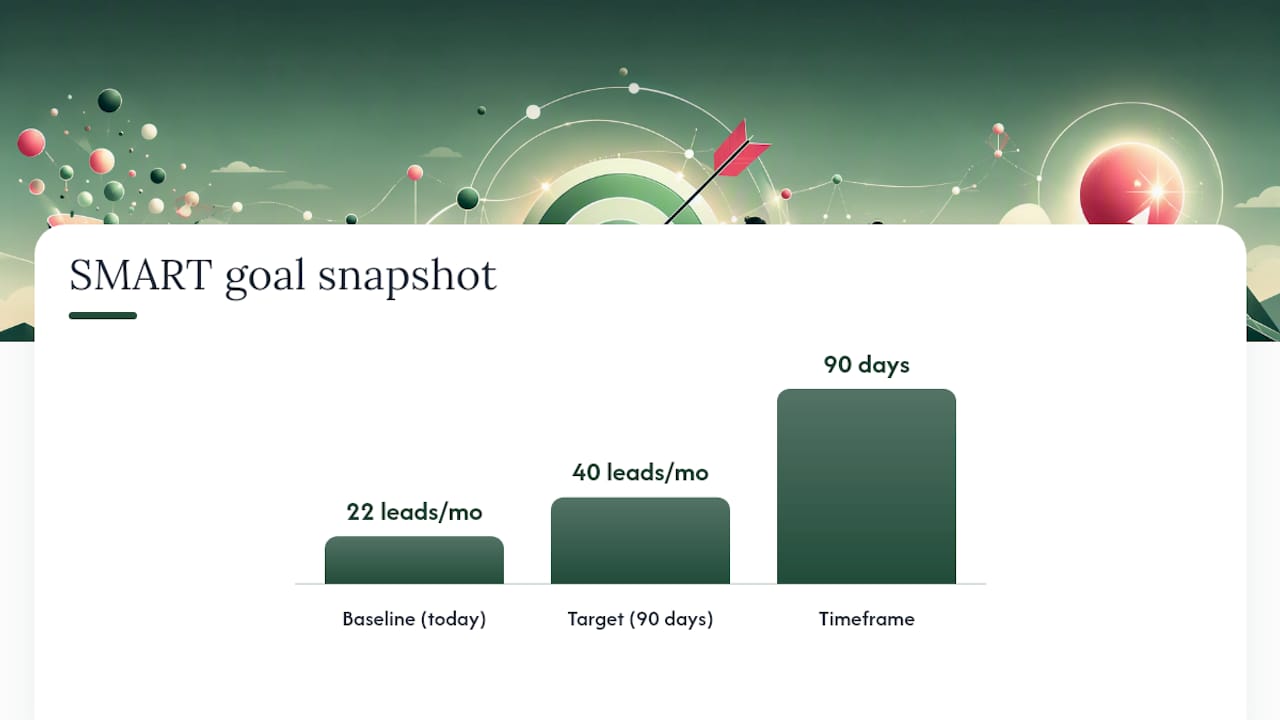
Turn that number into a SMART goal. That means it has a baseline (where you stand today), a specific metric (how you’ll measure it), and a timeframe (usually 90 days for a first pass). “Grow leads” is not a goal. “Generate 40 qualified leads per month by the end of Q2, up from 22 today, tracked through form fills and phone calls” is.
Once the goal is locked, write your unique value proposition, or UVP, the one sentence that tells a prospect why you and not the next option in their search results. A strong UVP names a specific customer outcome, not a feature list. This isn’t abstract branding exercise. It’s the sentence that shapes every headline, ad, and email you write for the next quarter.
Here’s how the chain works in practice, using a local HVAC company as an example:
- Goal: Increase qualified service calls from 30 to 50 per month within 90 days.
- UVP: “Same-day HVAC repair with a flat-rate quote before we touch your system.”
- Messaging link: Every ad, postcard, and Google Business Profile post repeats the same-day, flat-rate promise, because that’s the specific friction point the UVP was built to solve.
Marketing consultants still lean on the 4 Ps of marketing, product, price, place, and promotion, because the framework forces you to check that your UVP actually holds up against what you charge, where customers find you, and how you reach them. Skip that check, and you’ll write a beautiful UVP that your pricing or distribution quietly contradicts.
How Do You Research Your Audience and Competitors on a Small Budget?
You don’t need a market research firm to understand who buys from you. You need thirty minutes, your existing customer list, and a willingness to ask direct questions.
Build one or two buyer personas from real customers, not guesses. Pull five to ten of your best customers and document these fields for each:
- Demographics and firmographics — age range, household or company size, location.
- The trigger — what specific event made them start looking for a solution like yours.
- The objection — what almost stopped them from buying.
- The channel — where they first heard about you.
- The language — the exact words they used to describe their problem, pulled from emails, reviews, or sales notes.
That fifth field matters more than people think. Customers rarely describe their problems the way business owners do internally. If your sales notes say “cost-conscious,” but three customers separately wrote “I just needed something that wouldn’t break the bank this month,” use their words in your ads.
Four low-cost research methods will get you there fast:
- Short customer interviews. Fifteen minutes, five questions, done by phone or video. Offer a small discount as thanks.
- Review mining. Read every review you have, plus your top three competitors’ reviews. Patterns in complaints reveal unmet needs you can market against.
- Social listening. Search your business name, your category, and your city on social platforms to see what people say when they’re not being asked.
- A one-question survey. Email your list one question: “What almost stopped you from buying from us?” Response rates on single-question surveys run far higher than long ones.
While you’re at it, build a simple competitor scorecard. Don’t rank competitors on price alone. Score them on response time, review sentiment, website clarity, and how specific their messaging is. A competitor with mediocre service but crystal-clear messaging often outperforms a better business that describes itself in vague, generic terms. If your research shows customers complain about slow callbacks industry-wide, that’s a messaging angle and a channel signal: it tells you speed of response belongs in your UVP and that channels like local search and review platforms, where response time is visible, deserve priority.
Which Marketing Channels Should Small Businesses Actually Use?
Pick 3 to 5 channels. Not ten. The single biggest mistake in small business marketing is spreading a thin budget across every platform that exists instead of dominating a few that actually reach the goal you set.
Use a three-part filter for every channel you’re considering:
- Audience presence. Are your actual customers spending time there, based on the research you just did?
- Impact on your primary goal. Does this channel drive the specific metric you chose, or does it just generate vague “awareness”?
- Execution capacity. Do you have the skill, time, or budget to show up consistently, or will this channel go dark after three weeks?
Here’s how that plays out across common business types:
Local retail or service businesses (HVAC, salons, restaurants, dentists) should lean hardest into local SEO. A complete Google Business Profile, consistent business listings, and active review management drive high-intent traffic from people already searching for what you sell nearby. Pair that with email for repeat visits and a referral program, since local trust travels fast through word of mouth.
B2B service businesses (consultants, agencies, contractors) get more mileage from content and SEO paired with email nurture, since B2B buying cycles run longer and buyers research before they ever contact you. LinkedIn and referral partnerships often round out the mix.
E-commerce businesses typically need paid search or social to drive first-time traffic, email marketing to recover carts and drive repeat purchases, and content that supports organic product discovery.
Run each candidate channel through this quick readiness checklist before committing:
- Do you or someone on your team already know the platform, or is there a real learning curve?
- Do you have (or can you afford) the tools to execute it well?
- Can you sustain it for at least 90 days without burning out?
- Does it map directly to the primary goal from your SMART goal statement?
Pro Tip: If you’re unsure between two channels, choose the one where your competitors are weakest, not the one that feels most exciting. A mediocre Instagram presence competing against ten strong ones rarely wins. Undefended local search or email often does.
Email deserves a specific callout here. It remains one of the highest-ROI channels available to small businesses once you have even a modest list, because it’s the one channel you fully own, immune to algorithm changes and ad cost inflation.
How Should a Small Business Allocate Its Marketing Budget?
Budget conversations in small business marketing tend to freeze people, usually because they’re looking for one right number. There isn’t one. There’s a starting point and a rule for adjusting it.
A common starting benchmark is a percentage of revenue, often somewhere in the low single digits for established businesses and higher for newer ones still building awareness. If percentage-of-revenue feels abstract at your size, an alternative is to fund based on your goal: calculate what it costs to acquire the customers needed to hit your SMART goal, then work backward to a monthly number.
This keeps your core engine funded while still leaving room to find the next growth lever without betting the whole budget on an unproven idea.
Time and money trade off constantly at this budget level. If cash is tighter than time, lean on organic channels, local SEO, email, referrals, and accept the slower ramp. If time is tighter than cash, a small amount of paid search or social can buy you speed while you build organic assets in the background.
Track both recurring and one-time costs so nothing surprises you at quarter-end:
- Recurring: email platform subscription, social scheduling tool, ad spend, website hosting, any retainer for outside help.
- One-time: website updates, photography or video, initial ad account setup, branding refreshes.
How Do You Turn a Marketing Strategy Into a Repeatable Plan?
Strategy without a workflow is just a nice document nobody executes past month one. A documented marketing plan needs a repeatable process behind it, or the whole thing stalls the first time someone gets busy.
Use a five-step campaign workflow for every initiative, big or small:
- Brief. One page: goal, audience, channel, message, deadline, and who owns it.
- Create. Build the actual asset, email, ad, post, page, against that brief.
- Publish. Schedule and release on the calendar date, not “whenever it’s ready.”
- Promote. Push it through every channel that supports it, don’t rely on one post to carry the whole campaign.
- Measure. Check results against the KPI tied to your primary goal, on a fixed date, not “eventually.”
Assign clear ownership using a simplified RACI approach, one person Responsible for doing the work, one Accountable for the outcome (often the same person in a small team), and anyone else kept Informed. The single most common breakdown on small marketing teams isn’t lack of ideas, it’s lack of a named owner for each channel’s metrics and for the monthly reporting meeting itself. Assign both explicitly, even if it’s just you.
Build two lightweight templates and reuse them for every campaign:
- Content calendar fields: date, channel, asset type, owner, status, goal tie-in.
- Campaign brief fields: objective, audience segment, key message, call to action, budget, deadline, success metric.
Pro Tip: Write the campaign brief before you write a single word of copy. Teams that skip this step end up with beautiful content that doesn’t actually say anything the customer needed to hear.
Automate the repetitive, low-judgment tasks, social scheduling, email send times, basic reporting dashboards, and a marketing automation checklist can help you sequence that rollout without overbuilding. Outsource the specialized, high-skill work instead, complex SEO technical fixes, professional photography, or strategy design, where a few hours of expert time saves weeks of trial and error.

What KPIs Should Small Businesses Track, and How Often?
Vague dashboards produce vague decisions. Layer your KPIs into three tiers, and review each tier on its own cadence.
- Visibility metrics — website traffic, impressions, social reach, local search rankings. Track monthly; these show whether people can find you at all.
- Engagement metrics — email open rates, time on page, social interactions. Track monthly; these show whether your message resonates once found.
- Conversion metrics — leads generated, purchases, booked calls. Track weekly and roll up monthly; these connect directly to your primary goal.
Implement basic attribution with UTM parameters on every link you share outside your own website, social posts, email campaigns, paid ads. This single habit is the difference between “our website traffic went up” and “our Tuesday email drove 34 of those visits.” Structured KPIs paired with UTM tagging let you trace which channel actually earns credit for a result, instead of guessing.
Run a fixed monthly reporting meeting, same day every month, thirty minutes, three questions: What moved? What didn’t? What do we change next month? A report nobody discusses is wasted effort.
Quick ROI math example: if a local retail business spends $600 a month on a channel and that channel drives 8 new customers worth $150 in average lifetime value each, that’s $1,200 in return against $600 spent, a 2:1 return. As a general rule of thumb, a channel returning less than what you put in after 90 days of honest effort is a candidate to cut or restructure, not a channel worth stubbornly funding.
What Does a 90-Day Small Business Marketing Plan Look Like?
A 90-day window gives you enough time to see real signal without dragging out decisions for a year. Break it into three phases.
Weeks 1 to 2: Foundation
- Finalize your SMART goal and UVP.
- Complete one buyer persona and a competitor scorecard.
- Select your 3 to 5 channels using the readiness checklist.
- Set up UTM tracking and a basic monthly reporting template.
Weeks 3 to 6: Launch
- Publish your first content or campaign assets on each chosen channel.
- Activate your primary channel fully, complete Google Business Profile, first email send, first ad campaign, whichever applies.
- Assign channel owners using the RACI approach.
- Run your first monthly reporting check at the end of week 4.
Weeks 7 to 10: Promote and Optimize
- Double down on whatever channel shows early traction.
- Launch a referral or partnership component if your channel mix includes one.
- Test one small variable per channel, a subject line, an ad image, a landing page headline.
- Hold your second monthly reporting meeting at the end of week 8.
Weeks 11 to 13: Measure and Decide
- Pull a full 90-day report against your original SMART goal baseline.
- Calculate simple ROI for each channel using the formula above.
- Decide what to scale, what to fix, and what to cut entirely.
- Set the next 90-day goal using this cycle’s results as the new baseline.
Owner assignments should stay minimal and explicit. Someone owns content creation. Someone owns paid channels if you’re running them. One person owns the monthly report, no exceptions, because reporting without a named owner is the task that quietly disappears first when things get busy.
For testing, keep it simple: never test more than one variable per channel per cycle, or you won’t know which change caused which result. At the 90-day mark, the rule for scaling is straightforward. If a channel hit or beat its ROI target and you have the capacity to do more, increase budget there before adding a new channel.
How Connection-built Thinks About Small Business Marketing Strategy
Most small business marketing advice treats channels, branding, and web presence as separate projects. We don’t. A goal, a UVP, and a channel plan only work when the message behind them is consistent everywhere a customer encounters your business, your website, your social presence, your follow-up emails, your storefront signage.
That’s the disconnect we see most often: a business with real momentum in one area, say local SEO, undercut by a website or brand message that doesn’t match what actually made customers choose them. Our approach at Connection-built integrates storytelling, brand development, and marketing strategy and execution so those pieces reinforce each other instead of working against one another.
Not every business needs outside help to run the 90-day plan above. If you have the time to own reporting, content, and channel execution yourself, do it, and revisit this guide each quarter. Bring in a partner when the gap is capacity, not knowledge, when you know exactly what needs to happen but can’t get it built, published, and measured consistently on your own.
— Chris
Ready to Put This Plan Into Action?
Reading a 90-day marketing plan and running one are two different things, especially when you’re also handling sales calls, payroll, and everything else that comes with owning a small business. Outside partners exist for the gap between knowing your strategy and having someone execute it consistently, week after week, without it falling to the bottom of your to-do list.
Our work centers on strategic branding and small business marketing built around the same foundation this guide walks through: one clear goal, a message that actually reflects who you are, and channels chosen for impact instead of habit. For businesses that need the full picture, brand, web, SEO, and ongoing execution working as one system, our marketing, web, and SEO services cover that ground without you having to coordinate five different vendors. You can also see how this plays out for real clients in our success stories.
If your 90-day plan feels right on paper but you’re not confident it’ll get built and measured on schedule, book a strategy session with our team and we’ll map out what execution actually looks like for your business.
Sources
A few resources are worth bookmarking alongside this guide. The SBA’s marketing and sales guidance lays out the core elements every marketing plan needs, target market, competitive advantage, goals, action plan, and budget. The UH SBDC marketing plan template offers a downloadable, fillable structure with a working example, useful if you want a document to build directly inside. For a broader look at the framework behind the 4 Ps, Forbes Advisor’s breakdown is a solid refresher, and Backlinko’s step-by-step strategy framework pairs well with the goal-to-channel sequence covered here.
- What Are the 4 Ps of Marketing? (Forbes Advisor)
- Marketing and sales | U.S. Small Business Administration
FAQ
What Is the Marketing Strategy for a Small Business?
A small business marketing strategy is a documented plan that defines one primary measurable goal, identifies the target audience and UVP, and commits resources to 3 to 5 channels that directly support that goal. The SBA frames it around target market, competitive advantage, goals, action plan, and budget, all elements this guide walks through step by step.
What Are the 5 Ps of Strategic Marketing?
Most marketing frameworks reference the 4 Ps, product, price, place, and promotion, as the core marketing mix small businesses use to align what they sell with how they sell it. Some versions add a fifth P, often “people” or “physical evidence,” but definitions vary by source and there’s no single agreed fifth element.
What Are the Three Cs in Marketing?
The three Cs typically refer to Company, Customer, and Competitor, a framework used to check that your business capabilities, your customers’ needs, and your competitors’ positioning are all accounted for before you finalize a strategy. It works well alongside the buyer persona and competitor scorecard exercises covered earlier in this guide.
How Many Marketing Channels Should a Small Business Use?
Most small businesses get the best results focusing on 3 to 5 channels chosen through an audience presence, goal impact, and execution capacity filter, rather than spreading a limited budget across every available platform. Adding channels beyond that range without added budget or team capacity usually dilutes results instead of multiplying them.
How Much Should a Small Business Spend on Marketing?
There’s no single universal figure, but a common approach is to set a budget as a percentage of revenue, then allocate it using a 70/20/10 split across proven channels, optimization, and new experiments. Businesses newer to marketing or actively building awareness often need to start on the higher end of that range to gain traction.
Recommended
Want to talk it through? Start a conversation. https://connection-built.com