
September 5, 2026
Roll Out in 90 Days: AI Aware Reputation Management for Brand Leaders

A reputation management strategy is a standing program that controls what search engines, review sites, social platforms, and AI assistants say about your brand. The goal is protecting trust before it erodes, not scrambling after a crisis. Start today with a baseline audit of your branded search results and AI-generated answers, then build ownership and cadence from what you find.
TL;DR:
- Monitoring and managing search results, review platforms, social channels, AI outputs, and reference sources prevents reputation gaps from compounding.
- Building a standardized, authoritative owned asset base and a comprehensive monitoring stack are essential foundational steps within the first 30 days.
- Effective review workflows, authoritative content, and AI output audits should be implemented concurrently to improve perceptions across all surfaces.
- Operationalizing the strategy into 90-day phases and maintaining ongoing audits, content updates, and AI monitoring sustains reputation health over time.
- Engaging a specialized agency ensures consistent execution of audits, monitoring, and content efforts, preventing common in-house stall points.
Table of Contents
- What Does a Reputation Management Strategy Actually Cover?
- What Should You Measure to Know It’s Working?
- The Operational Playbook: Pillars That Actually Move the Needle
- How Do You Roll This Out in 90 Days?
- What’s Your Protocol When a Crisis Hits?
- How Do You Know the Strategy Is Working?
- How Does an Agency Partner Fit Into This Plan?
- An Editorial Take on What Actually Moves the Needle
- Ready to Put This Plan Into Action?
- Sources
What Does a Reputation Management Strategy Actually Cover?
Most brand leaders think reputation management means watching star ratings and hoping for good press. That’s a fraction of the job. A real reputation management strategy monitors perception across five interconnected surfaces and takes deliberate action to shape what people find there.
Those surfaces don’t operate in isolation. A single negative review can surface in Google’s top results, get cited by an AI assistant, and resurface on a competitor’s comparison page. That’s why a fragmented approach (someone in customer service handles reviews, marketing handles social, nobody handles AI) leaves gaps that compound.
The five surfaces every strategy needs to cover:
- Search results — what ranks on page one for your brand name and branded queries.
- Review platforms — Google Business Profile, industry-specific sites, and third-party aggregators.
- Social channels — owned accounts plus unauthorized mentions, tags, and impersonation risk.
- AI assistant outputs — how ChatGPT, Perplexity, and similar tools summarize your brand when someone asks about it.
- Wikipedia and reference sources — the pages AI systems and journalists often treat as ground truth.
The business case is concrete, not abstract. Companies with strong reputations attract better job candidates at lower recruiting cost, close sales faster because buyers skip the vetting phase, and command premium pricing because trust reduces perceived risk. A weak reputation does the opposite: it inflates customer acquisition cost, slows hiring, and gives procurement teams a reason to negotiate harder.
The biggest misconception is that reputation management is a PR function you activate during a crisis. It isn’t. It’s closer to insurance you fund continuously, so the payout (or the absence of a disaster) happens quietly in the background.
What Should You Measure to Know It’s Working?
Reputation work only earns budget when it connects to a number a CFO cares about. Vague goals like “improve our image” don’t survive a budget review. Specific, measurable objectives do.
Downstream business outcomes to track include:
- Hiring premium — reduced time-to-fill and lower recruiting spend as candidates self-select in.
- Customer acquisition cost (CAC) — trust reduces the ad spend needed to convert a skeptical prospect.
- Pricing power — the ability to hold margin against lower-priced competitors.
- Valuation and partnership signals — investors and partners increasingly check AI summaries and review sentiment during diligence.
Separate your indicators into leading and lagging categories, because conflating them causes teams to celebrate too early or panic too late. Leading indicators (review response rate, AI answer accuracy, content publishing velocity) move within weeks. Lagging indicators (aggregate star rating, branded search sentiment, hiring premium) take months to shift.
Reputation shapes buying decisions long before a sales call happens. Buyers routinely research a company’s reviews and search presence before ever engaging a salesperson, which means your reputation strategy is doing sales work whether anyone assigns it that job or not.
Sample SMART objectives worth adopting:
- Improve AI assistant answer accuracy for three core branded prompts from “outdated or incomplete” to “accurate and current” within one quarter.
- Raise Google review response rate significantly within a short time frame.
- Increase share of positive-sentiment search results in the top 10 branded results from 60% to 85% within two quarters.
The Operational Playbook: Pillars That Actually Move the Needle
Most reputation advice reads like a checklist with no order of operations. That’s a mistake. Some moves are foundational and everything else depends on them; others are maintenance work that only matters once the foundation exists. Here’s the priority order.
1. Build the owned asset foundation first
Your own website is the single most consequential reputation asset you control. A canonical site with structured data and consistent executive bios becomes the reference point AI engines and search algorithms pull from when someone asks who you are. If your “About” page, LinkedIn profile, and press mentions describe your founder three different ways, you’re actively confusing the systems that are supposed to represent you accurately.
Before anything else, standardize:
- Executive bios (same wording, same credentials, same photo, everywhere) with help from a professional LinkedIn profile writing service
- Schema markup for organization, person, and review data
- A clear, current “About” and leadership page that doesn’t require a PDF download to understand who runs the company
2. Stand up your monitoring stack
You can’t manage what you don’t see. A monitoring stack needs to cover search results, review platforms, social mentions, niche forums, and AI assistant outputs. Google Alerts and native review dashboards handle basic tracking. Social listening tools catch mentions and tags. The piece most companies skip entirely is auditing what ChatGPT, Perplexity, and similar tools actually say when prompted with questions about your brand, your founder, or your product category.
A proper baseline audit spans traditional search, niche communities, review sites, and AI-generated answers, and strong programs repeat that audit quarterly because AI-generated summaries drift as models retrain and re-crawl the web.
3. Build a review management workflow, not a reaction habit
Reviews need a documented process, not ad-hoc responses from whoever happens to see the notification first. A workable workflow includes:
- Solicitation timing — ask for reviews at the moment of peak satisfaction, not weeks later.
- Response policy — every review gets a reply within 48 hours, positive or negative.
- Escalation triggers — reviews mentioning legal threats, safety concerns, or repeated complaints get routed to a named owner, not left in a queue.
- Platform-specific rules — Google, Yelp, and industry sites each have different policies on solicitation and response; know them before you violate one.
Responding to criticism with transparency, rather than defensiveness, builds more durable trust than chasing a flawless star rating ever will. A five-star average built on silence looks thinner than a 4.6 average with thoughtful, human responses to the rough reviews.
4. Saturate high-value search real estate with owned content
Where legal removal of a damaging but lawful result isn’t realistic, publishing well-structured, authoritative content is the pragmatic way to push it down. Case studies, detailed FAQs, founder bylines on industry publications, and help-center articles all compete for the same search real estate that a single bad review or outdated news article currently occupies.
The tactic works because search and AI systems both reward depth and freshness. A thin “About Us” page loses to a detailed case study with named clients, specific numbers, and regular updates.
5. Treat AI outputs as a distinct monitoring and improvement target
This is the pillar most reputation plans still miss entirely. Reputation work now requires auditing and influencing AI assistant outputs alongside traditional search work, because AI assistants now sit above search as the first impression layer for many stakeholders, from job candidates to investors.
Run a fixed set of prompts against major AI assistants every quarter (“Who is [company]?”, “Is [company] legitimate?”, “What do people say about [company]?”) and log the answers. When the outputs are wrong, outdated, or thin, the fix usually isn’t a support ticket to the AI company. It’s strengthening the sources those systems pull from: your press mentions, your LinkedIn presence, your Wikipedia page if you have one, and your own site’s structured data.

6. Lock down social handles and hygiene
Claim your brand name and close variants across every platform you might plausibly use, even ones you don’t actively post to yet. Unclaimed handles are an open invitation for impersonation, and impersonation accounts are exponentially harder to clean up after they’ve accumulated followers than they are to prevent.
7. Layer in third-party reinforcement
Earned editorial coverage compounds over time. Reputable press mentions, founder appearances on industry podcasts, and partner pages that reference your work all become authoritative signals that both search engines and AI systems weight heavily, because they carry a third party’s credibility rather than your own marketing claims. Targeted, consistent placements beat a single big press hit that fades from relevance within a year.
Pro Tip: Don’t chase every podcast or publication that will have you. Pick three to five outlets your actual buyers and candidates read or listen to, and pitch those consistently. Concentrated authority beats scattered mentions.
A mixed approach that combines SEO-driven content, structured review workflows, targeted PR, and AI visibility work consistently outperforms single-channel efforts, because each channel reinforces the credibility signals the others depend on.
How Do You Roll This Out in 90 Days?
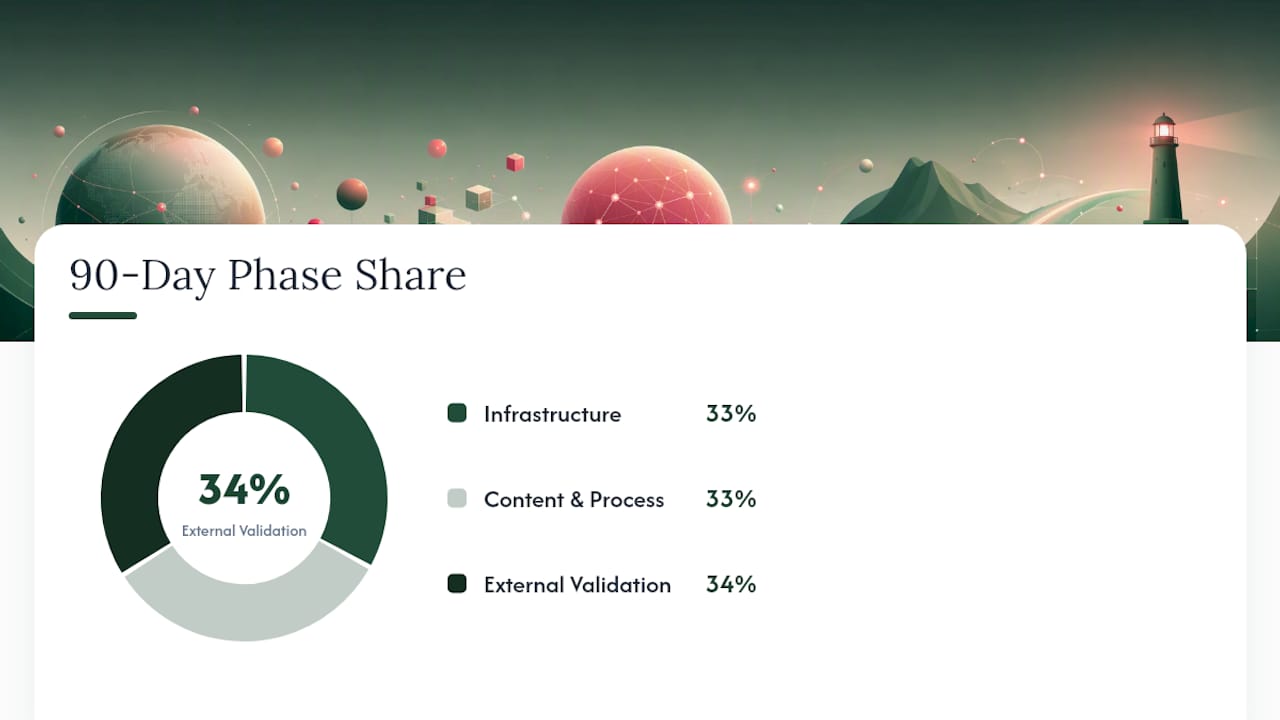
Treating reputation management as a project with a start date and clear phases, rather than a vague ongoing responsibility nobody owns, is what separates strategies that stick from ones that die after the first status meeting. Operationalizing reputation work as a 90-day project that transitions into a standing cadence gives you both urgency and durability.
Before Day 1: Run the baseline audit. Document your current branded search results (screenshots of page one), pull your aggregate ratings across every review platform, log responses from five to ten AI prompts across major assistants, and inventory your owned assets (bios, schema, social handles). This audit is your scorecard’s starting line.
Days 1 through 30 focus on infrastructure and triage: claim unclaimed profiles, fix glaring bio inconsistencies, assign a named reputation owner, install your monitoring stack, and remediate anything urgent (active impersonation, a false review violating platform policy, an outdated executive bio on a high-traffic page).
Days 31 through 60 shift to content and process: launch your review solicitation workflow, publish the first wave of case studies or FAQ content targeting weak search results, and begin Wikipedia hardening if your organization meets notability guidelines.
Days 61 through 90 activate external validation: pitch press and podcast placements, put your founder or executives in front of a few targeted outlets, run your first remeasurement against the baseline, and lock in the ongoing monthly and quarterly cadence.
A simple RACI clarifies who does what, which prevents the classic failure mode where everyone assumes someone else is handling it.
| Task | Responsible | Accountable | Consulted | Informed |
|---|---|---|---|---|
| Baseline audit | Marketing lead | CMO/Owner | IT/Legal | Executive team |
| Review response | Customer service manager | Marketing lead | Legal (escalations) | Sales team |
| Content publishing | Content writer | Marketing lead | Subject matter experts | Full team |
| AI output monitoring | Marketing lead | CMO/Owner | External agency | Executive team |
| Press/PR activation | PR lead or agency | CMO/Owner | Founder/Executives | Full team |
Milestone checks at Day 7 (audit complete, owner assigned), Day 30 (profiles claimed, monitoring live), Day 60 (content published, review workflow running), and Day 90 (first remeasurement, cadence documented) keep the project honest without requiring daily oversight.
After Day 90, the work doesn’t end. It becomes monthly review-response and monitoring checks, plus quarterly AI re-audits and content refreshes, because quarterly re-audits catch drift in how assistants synthesize brand information that daily monitoring simply misses.
What’s Your Protocol When a Crisis Hits?
Reputation crises get worse when the response is improvised. A documented protocol, decided before you need it, is what keeps a bad review from becoming a bad week.
Triage every incoming issue on three criteria: how severe is the reputational damage, is there legal exposure, and how fast is it spreading. A single frustrated review has a different response path than a viral social post alleging discrimination, and treating them identically wastes urgency where it matters and creates panic where it doesn’t.
- Assess severity and involve the right people. Low-severity issues stay with the reputation owner. Anything with legal exposure pulls in counsel immediately, before a public response goes out.
- Draft a holding statement fast. You don’t need the full story to acknowledge the issue. A short, honest statement that you’re looking into it buys time without looking evasive.
- Coordinate one spokesperson. Multiple people responding publicly, even with good intentions, creates contradictions that extend the story’s life.
- Respond in a non-defensive tone and protect privacy. Acknowledge concerns publicly, then move detailed or personal discussion to private channels (email, DM, phone) rather than litigating specifics in a comment thread.
- Decide legal takedown versus content suppression. Legal removal only works for genuinely false, defamatory, or platform-policy-violating content. For lawful but unflattering content, suppression through fresh, authoritative publishing is the realistic path.
Pro Tip: Write your holding statement templates before you need them. A crisis is the worst possible moment to be drafting language from scratch while your legal team, your CEO, and your marketing lead are all messaging you at once.
How Do You Know the Strategy Is Working?
A reputation scorecard turns scattered anecdotes (“someone said something nice about us on LinkedIn”) into a trend line leadership can actually evaluate. The strongest scorecards measure both visibility and operational performance, then tie both back to business KPIs like CAC and hiring cost.
Core KPIs worth tracking on a recurring basis:
- Sentiment trend — the ratio of positive to negative mentions across search and social, tracked monthly.
- Review health — aggregate rating, response rate, and response time.
- Citation share — how often your brand appears in the top results for category-relevant, non-branded searches.
- AI answer accuracy — a simple pass/fail score against your fixed set of quarterly test prompts.
It’s tracking the exact surface your next customer is likely to check.
Set your reporting rhythm in three tiers: a monthly operational check (response rates, new mentions, content published), a quarterly strategic review (sentiment trend, AI re-audit results, scorecard against goals), and an annual refresh (full audit, updated objectives, budget reassessment).
Set expectations honestly. Visibility gains (new content ranking, review response rates improving) typically show up within six to eighteen months. Recovering from a serious reputational hit, the kind involving major press coverage or a sustained negative campaign, can take years of consistent work. Anyone promising a 30-day turnaround on a deep reputation problem is selling something.
How Does an Agency Partner Fit Into This Plan?
Executing all seven pillars in-house, on top of a full marketing calendar, is where most internal teams stall out. This is exactly where a specialist partner like Connection-built earns its retainer: mapping the audit, monitoring, content, and activation phases to actual deliverables instead of a vague promise to “handle reputation.”
A well-structured retainer typically delivers:
- A completed baseline audit with documented findings in the first two to three weeks.
- Monthly monitoring reports covering search, reviews, social, and AI outputs.
- A content calendar producing case studies, FAQs, and bylines tied to specific search gaps.
- Quarterly strategic reviews measuring scorecard movement against original goals.
When evaluating any agency partner, ask for client references you can actually call, confirm they’ll build a scorecard tied to your business KPIs (not vanity metrics), and insist on clear accountability before signing. If they can’t tell you who’s accountable for what by Day 30, that’s your answer.
Connection-built’s success stories show what sustained strategic branding and marketing support looks like when it’s applied consistently rather than in one-off bursts.
An Editorial Take on What Actually Moves the Needle
The biggest mistake I see in reputation planning isn’t a bad tactic. It’s treating the whole effort as a one-off project instead of infrastructure. Companies run a single audit, fix a few glaring issues, feel better, and quietly let the monitoring lapse within six months. Then a review crisis hits and everyone acts shocked that nobody was watching.
Start with exactly two things this week: run the baseline audit across search and AI assistants, and name one person who owns reputation as part of their actual job description, not as an unpaid extra duty. Everything else in this playbook depends on those two moves happening first.
The other mistake worth naming: responding to criticism defensively in public. It rarely wins the argument and it always extends the story’s life. Move the details to a private channel and let your public response stay calm.
Give this eighteen months before judging it. Real reputation work compounds quietly, then all at once.
— Chris
Ready to Put This Plan Into Action?
This agency builds the reputation infrastructure most small businesses and nonprofits never get around to: the canonical website, consistent bios, and content that occupies search real estate before a competitor or a bad review does. Where a generic agency hands you a monthly report and calls it strategy, a specialist agency ties the audit, the content calendar, and the monitoring cadence to the same branding and marketing work already shaping how customers find you.
An initial engagement typically starts with a discovery session to map your current reputation gaps, moves into the 90-day rollout described above, and settles into an ongoing retainer covering monitoring, content, and quarterly reviews. If you’re a small business or nonprofit in West Michigan looking to rebuild or reinforce your public image, start with a look at Connection-built’s marketing and web services or explore real client outcomes to see what a sustained strategy delivers over time. From there, a conversation about your specific audit and rollout is one message away.
Sources
- Reputation Management: How to Protect Your Brand Online
- 14 Reputation Management Trends Brands Should Be Leveraging
- Online Reputation Management Strategy: A 2026 Playbook - LucidRank
- Online Reputation Management: The 2026 Operational Guide
Recommended
Want to talk it through? Start a conversation. https://connection-built.com