
September 9, 2026
SEO Pricing 2026: Budget by Brand Stage with Decision Checklist

Most businesses should expect to pay between $1,000 and $2,500 per month for professional SEO, with hourly consulting running $75 to $150 and one-off projects priced by scope. The budgeting rule that matters most: match your spend to your competition, site complexity, and growth stage, not to whatever number sounds affordable. Nearly 78% of providers structure work as a monthly retainer, which tells you this is a sustained investment, not a one-time purchase.
TL;DR:
- SEO retainers typically range from $1,000 to $2,500 per month for small businesses, with higher budgets needed for enterprise-level campaigns exceeding $5,000 monthly.
- Pricing is heavily influenced by site complexity, industry competitiveness, scope of work, provider experience, and contract terms, not just market averages.
- Content production costs can significantly increase overall expenses, often costing $150 to $1,000 or more per piece, especially for high-quality, expert-written articles.
- Expect results to take at least three to six months, with full impact usually seen between six and twelve months, depending on niche and site conditions.
- Lower-priced SEO packages often rely on automation and templates, while higher budgets usually fund manual outreach, custom content, and comprehensive technical work.
Table of Contents
- SEO Pricing Models: Retainers, Hourly, and Project Rates
- What Determines How Much SEO Costs?
- What Do You Actually Get at Each Price Tier?
- How Do You Choose the Right SEO Pricing Model?
- How Long Does SEO Take to Show Results?
- Sample SEO Budgets by Business Type
- Why Your SEO Budget Should Follow Your Brand, Not Just the Market Rate
- Ready to Turn This Guide Into a Plan?
- Sources
SEO Pricing Models: Retainers, Hourly, and Project Rates
Before you can evaluate any proposal, you need to know what you’re actually being quoted. SEO pricing typically comes in three shapes, and each one fits a different business situation.
Monthly retainers dominate the market. About 78% of SEO providers bill this way, and the reason is simple: search rankings shift constantly, and a strategy built for January often needs adjusting by June. Retainers fund continuous work, technical monitoring, content production, and link acquisition that compounds over time.
Hourly consulting works best for narrow, defined jobs. If you need a technical audit, a keyword strategy session, or a second opinion on an in-house plan, hourly billing avoids locking you into ongoing spend. Typical hourly ranges land between $75 and $150, though some consultants charge up to $200 depending on experience and location.
Project-based pricing covers one-time engagements: site migrations, technical cleanups after a Google penalty, or a content audit with a delivered roadmap. Projects give you a fixed cost and a defined end date, which makes them easier to budget than open-ended retainers.
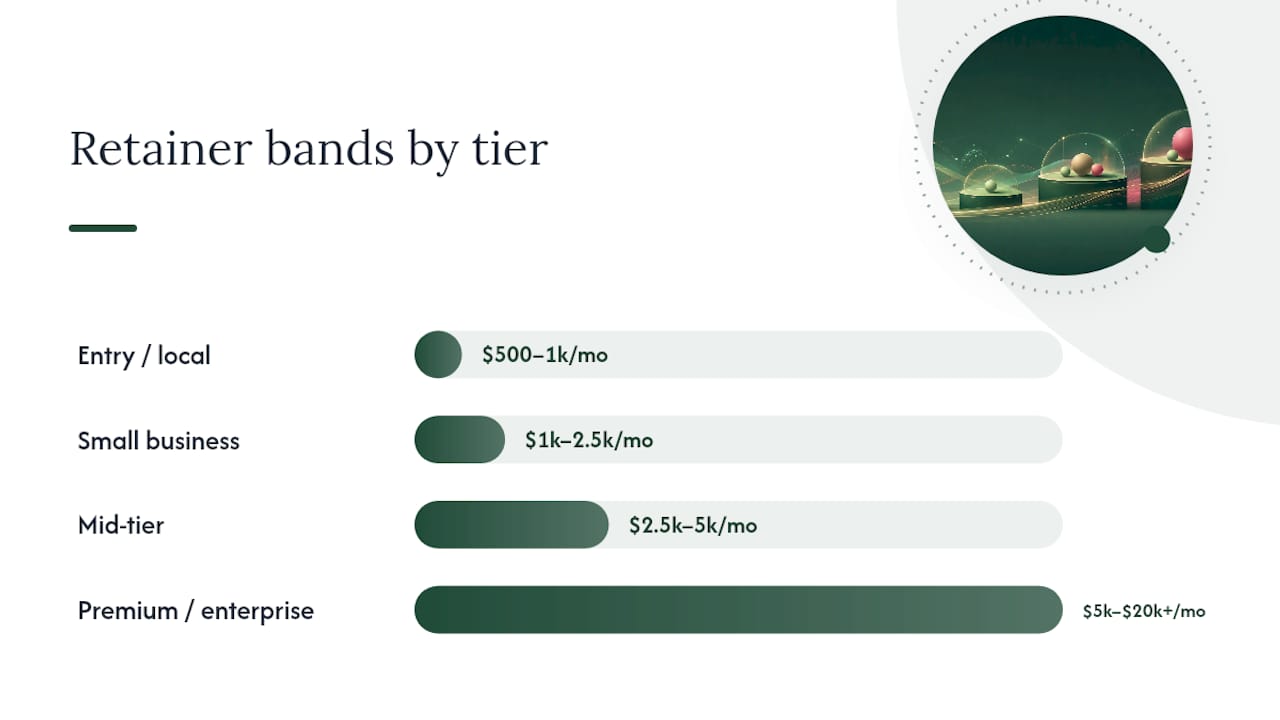
Here’s how those retainer bands typically break down by business tier:
- Entry/local tier: $500 to $1,000/month, often freelancers or small shops handling basic optimization
- Small business tier: $1,000 to $2,500/month, the range where most measurable, sustained growth happens
- Mid-tier: $2,500 to $5,000/month, typically agencies with dedicated specialists
- Premium/enterprise: $5,000 to $20,000+/month, custom-scoped for competitive national or international campaigns
Why do agencies cost more than freelancers? Survey data indicates agencies generally charge significantly more per month than freelancers, reflecting overhead and team resources. That gap reflects overhead, a full team of specialists rather than one generalist, and access to enterprise-grade tools. Enterprise pricing resists any standard range entirely. A national retailer competing for thousands of keywords across dozens of markets needs a scope built from scratch, which is why every serious enterprise quote starts with a discovery call, not a rate card.
Pro Tip: If two proposals quote wildly different monthly numbers for what sounds like the same work, ask each vendor to break down hours by deliverable. The dollar figure means nothing without knowing what it buys.
What Determines How Much SEO Costs?
Price differences between two SEO proposals rarely come down to one company padding its margins. They usually trace back to a specific, identifiable variable. Understanding these levers helps you interpret a quote instead of just reacting to the total.
- Site size and technical complexity: A 20-page brochure site costs far less to optimize than a 5,000-SKU ecommerce catalog with faceted navigation and duplicate content issues.
- Industry competitiveness: Ranking a local bakery for “best cupcakes near me” costs a fraction of what it takes to compete in personal injury law or SaaS project management, where competitors have spent years building authority.
- Scope of work: A plan limited to technical fixes costs less than one that adds content production, local SEO, and active link building on top.
- Provider experience and team composition: A solo freelancer working nights and weekends prices differently than an agency with a strategist, a writer, a developer, and an outreach specialist on staff.
- Current site health: A site recovering from a Google penalty or a botched migration needs diagnostic work before growth work even starts, which adds cost upfront.
- Contract terms and urgency: Month-to-month agreements often cost more per month than a 12-month commitment, since providers price in the risk of early cancellation.
Location plays a role too. A boutique consultant in a lower cost-of-living market may quote less than a comparable agency in a major metro, even when the actual work is identical in quality. That’s not a red flag. It’s just overhead economics.
Pro Tip: Ask any prospective provider what percentage of their current clients have been with them for over a year. High retention usually signals real results; high churn usually signals the opposite.
What Do You Actually Get at Each Price Tier?
A monthly number tells you almost nothing until you know what it buys. Here’s what tends to show up at common budget levels:
- Entry tier ($500 to $1,000/month): Basic technical fixes, minimal content (often one article or none), limited or no link building, and automated reporting rather than a strategist walking you through results.
- Small business tier ($1,000 to $2,500/month): Regular content cadence (two to four pieces monthly), ongoing technical maintenance, some manual outreach for links, and a monthly call with an actual person reviewing performance.
- Mid-tier ($2,500 to $5,000/month): A named team rather than a rotating pool, more aggressive content production, structured link acquisition, and custom reporting tied to business metrics rather than generic ranking screenshots.
- Premium and enterprise ($5,000+/month): Dedicated specialists per discipline, advanced technical work (structured data, international SEO, Core Web Vitals optimization), active digital PR and outreach campaigns, and custom analytics dashboards built around revenue, not just traffic.
Content is where budgets get tested. Quality content production, the kind written by someone who actually understands the subject, often costs $150 to $1,000 or more per piece, which is why many providers treat high-end content as a billable add-on rather than something bundled into a base retainer. Large-scale link campaigns, site migrations, and specialized authoritative outreach frequently fall into the same category. If a proposal seems to include everything for a suspiciously low price, ask which of these pieces are actually inside the number.
How Do You Choose the Right SEO Pricing Model?
Comparing proposals side by side only works if you’re comparing the same things. Before signing anything, run every vendor through the same checklist.
Ask each provider these questions directly:
- Who specifically will be doing the work, and what’s their experience?
- How many hours per month are allocated, and to which tasks?
- Can you show sample deliverables or a redacted case study from a similar client?
- What KPIs will you report on, and how often?
- What happens if the strategy isn’t producing results after six months?
Mapping hours to deliverables, rather than accepting a flat monthly total, exposes exactly where your budget is going, whether that’s content, technical fixes, or outreach.
Watch for these red flags without exception:
- Guaranteed rankings. No legitimate provider can guarantee a specific Google ranking, since no one controls the algorithm except Google itself.
- Vague deliverables. “SEO optimization” with no specifics is a description, not a plan.
- Promises of results in days or weeks. Real movement takes months, not a sprint.
- Suspiciously low prices. Packages under roughly $500/month usually can’t fund the hours needed for genuine content or link work, so they often lean on automation or templated shortcuts instead.
Pro Tip: Lower price often signals a more automated, templated approach, while mid-to-high retainers typically fund human strategists, custom content, and manual relationship-based link building. Price is frequently a proxy for methodology, not just effort.
If you’re weighing in-house hiring against outsourcing, remember that a single in-house SEO hire often costs $60,000 to $90,000 a year in salary alone, before tools and training, and rarely covers every discipline a full retainer team provides.
How Long Does SEO Take to Show Results?
SEO rewards patience more than any other marketing channel, and the timeline is fairly predictable. Expect initial technical fixes in the first one to three months, early measurable gains (more impressions, some keyword movement) around three to six months, and fuller business impact, real traffic and conversion growth, closer to six to twelve months out.
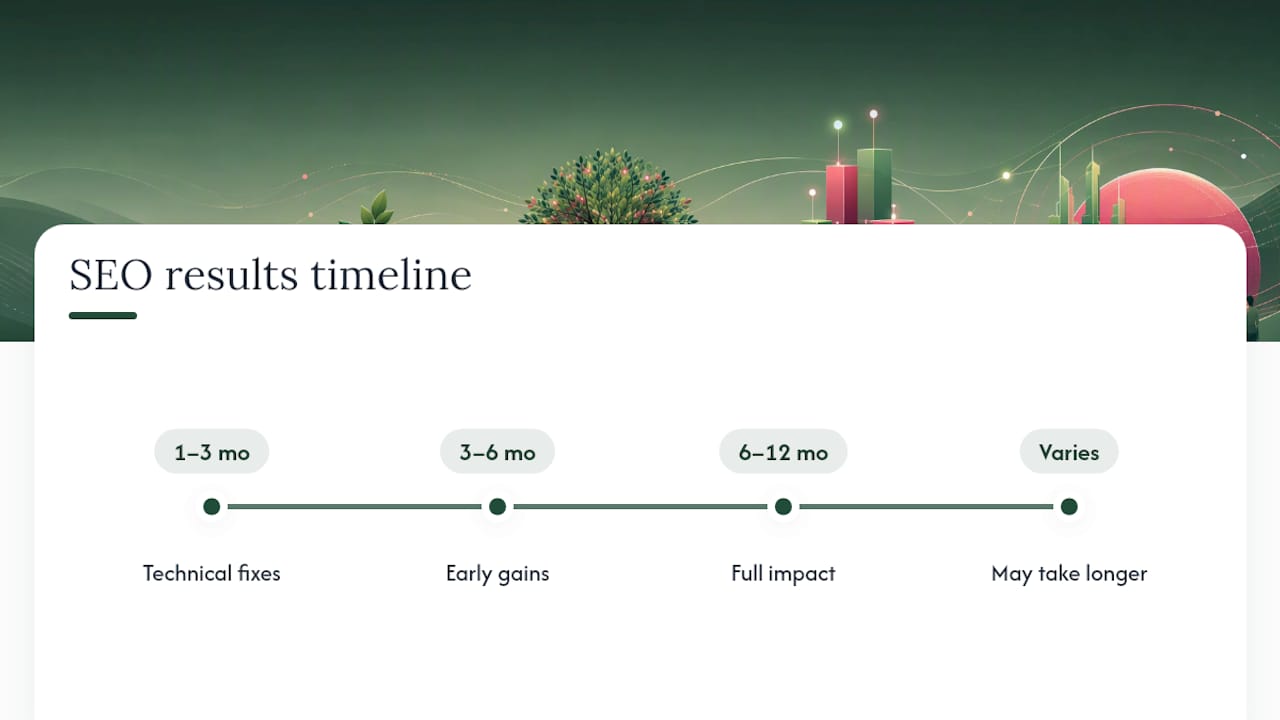
Practitioners commonly recommend committing to at least three to six months before judging results, with full ROI often materializing closer to the twelve-month mark. Competitive niches, heavy technical debt, and a large content backlog all stretch that timeline further. A clean, well-structured site in a low-competition niche might see gains faster than the average; a site recovering from years of neglect in a crowded market should plan for the longer end.
Sample SEO Budgets by Business Type
- Small local shop: A retainer in a moderate monthly range focused on local search optimization, Google Business Profile management, and several location-relevant content pieces monthly.
- SaaS startup: A $1,500 to $3,000/month retainer prioritizing technical SEO, product-led content, and early link building to establish domain authority before competitors lock in the top results.
- Mid-market ecommerce: A $2,500 to $5,000/month investment covering category and product page optimization, technical crawlability fixes, and ongoing content to support a growing catalog.
- Enterprise or national brand: Pricing here is fully custom, but expect a starting band north of $5,000/month, scaling based on market count, keyword volume, and the size of the content and outreach team required.
Why Your SEO Budget Should Follow Your Brand, Not Just the Market Rate
The businesses that get the most from their SEO spend aren’t the ones chasing the cheapest quote. They’re the ones treating search visibility as one piece of a larger brand and growth plan. A budget disconnected from your actual positioning, messaging, and website experience tends to produce traffic that doesn’t convert. At Connection-built, we build SEO budgets around what a business is actually trying to become, not just what a keyword tool suggests.
— Chris
Ready to Turn This Guide Into a Plan?
You now have the ranges, the red flags, and the checklist. What most businesses need next is someone to translate that into a plan built around their actual brand and growth stage, not a generic package. A typical SEO service provider structures work in three steps: an audit to see where you stand, a scoped project for the fixes that matter most, and an ongoing retainer once the foundation is solid.
That progression mirrors the checklist in this guide: clear deliverables, named hours, and reporting tied to business outcomes instead of vanity metrics. If your current SEO spend feels disconnected from your brand or your growth goals, it’s worth a conversation. Explore Connection-built’s approach for small business marketing or check out results from past client work to see how integrated strategy plays out in practice. If you’re ready to talk numbers and scope, reach out about a marketing and SEO plan built around where your business actually stands.
Sources
- SEO Pricing: How Much Does SEO Cost? 439 People Polled — Ahrefs
- How Much Does SEO Cost? – Forbes Advisor
- SEO Pricing: How Much Does SEO Cost in 2026? — Backlinko
- How Much Does SEO Cost in 2026? Pricing Guide — Shopify
Recommended
Want to talk it through? Start a conversation. https://connection-built.com