
September 10, 2026
Systems Before Scale, a 90 Day Small Business Growth Strategy

The single most important small business growth strategy right now is disciplined operations, not aggressive expansion. Build repeatable systems, protect the customers you already have, and run every new idea through a scoring filter before you fund it. In the coming weeks, document your top operational procedures, launch a retention offer, and score your ideas before acting on them. The roadmap below shows you exactly how.
TL;DR:
- Prioritize documenting essential operational procedures like onboarding, billing, and handoffs before scaling to ensure consistent delivery and prevent chaos.
- Focus on retention efforts such as referral programs and email nurture sequences, since existing customers are more cost-effective for growth than acquiring new ones.
- Use a simple scoring matrix to evaluate new ideas and pilot the highest-ranking options over a short period to avoid resource drain on poor-fit initiatives.
- Consolidate tools by adopting a single CRM and automation layer to reduce information loss and waste in small teams.
- Track key metrics weekly, including customer acquisition cost, lifetime value, and retention rate, to make timely, informed growth decisions.
Table of Contents
- Top Small Business Growth Strategies at a Glance
- Build Scalable Systems and Capacity Before You Grow
- Marketing and Sales Strategies That Actually Move the Needle
- Which Automation and AI Tools Actually Help Small Teams?
- How to Pilot New Products Without Breaking Your Business
- Prioritization Framework: Scoring Matrix and 90-Day Roadmap
- What KPIs Should You Track for Sustainable Growth?
- Approach to Smart Growth
- A Straight Take on Why Most Growth Advice Fails Small Businesses
- How Connection-built Helps You Put This Into Practice
- Sources
- FAQ
Top Small Business Growth Strategies at a Glance
Growth compounds when you fix the fundamentals before chasing new customers. Pick one to three items from this list and commit to testing them for the next 30 to 90 days, rather than trying all fifteen at once.
Operations
- Document your top three SOPs (onboarding, billing, handoffs) — cuts errors and frees your time for growth work.
- Run a weekly capacity audit — prevents overpromising to new clients.
People
- Hire by role, not by resume gut-feel — improves fit and cuts turnover.
- Build a 30/60/90 onboarding plan — shortens time to full productivity.
Marketing & sales
- Launch a referral program — increases lifetime value and lowers acquisition cost.
- Build a two-step email nurture sequence — improves conversion without added ad spend.
Tech and automation
- Consolidate to one CRM — reduces missed follow-ups.
- Automate one repetitive task this month — reclaims hours for revenue work.
Product and market expansion
- Pilot one new offer with a fixed end date — tests demand before you overinvest.
Finance
- Switch to a rolling weekly cash forecast — catches shortfalls before they become emergencies.
- Track gross margin by service line — reveals where profit actually hides.
Build Scalable Systems and Capacity Before You Grow
Most small businesses don’t break from lack of demand. They break because nobody wrote down how the work actually gets done, so growth just multiplies the chaos. Sustainable scaling depends on repeatable delivery, clear role definitions, and full financial visibility — three markers you should confirm exist before you take on more customers than your current setup can handle.
Start with SOPs. You don’t need fifty documented processes on day one. You need the three that touch every customer: onboarding, billing, and internal handoffs between team members. These are where growth usually reveals its cracks first, because they’re the moments a customer notices when something slips.
Hiring works the same way. Skip the resume-only decision and build a short skills test or a paid trial task tied to the actual role, scored against a simple rubric. This catches mismatches before they cost you a quarter of ruined momentum.
Here’s a quick operational audit to run this week:
- List every task a new customer touches from inquiry to delivery.
- Flag which steps live only in someone’s head, not on paper.
- Time each step to identify your real capacity ceiling.
- Rank the three most fragile handoffs for documentation first.
Pro Tip: Start SOP documentation with billing before anything else. Billing errors erode trust faster than almost any other operational failure, and they’re usually the easiest process to write down in under an hour.
Marketing and Sales Strategies That Actually Move the Needle
Retention beats acquisition, full stop. Most customers are more likely to buy again from a business they’ve already purchased from than to convert as a fresh lead, which makes your existing customer list the cheapest growth channel you own. Before you spend another dollar on new-customer ads, build a minimal sales playbook: a scripted response for your top three objections, a defined follow-up cadence, and clear conversion checkpoints so you know where prospects stall.
Then match your channel to your actual goal instead of chasing whatever platform is trending:
- Email nurture sequences for shortening time-to-value after a first purchase.
- Referral incentives for lowering acquisition cost using existing happy customers.
- Targeted local partnerships for reaching a narrow audience without ad-spend waste.
- Direct outreach for high-ticket services where personal contact converts better than automation.
Measure everything against customer acquisition cost versus payback period, not vanity metrics like impressions. And don’t underestimate the experience itself: roughly 80% of buyers now say experience matters as much as the product or service quality. A clunky handoff after the sale can undo a great marketing campaign in a single interaction.
Which Automation and AI Tools Actually Help Small Teams?
You need one CRM, one shared documents home, and one automation layer. That’s it. Every additional tool you bolt on creates a new place for information to get lost, and small teams pay for that fragmentation in wasted hours more than in subscription fees.
Small businesses see the most value from automation in three specific areas: customer support triage, draft-stage proposal generation, and basic performance analytics. These are repetitive, rules-based tasks where AI removes grunt work without touching the judgment calls that actually need a human.
Roll out any new automation carefully:
- Test it on a small batch of real cases before full deployment.
- Monitor outputs weekly for the first month.
- Keep a manual rollback option ready in case the automation misfires.
- Document the new workflow the moment it stabilizes.
Pro Tip: Measure automation ROI as time saved multiplied by your margin per hour, not just “hours freed up.” A tool that saves five hours a week is worth far more in a 40% margin business than a 10% margin one.
How to Pilot New Products Without Breaking Your Business
Test before you commit. Pick a fixed sample size, a short timeline (four to eight weeks works for most services), a clear success metric, and a price point you’re willing to defend, then run the pilot exactly as designed without mid-course changes.
- Define the pilot: sample size, timeline, pricing, and the one metric that decides success or failure.
- Score the idea using impact, effort, and fit before you even launch it.
- Decide upfront whether success means expanding distribution or deepening your existing offer.
- Collect feedback within 48 hours of each pilot interaction, while it’s still fresh.
A weighted scoring matrix keeps you from chasing whatever idea feels exciting this month instead of the one with real operational fit.
Prioritization Framework: Scoring Matrix and 90-Day Roadmap
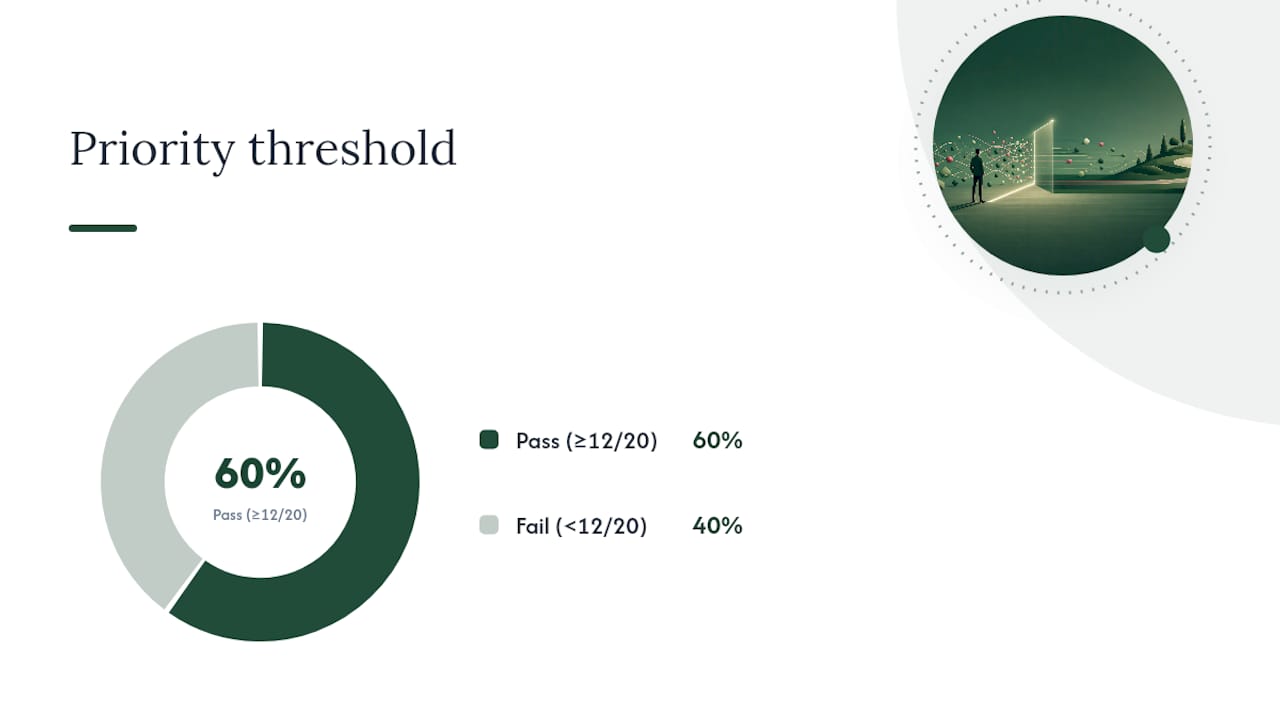
A feasibility or scoring matrix prevents you from funding vanity projects that feel good but drain resources from initiatives with actual traction. Score every idea on four factors, 1 to 5 each: impact, effort, current capacity, and payback speed. Anything scoring below 12 out of 20 gets shelved.
A sample 90-day roadmap:
- Days 1 to 30: Document core SOPs, audit capacity, launch one retention offer, and score your idea backlog.
- Days 31 to 60: Run your highest-scoring pilot, track weekly KPIs, and adjust the sales playbook based on early conversion data.
- Days 61 to 90: Decide whether to scale the pilot, kill it, or extend testing, then document the winning process as a new SOP.
Watch for red flags along the way: rising acquisition cost with flat retention, capacity strain showing up as missed deadlines, or a pilot that needs constant manual rescue to survive. Any of those means pause, not push forward.
What KPIs Should You Track for Sustainable Growth?
Track six numbers weekly, not monthly: customer acquisition cost (CAC), lifetime value (LTV), gross margin, retention or churn rate, time-to-value for new customers, and cash runway in weeks.
- CAC vs. LTV: if LTV isn’t at least three times CAC, your growth engine is running at a loss.
- Gross margin by offer: reveals which services are quietly subsidizing the others.
- Churn rate: even small improvements here often outperform new-customer campaigns.
- Cash runway: a rolling weekly cash forecast catches shortfalls that a static monthly budget misses entirely, especially around payroll timing and large vendor payments.
Run a 30-minute weekly review of these six numbers with your leadership team. Decide what changes in the next seven days based on what moved, not on what you hoped would move.
Approach to Smart Growth
Growth builds around the same discipline this article describes: clarify your message first, align every marketing effort behind it, then install the systems that make growth repeatable instead of chaotic.
- Brand clarity work that removes the disconnect between what your business actually does and how customers currently perceive it.
- Marketing alignment across web, SEO, and social so every channel points to the same story.
- People strategy and onboarding systems that turn engaged, well-supported employees into a real driver of customer experience and retention.
- Fractional marketing support for teams that need senior strategy without a full-time hire.
See how this plays out for real clients on the success stories page, or review the full scope of work on the services overview.
A Straight Take on Why Most Growth Advice Fails Small Businesses
Most growth content sells excitement: new channels, new tools, new campaigns. The businesses that actually scale sustainably do something far less glamorous. They write down their onboarding process. They forecast cash weekly instead of guessing monthly. They say no to good ideas that score poorly on a simple matrix. None of that trends on social media, but it’s the difference between a business that grows and one that just gets busier and more fragile. Pick one system to document this week. Start there.
— Chris
How Connection-built Helps You Put This Into Practice
This is an alternative to hiring a full marketing department when aligned strategy and execution are needed. Instead of juggling multiple freelancers, you get integrated support that clarifies brand story, builds marketing systems, and helps install the operational discipline this article describes.
A starter engagement typically begins with a clarity conversation about brand message, customer perception, and missing systems before growth can stick. From there, a plan is mapped across branding, marketing, and people strategy so every piece works together instead of competing for attention. If you’re ready to see what that looks like for your business, start with the small business marketing services page and take the next step toward a plan built specifically around where you are right now.
Sources
- The full stack growth system: a six-part framework for scaling revenue — Forbes Business Council
- How to develop business growth strategies that drive results — HBS Online
- 7 small business growth strategies for 2027 — Salesforce Blog
- Scale a small business with limited resources — SBDC (University of Houston)
FAQ
What Business Will Boom in 2026?
No single industry has a guaranteed boom. The businesses that grow reliably tend to be the ones with strong retention systems and disciplined operations, regardless of sector.
What Are the 7 Stages of Business Growth?
Definitions vary across sources, but most models track a path from existence and survival through early growth, expansion, maturity, and eventual renewal or decline. The stage matters less than whether your systems can support the stage you’re actually in.
What Business Has a 90% Success Rate?
Survival odds improve dramatically for any business that builds repeatable systems and tracks cash weekly rather than guessing at growth.
What Are the 5 P’s of Business Strategy?
Common versions include product, price, place, promotion, and people, though frameworks vary by source. What matters more for small businesses is whether your strategy connects those elements to a clear growth plan, as HBS Online notes, rather than treating them as a checklist.
How Do I Choose the Right Small Business Growth Strategy?
Score every option on impact, effort, current capacity, and payback speed, then commit to the one to three highest scorers instead of pursuing every idea at once. Connection-built builds this prioritization directly into its brand and marketing planning process.
Recommended
Want to talk it through? Start a conversation. https://connection-built.com