
September 20, 2026
4 Ready to Use Social Media Guidelines HR Can Apply to Employees

A practical social media guideline for employees defines scope and authorized speakers, protects confidential information, preserves employees’ legal rights, and gives HR ready-to-use procedures for crises and enforcement. Get those four things right and you’ve built a policy that guards the brand without silencing your people. The next step is simple: adopt tailored language for each section below, then train every manager to apply it consistently.
TL;DR:
- Employees’ personal posts remain protected unless they disclose employer affiliation, share confidential information, or relate to harassment or leakage of sensitive data.
- Authorized posters should use strong security measures like multi-factor authentication and follow clear approval workflows before posting on official accounts.
- Crisis response procedures should be rapidly initiated within the hour, with predefined triage criteria to assess risk levels and decide on public or internal responses.
- Enforcement must follow a legal ladder: informal retraining for first offenses, warnings for repeated issues, and formal discipline or termination for severe violations, all reviewed by legal.
- Monitoring should be limited to public content, with transparency about what data is tracked, and should avoid private accounts or messages to maintain trust and legal compliance.
Table of Contents
- What Should a Social Media Policy for Employees Include?
- Personal Accounts vs. Official Accounts: Where’s the Line?
- What Happens When a Post Goes Wrong?
- What Are the Legal Guardrails for Enforcement?
- Ready-to-Use Policy Language You Can Paste In
- How Do You Roll Out the Policy Without It Getting Ignored?
- How Should Companies Monitor Employee Social Media Activity?
- Does the Policy Apply to What Employees Post After Hours?
- How Can Employees Protect Their Own Privacy on Social Media?
- How Should Employees Handle Customer Interactions on Social Media?
- Can Employers Use Social Media Monitoring Tools?
- Who Owns the Content Employees Create for Social Media?
- Connection Built Perspective: Policy as a Tool for Advocacy, Not Silence
- How Connection Built Helps You Put This Policy to Work
- Sources
- FAQ
What Should a Social Media Policy for Employees Include?
Every defensible policy starts with the same architecture, and getting the structure right matters more than getting every sentence perfect. The Society for Human Resource Management frames a social media policy as a piece of the broader code of conduct, one that has to name both professional accounts and the personal ones that could still touch the company’s reputation.
Start with scope. Spell out who the policy covers (full-time staff, part-time staff, contractors, interns) and which platforms count. Then define your terms clearly enough that nobody can plead confusion:
- Official accounts: channels the organization owns, controls, and posts under its own name or logo.
- Personal accounts: an employee’s individual profiles, even when a bio mentions where they work.
- Confidential information: financial data, unreleased products, client lists, internal strategy, and anything covered by an NDA.
- Authorized posters: the specific people cleared to publish on official channels, plus their backup coverage.
Authorized-poster rules deserve their own subsection. Government agencies model this well: the OPM’s social media policy lays out branding standards, an approval workflow, and clear authorization steps before anyone posts on an agency’s behalf. Borrow that structure. Require a password manager for shared logins, mandatory multi-factor authentication, and immediate access removal when someone leaves the team.
Disclosure rules come next. When employees promote company products or services, the FTC requires them to disclose that connection clearly and close to the endorsement, not buried in a bio or a hashtag string at the end of a caption.
Finally, add a savings clause. This is the sentence that keeps your policy legal, and it belongs in every version you publish, no exceptions.
Pro Tip: Write your savings clause first, before drafting any restriction. Every other rule in the policy should be tested against it: “Does this language risk chilling a protected conversation about pay or working conditions?” If yes, rewrite it.
Personal Accounts vs. Official Accounts: Where’s the Line?
Employees’ personal posts become the company’s business only in specific circumstances: when someone identifies their employer while posting hate speech, when a public-facing role blurs the line between “me” and “the brand,” or when a post reveals confidential information regardless of privacy settings. Outside those triggers, personal expression stays personal.
A common fix is a disclaimer like “Views are my own and don’t represent my employer.” It helps, but it isn’t a shield. Courts and employers both recognize that a disclaimer doesn’t erase harm if the post includes harassment, threats, or leaked data.
Give employees concrete boundaries instead of vague warnings:
- Permitted: sharing a job posting, celebrating a work win, discussing pay or scheduling frustrations, commenting on industry news.
- Permitted with care: tagging the company in personal opinions on hot-button topics; encourage a disclaimer here, don’t mandate one.
- Prohibited: posting confidential documents, harassing coworkers or clients, impersonating the company, or speaking on the organization’s behalf without authorization.
Executives and public-facing employees need a tighter version of this list, since their personal accounts carry brand weight whether they intend it or not. Spell out that spokespeople and leadership should route anything company-related through the communications team before posting, even on personal channels.
What Happens When a Post Goes Wrong?
Build the crisis playbook before you need it, not during the fire. A workable sequence looks like this:
- Flag it fast. Whoever spots the post (HR, marketing, a coworker) alerts a designated point person within the hour.
- Notify the chain. HR, communications, legal, and IT get looped in simultaneously, not sequentially.
- Triage the risk. Weigh the employee’s seniority, how closely the post relates to their job, and how extreme the content is. The Australian Public Service’s social media guidance uses exactly this three-factor lens to judge proportional response.
- Draft the correction. Legal and comms approve any public statement before it goes live; speed matters, but accuracy matters more.
- Decide on public acknowledgment. Only address the incident publicly if the post reached a wide audience or affects customers directly.
- Document everything. Screenshot the post, log the timeline, and record every decision for the disciplinary file.
Pro Tip: Assign backups for every role in the notification chain. Crises rarely happen when your general counsel is sitting at their desk.
What Are the Legal Guardrails for Enforcement?
Get the legal foundation wrong and the rest of the policy collapses, no matter how well you’ve written the tone. Three bodies of law and guidance shape almost every clause you’ll draft.
The National Labor Relations Act protects “protected concerted activity”, meaning employees can discuss wages, hours, and working conditions online, including criticism of management, without fear of discipline. A policy that could reasonably be read to chill that conversation risks an NLRB challenge, which is exactly why the savings clause isn’t optional decoration. It’s the clause that keeps an otherwise reasonable policy from becoming unenforceable.
Password and access limits matter just as much. Legal templates consistently advise against requiring employees to hand over personal account passwords, and several state privacy laws back that up directly.
On the marketing side, the FTC’s endorsement rules apply the moment an employee promotes a product they’re connected to professionally. Skipping disclosure isn’t just a policy violation. It’s a regulatory exposure for the company.
Enforcement itself should follow a consistent ladder:
- First offense: informal conversation and retraining.
- Repeat or moderate offense: written warning, documented in the employee file.
- Severe offense (leaked confidential data, harassment, impersonation): formal discipline, potentially termination.
- Every stage: legal review before finalizing consequences tied to online speech.
A SHRM analysis of effective social media policies points to the same pattern across organizations that avoid legal trouble: clear definitions, a documented crisis process, and named spokespeople, reviewed and signed off by legal counsel before publication.
Ready-to-Use Policy Language You Can Paste In
You don’t need to draft these clauses from scratch. Adapt the following starting points to your organization’s voice and jurisdiction, then have counsel review the final version.
- Purpose statement: “This policy exists to protect [Company]'s reputation, safeguard confidential information, and support employees in engaging online professionally and personally.”
- Confidentiality clause: “Employees may not share proprietary, financial, or unreleased company information on any social platform, public or private.”
- Disclosure clause: “Employees who endorse [Company] products or services on personal accounts must disclose their employment relationship clearly, per FTC guidelines.”
- Authorized posters clause: “Only individuals designated by the Marketing or Communications team may post on official company accounts. Credentials are managed through [password manager] with mandatory MFA.”
- Savings clause: “Nothing in this policy is intended to restrict employees’ rights under Section 7 of the National Labor Relations Act to discuss wages, hours, or working conditions.”
Adjust the confidentiality and disclosure language for regulated industries like healthcare or finance, where additional statutes may apply.
How Do You Roll Out the Policy Without It Getting Ignored?
A policy nobody reads protects nobody. Build the rollout with the same intention as the document itself.
- Add it to onboarding. New hires review and sign the policy in week one, not buried in a stack of forms.
- Run annual refreshers. Platforms and risks change fast enough that a one-time training goes stale within a year.
- Train managers separately. Give them scenario-based practice, not just a copy of the handbook, since they’re the ones fielding real-time questions.
- Keep it visible. Store the policy in the employee handbook and your HRIS, and link to it from every internal comms channel.
- Collect feedback. Ask employees what’s unclear during reviews, and revise the language accordingly. Workable’s guidance on company social media policy notes that policies land better, and get followed more consistently, when employees have a hand in shaping them.
How Should Companies Monitor Employee Social Media Activity?
Limit monitoring to what’s publicly visible. Friending, following under a fake name, or requesting access to private accounts to check on employees crosses a line that damages trust faster than any single bad post could.
Track outcomes instead of surveillance:
- Incidents reported and how quickly they’re resolved.
- Repeat issues by department or role, which often point to a training gap rather than a personnel problem.
- Employee advocacy participation, since a policy that enables sharing should show rising engagement, not shrinking silence.
- Consistency of enforcement, documented so similar violations get similar consequences regardless of who committed them.
Keep records of every reported incident and every disciplinary outcome. Consistent documentation is what protects the company if an enforcement decision is ever challenged.
Does the Policy Apply to What Employees Post After Hours?
Yes, but only within limits, and the limits matter as much as the coverage. A policy can reasonably address after-hours posts when they identify the employer, involve confidential information, or constitute harassment of a coworker, client, or the company itself. It cannot reasonably reach into an employee’s private opinions on politics, religion, or personal life simply because they happen to work for you.
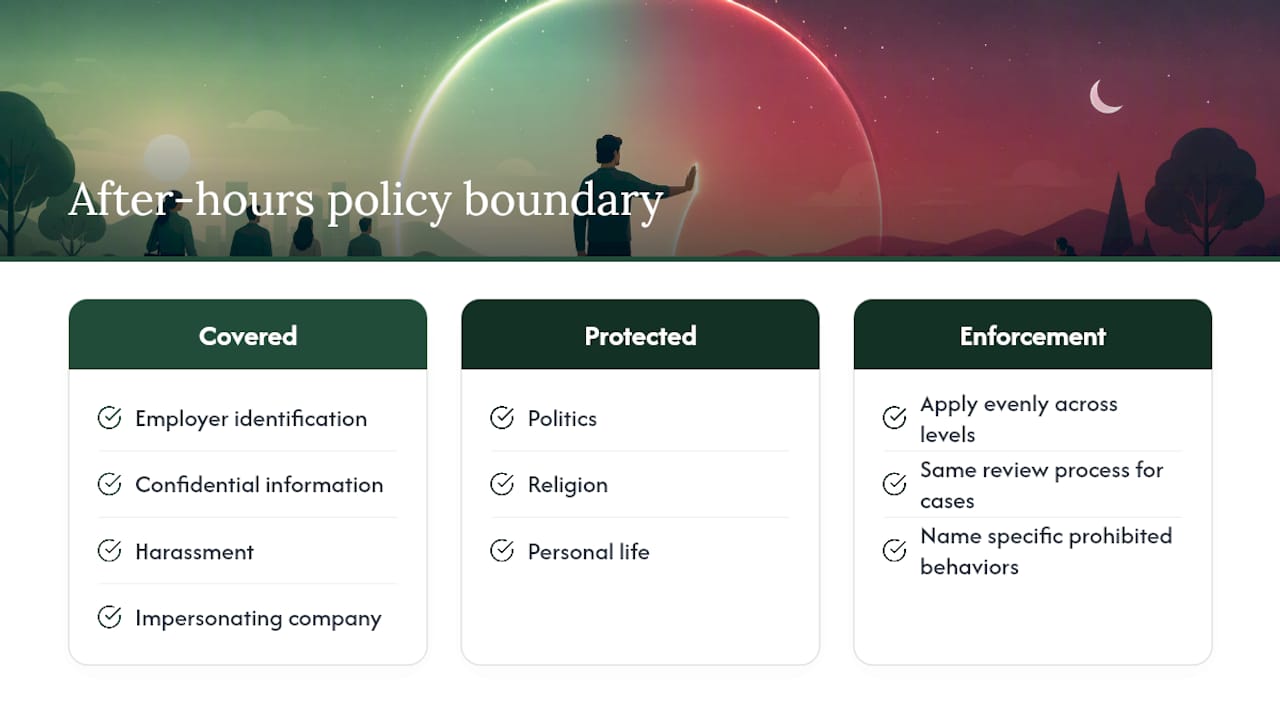
Write the after-hours section with restraint. Broad language like “employees may not post anything that reflects poorly on the company” invites exactly the kind of NLRB scrutiny discussed earlier, since “reflects poorly” is vague enough to sweep in protected complaints about pay or scheduling. Narrow it instead: name the specific behaviors that cross the line (harassment, leaking confidential data, impersonating the company) rather than banning a broad category of “bad” speech.
Off-duty conduct policies also need to apply evenly across seniority levels. A junior employee’s vent post and an executive’s public complaint about a client carry different reputational weight, but the process for reviewing each should follow the same triage steps, not a different standard depending on title. Consistency here is what keeps enforcement defensible if it’s ever tested.
How Can Employees Protect Their Own Privacy on Social Media?
Encourage employees to treat their privacy settings as an active decision, not a default they set once and forget. Platforms change their sharing defaults often enough that a setting locked down last year may be public again this year without anyone noticing.
A few habits are worth building into training material directly:
- Separate professional and personal profiles where the platform allows it, so a work-adjacent audience isn’t seeing every personal post.
- Review tagged-photo and location settings regularly, since these often leak more information than the posts themselves.
- Avoid oversharing schedules or travel, which can create physical security risks, not just reputational ones.
- Use strong, unique passwords and enable MFA on personal accounts, the same standard you require for company logins.
None of this belongs in the disciplinary section of your policy. Frame it as guidance in the training materials instead, positioned as protecting the employee, not policing them. That framing shift changes how the whole document lands with staff.
How Should Employees Handle Customer Interactions on Social Media?
Customer-facing social interactions need their own lane in the policy, separate from personal-conduct rules. Anyone responding to a customer comment, complaint, or direct message on behalf of the company should follow a consistent tone guide and escalation path, especially when the interaction turns negative.
Set a clear rule: employees who aren’t designated spokespeople should not respond to customer complaints on official channels, even with good intentions. A well-meant reply from an unauthorized account can contradict official messaging or make a promise the company can’t keep.
For authorized responders, build in a few non-negotiables:
- Acknowledge quickly, even if the full resolution takes longer, since silence reads as indifference.
- Move detailed disputes to a private channel (DM, email, phone) rather than negotiating specifics in public comments.
- Never argue publicly with a customer, regardless of how unreasonable their comment seems.
- Loop in a manager for anything involving a refund, legal threat, or repeated complaint pattern.
If your organization runs regular reputation monitoring, a resource like this guide to managing online reputation for small and midsize businesses offers a useful framework for tracking and responding to public sentiment beyond individual customer replies.
Can Employers Use Social Media Monitoring Tools?
Monitoring tools that scan public mentions, hashtags, or brand tags are common and generally fine to use, since they’re scanning content the employee already chose to make public. The line gets crossed when monitoring extends into private messages, closed groups, or anything requiring login credentials the employee hasn’t voluntarily shared.
If your organization deploys a monitoring tool, disclose that fact in the policy itself. Employees should know, in writing, what’s being tracked (brand mentions, public posts tagging the company) and what isn’t (private accounts, personal messages, activity unrelated to the company). Transparency here isn’t just good practice, it’s what keeps the monitoring defensible if an employee ever challenges it.
Consent matters most when monitoring extends beyond public content, such as software that tracks an employee’s activity across company-issued devices. That kind of monitoring needs its own explicit consent language, separate from the general social media policy, and should be reviewed against your state’s privacy statutes before rollout.
Who Owns the Content Employees Create for Social Media?
Intellectual property questions get complicated fast once employees start creating content, and this is one of the most frequently overlooked sections in a first-draft policy. Content an employee creates specifically for official company accounts, during work hours, using company resources, generally belongs to the company under standard work-for-hire principles. Spell that out explicitly rather than assuming it’s obvious.
Personal content is different. If an employee shoots a video on their own time, on their own account, and simply mentions the company, ownership stays with them, even if the company benefits from the exposure. Trouble arises in the gray zone: an employee-created reel using company branding, filmed on company premises, but posted to their personal account.
Address that gray zone directly in the policy with a licensing clause rather than leaving it ambiguous. A simple structure works: the company retains rights to use, repost, and adapt any content created using company branding or resources, regardless of which account it originated from, while the employee retains authorship credit. Put this in writing before the first viral employee video creates a dispute nobody anticipated.
Connection Built Perspective: Policy as a Tool for Advocacy, Not Silence
The best social media guideline protects the brand and turns employees into genuine advocates instead of nervous bystanders. A rigid, restriction-heavy policy does the opposite: it teaches people to say nothing rather than risk saying the wrong thing. The fix isn’t fewer rules, it’s clearer ones, paired with a simple content library or approval workflow that gives employees pre-cleared material to share confidently. Explore how social media strategy support can turn policy into participation.
— Chris
How Connection Built Helps You Put This Policy to Work
Drafting the policy is only half the job. Getting employees to actually understand it, follow it, and feel good about it takes training, templates, and a rollout plan that fits how your team actually works. That’s where Connection-built’s approach differs from a generic legal template: instead of handing you a document and walking away, we build the social media strategy, training materials, and content libraries that make the policy usable from day one.
A typical engagement starts with a review of your current policy (or a blank page, if you don’t have one yet), moves into tailored language for your industry and team structure, and ends with a rollout plan your managers can actually run. For nonprofit leadership teams balancing donor trust with staff advocacy, the same framework extends into mission storytelling and donor engagement work as well.
If you’re ready to turn a policy binder into a working system, start by reviewing Connection-built’s services and book a conversation about your rollout.
Sources
- How to Create an Effective Social Media Policy | SHRM
- NLRB — Protected Concerted Activity
- OPM social media policy (example)
- Forms-legal
FAQ
What Is the 5-3-1 Rule for Social Media?
The 5-3-1 rule is a content planning guideline, not a legal or HR standard: it suggests sharing 5 curated pieces from others, 3 original posts, and 1 personal or behind-the-scenes update per week. It has no bearing on workplace social media policy or employee conduct rules.
Can My Employer Tell Me What I Can and Can’t Post on Social Media?
Employers can set reasonable rules about confidential information, harassment, and impersonation, but they cannot lawfully restrict discussions of wages or working conditions under the NLRA. A policy that’s too broad risks violating employees’ protected rights.
Can an Employer Discipline an Employee for Social Media Posts?
Yes, when the post violates a clearly written policy covering confidentiality, harassment, or impersonation. Discipline should follow a proportional ladder, from a warning to formal action, and should never target posts about pay, scheduling, or working conditions protected under labor law.
Should Employees Be Allowed to Use Social Media at Work?
Most policies allow limited personal use during breaks while restricting it during focused work time, rather than banning it outright. The SHRM framework recommends pairing any usage limits with clear definitions so employees know exactly where the line sits.
Want to talk it through? Start a conversation. https://connection-built.com