
August 27, 2026
Website Redesign Cost: SMB Budgets $3K–$65K, Scoping Checklist

Small business redesigns typically run $3,000 to $15,000, mid-market projects with custom features land between $15,000 and $65,000, and enterprise rebuilds start around $65,000 and climb past $160,000. The rule that governs which band applies to you: scope before price. Expect variance, and budget separately for content migration, media, and third-party integrations, since those add-ons rarely appear in the headline number.
TL;DR:
- Smaller projects through $15,000 focus on quick template upgrades, with custom features significantly increasing costs at mid-market and enterprise levels.
- Content migration, unique page templates, and integrations like CRM or APIs are the main drivers expanding the budget beyond the base scope.
- Proper project phases, especially discovery and QA, should represent about 10% to 20% of the total, with clear itemized proposals enabling better comparison and negotiation.
- Rushed timelines or scope cuts often lead to higher costs or missed deliverables, making upfront planning and milestone payments essential.
- Post-launch costs such as hosting, maintenance, and security support roughly add 15% to 20% annually of the initial redesign investment.
Table of Contents
- Website Redesign Cost Ranges at a Glance
- What Actually Drives the Cost of Website Redesign Pricing
- The Phase-by-Phase Breakdown Behind Every Website Redesign Quote
- How to Scope a Redesign and Get Quotes You Can Actually Compare
- Cutting Website Redesign Costs Without Cutting Results
- How Long a Redesign Actually Takes
- Budgeting for What Comes After Launch
- Making the Business Case to Stakeholders
- How Connection-built Scopes Redesign Budgets to Avoid Surprises
- What I’ve Learned Negotiating Redesign Quotes for Small Businesses
- Get an Itemized Website Redesign Quote That Actually Matches Your Goals
- Sources
Website Redesign Cost Ranges at a Glance
Most cost conversations skip straight to a number, but the number only makes sense once you know what tier of project you’re actually buying. Website redesign pricing splits into three practical bands, and each one maps to a different kind of business problem.
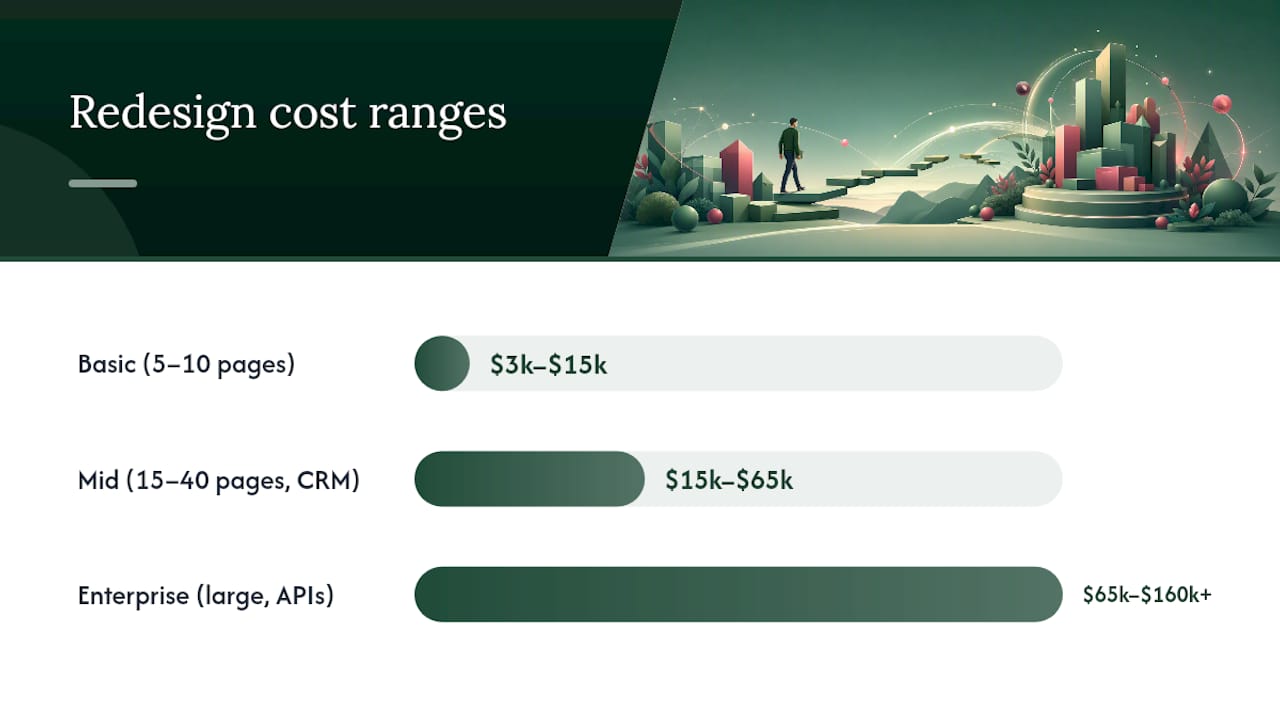
A basic or template refresh typically costs $3,000 to $15,000. This tier covers a business with 5 to 10 pages that needs a modern look, a mobile-friendly layout, and maybe a swapped-out theme on a platform like Webflow or WordPress. You’re not rebuilding functionality here. You’re refreshing the shell. A local service business replacing a dated 2018 site with a clean, templated design sits squarely in this range, and small-business redesigns using templates often land between $3,000 and $15,000 according to recent industry pricing breakdowns.
The mid-range, custom marketing site tier runs $15,000 to $65,000. Picture 15 to 40 pages, a CRM integration for lead capture, custom-designed templates for key landing pages, and probably a blog or resource library built for SEO. This is where most growing SMBs actually live, because it’s the point where a website stops being a brochure and starts being a sales tool. Agency benchmark data shows most companies spend between $15,000 and $80,000 on redesigns, with many mid-market projects clustering around $35,000 to $65,000. That clustering matters. If a proposal comes in dramatically below or above that band, ask why before you ask how fast.
High-end and enterprise projects run in the high cost range beginning around $65,000 and can extend beyond $160,000. Think large multi-department sites, custom web applications, API integrations with internal systems, and design systems built to scale across dozens of future pages. A regional healthcare network connecting patient portals, scheduling APIs, and a rebuilt public site is a textbook example. Costs can extend well past $160,000 for full enterprise rebuilds, and at this level, the redesign is really a software project wearing a marketing hat.
| Project tier | Typical cost range | What’s included |
|---|---|---|
| Basic/template refresh | $3,000–$15,000 | 5–10 pages, theme customization, mobile optimization |
| Mid-range/custom marketing site | $15,000–$65,000 | 15–40 pages, CRM integration, custom templates |
| High-end/enterprise | $65,000–$160,000+ | Large site architecture, custom apps, API integrations |
One more variable worth naming: geography and vendor type shift these numbers meaningfully. Freelancers and smaller shops can undercut both, but that discount frequently means less project management and fewer built-in safety nets. Price is never just about talent. It’s about what’s wrapped around the talent.
What Actually Drives the Cost of Website Redesign Pricing
The sticker price on a redesign proposal is really a sum of individual decisions, and most business owners don’t realize how much control they have over each one. Here’s what agencies and freelancers actually count when they build a quote:
- Page count and unique templates. Every page that needs its own layout, not a reused template, adds design and development hours. A 10-page site with three unique templates costs less than a 10-page site where every page looks different.
- Custom features and integrations. CRM syncing, e-commerce checkout, client portals, or booking systems each require their own build, testing, and often ongoing licensing. These are usually the single biggest line items after core design and development.
- Content migration and new copywriting. Moving old content into a new structure sounds simple until you’re rewriting for a new information architecture. Per-page migration commonly runs $100 to $300 per page, and that’s before you factor in new copy.
- Design scope. A full design system with documented components, accessibility standards, and motion design costs more than a straightforward visual refresh, but it also pays off over years of future updates.
- Performance, security, and compliance. Sites handling payment data, health information, or accessibility mandates (ADA/WCAG) need extra QA and legal review, which adds both time and cost.
- Team composition and timeline. An agency team bundles project management and quality assurance into the rate. A freelancer skips those overheads but often skips the safety net too. Either way, a compressed timeline almost always means a higher rate, since rush work pulls resources from other clients.
Think of these drivers as dials, not fixed costs. Turning down the page count or delaying a custom integration to phase two doesn’t cheapen your site. It reallocates the budget toward what matters most right now.
The Phase-by-Phase Breakdown Behind Every Website Redesign Quote
Every legitimate redesign proposal, whether it’s $10,000 or $150,000, breaks down into the same phases. Knowing the norms lets you spot a quote that’s missing something important, usually discovery or QA, both of which get cut first when a vendor is racing to look affordable.
- Discovery and strategy typically runs 10% to 20% of total budget, or roughly $5,000 to $15,000 on a mid-market project. This phase covers stakeholder interviews, competitive audits, sitemap planning, and success metrics. Skipping it is the most common shortcut agencies offer to lower a bid, and it’s also the shortcut most likely to cause expensive rework later.
- UX, wireframes, and prototypes usually land in the 15% to 25% range of the design budget. This is where information architecture and user flows get mapped before anyone touches visual design.
- Visual design and design system work typically consumes 20% to 35% of the total budget. This includes brand application, component libraries, and responsive layouts for every breakpoint.
- Design specs and handoff run about 5% to 10%, covering the documentation that developers actually build from. Thin handoff documentation is a quiet cause of scope creep later.
- Development (front-end, back-end, CMS setup) is the largest single phase, usually 25% to 50% of the total. A CMS like WordPress or a headless platform changes this cost depending on how much custom functionality is layered on top.
- QA, testing, launch, and training round out the build, typically 5% to 10%, and should always include a staging environment review before anything goes live.
- Project management runs 5% to 10% across the whole engagement, and a smart buyer adds a 10% to 15% contingency on top of the total quote for scope changes that inevitably surface mid-project.
A proposal that skips percentages entirely and just gives you one lump number isn’t necessarily dishonest, but it makes it much harder to negotiate trade-offs later.
How to Scope a Redesign and Get Quotes You Can Actually Compare
Getting three redesign quotes and finding they range from $12,000 to $95,000 doesn’t mean one vendor is ripping you off. It usually means you asked three different questions without realizing it. Fixing that starts before you ever contact a vendor.
- Document your priorities and success metrics first. Decide what “done” looks like: more leads, faster load times, a rebuilt content library, better mobile conversion. Vendors price against clarity, not vague ambition.
- Require itemized proposals with acceptance criteria. A single number tells you nothing. A line-item breakdown with defined deliverables tells you exactly what you’re paying for at each phase.
- Ask every vendor to separate discovery, design, and development costs. This is the fastest way to compare apples to apples. If one vendor won’t break it down, that’s information too.
- Reserve 10% to 15% contingency and structure payments around milestones, not a lump sum upfront. Milestone payments keep both sides accountable and protect you if a vendor underdelivers mid-project.
- Weigh hourly versus fixed-price models honestly. Fixed price protects your budget but can incentivize corner-cutting on ambiguous scope. Hourly billing gives flexibility but requires more oversight on your end to avoid drift.
Comparable quotes aren’t about finding the lowest number. They’re about finding the vendor whose breakdown matches your actual priorities.
Cutting Website Redesign Costs Without Cutting Results
You don’t need the enterprise budget to get enterprise-level thinking applied to your site. The trick is spending precisely where it moves the needle and deferring everything else.
- Launch an MVP, then iterate. Build your highest-traffic pages first (home, services, contact) with full custom attention, and phase in secondary pages after launch. Phased delivery is consistently a high-ROI approach for budget-constrained SMBs.
- Reserve custom templates for pages that convert. Use a strong template for your blog or resource library and save custom design work for your homepage and service pages.
- Automate content migration where it’s safe, but keep a human editor reviewing tone and accuracy, since automated tools can move copy faster than they can judge whether it still sounds like you.
- Use stock photography selectively and budget custom photography or video for a later phase once cash flow allows.
- Negotiate a scope-based retainer for ongoing optimization instead of a second full redesign in three years.
Pro Tip: Ask your vendor which three pages drive most of your current traffic before finalizing scope, then put your custom design budget there first. Everywhere else can start as a smart template.
How Long a Redesign Actually Takes
A basic refresh typically takes 4 to 8 weeks. Mid-range custom projects run 3 to 5 months once you factor in content development and integration testing. Enterprise builds often stretch 6 to 12 months, especially when custom applications or multiple internal systems are involved.

Compressing any of these timelines adds cost, because rushed work means more people working in parallel rather than in sequence, and parallel work multiplies coordination overhead. It also raises risk. QA gets squeezed, and squeezed QA is how bugs make it to launch day.
Before kickoff, resolve the dependencies that quietly stall projects: brand assets, hosting access, existing analytics data, and stakeholder sign-off authority. Vendors lose more time waiting on client decisions than on their own production work.
Budgeting for What Comes After Launch
A redesign budget that stops at launch day is an incomplete budget. Ongoing costs are where total cost of ownership either stays predictable or quietly spirals.
- Managed hosting and CDN services typically run $50 to $500 per month depending on traffic and platform complexity.
- Maintenance and retainer support commonly runs 15% to 20% of the original build cost annually, covering updates, backups, and small content changes.
- Third-party subscriptions and security monitoring (SSL renewal, malware scanning, plugin licensing) add a few hundred dollars a year but prevent much larger recovery costs after a breach.
- Content, CRO, and analytics work should get its own line item post-launch, since a professionally built site still needs ongoing maintenance and hosting factored into annual budgets.
Treat year one as the build. Treat every year after as maintenance plus growth investment, and budget both separately.
Making the Business Case to Stakeholders
The strongest ROI argument for a redesign isn’t aesthetic. It’s measurable: conversion rate, lead volume, average time on key pages, and organic search visibility. Pick two or three KPIs before the project starts so you have a clean before-and-after comparison.
A simple payback calculation works well in a boardroom: if a $40,000 redesign lifts monthly qualified leads by 15% and your average customer value supports that math, calculate how many months of that lift it takes to cover the investment. Most SMBs find the number is smaller than expected once lead value is factored honestly.
Phasing the roadmap helps here too. Show stakeholders an early win, like a faster-loading homepage or a redesigned contact flow, within the first month, rather than asking them to wait six months for the full reveal.
How Connection-built Scopes Redesign Budgets to Avoid Surprises
We start every engagement by tying scope directly to outcomes, not template pages. Before a single wireframe gets drawn, we document what growth actually looks like for your business, whether that’s lead volume, e-commerce conversion, or brand clarity across a fragmented multi-location presence.
Common client trade-offs we price transparently include: custom versus templated pages, phased content migration, and whether a CRM integration belongs in phase one or phase two. Our success stories show how this scoping discipline plays out across real client engagements, and it’s the same discipline we bring to every discovery conversation, regardless of budget size.
What I’ve Learned Negotiating Redesign Quotes for Small Businesses
The lowest quote in a stack of three almost always omits something, and it’s rarely obvious at first glance. Discovery gets folded into “design.” QA becomes “the developer will check it.” Content migration gets quietly pushed onto the client as a deliverable they’re expected to handle themselves. Read every low quote looking for what’s missing, not just what’s cheap.
Milestone-based payments protect you more than any contract clause. A vendor who resists that structure is telling you something about their cash flow, not your project.
A steep price cut mid-negotiation is rarely generosity. It’s usually a signal that the original number was padded, or that something in scope is about to quietly disappear. Ask what changed. If the answer is vague, that’s your answer.
— Chris
Get an Itemized Website Redesign Quote That Actually Matches Your Goals
Connection-built prices redesigns against your business outcomes, not a generic package tier, which means your quote reflects the pages, integrations, and growth priorities that actually matter to your business, not a bundle built for someone else’s company.
Whether you’re evaluating a basic refresh or a full custom rebuild with CRM and e-commerce integration, our team scopes the project the same way we advise you to shop for one: discovery first, itemized line items second, and a fixed plan for what happens after launch. We work across West Michigan with small businesses, nonprofits, and growing organizations that need marketing and web work built to hold up for years, not months. If you’re weighing a redesign against your 2026 budget, request an itemized scoping call and we’ll walk through your priorities, your realistic price range, and where a phased approach could save you money without sacrificing results. Start with our small business marketing services page to see how we structure engagements from discovery through ongoing growth support.
Sources
- Website Redesign Cost: 2026 Buyer’s Guide | Launch Day Advisors
- The True Website Redesign Cost in 2026 (Pricing Breakdown)
- Teamvoy — website redesign cost analysis
- How Much Does A Website Cost? (2026 Guide) — Forbes Advisor
Recommended
Want to talk it through? Start a conversation. https://connection-built.com